

Table of Contents
- What Is an AI Trade Analyzer?
- What AI Trade Tools Do Well
- Where AI Can Go Wrong
- How to Check AI Trade Advice
- Writing Good Prompts
- AI Tools vs Value Calculators
- Common Mistakes
- Types of AI Trade Tools
- Privacy and League Access
- Example: Checking an AI Answer
- When AI Helps Most
- Frequently Asked Questions
- Conclusion
- Related Guides
- Compare With Other Sources
A fantasy football trade analyzer AI tool promises fast trade advice in plain language. Some are useful, but AI can also be confidently wrong about injuries, roles or values. This guide explains how AI trade tools work, what they do well and how to check their advice before you accept a deal.
What Is an AI Trade Analyzer?
Most AI trade tools use a large language model, the same kind of system behind chat assistants. You describe a trade and the tool writes back an opinion: who wins, why and what to consider. Some tools add live data such as rankings or projections; others rely only on what the model learned during training.
That difference matters. A fantasy football trade analyzer AI tool without live data may not know about last week’s injury or a new depth chart. Our own dynasty trade calculator is not an AI tool: it uses player and pick values on one scale and adds up both sides.
What AI Trade Tools Do Well
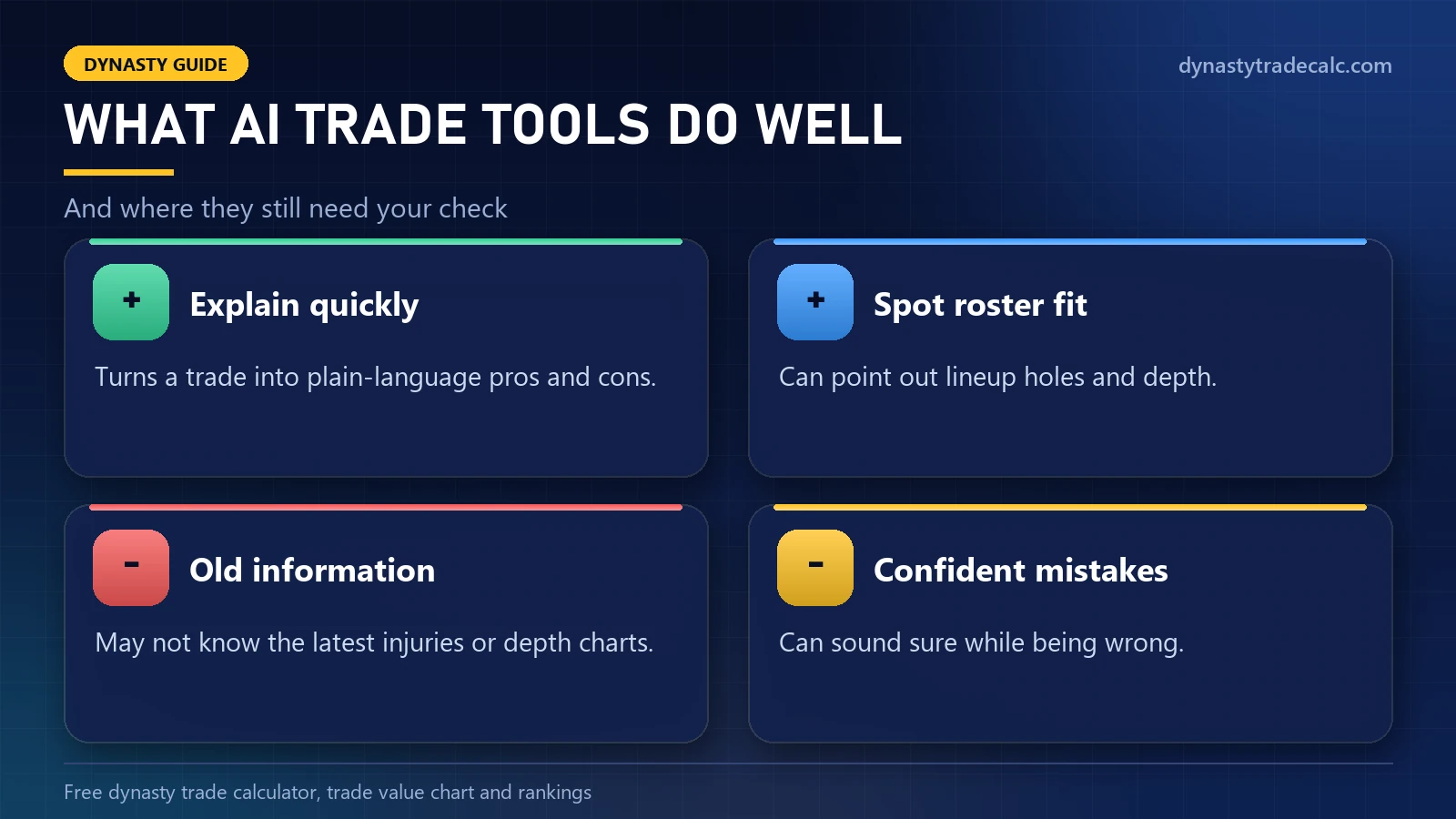
- Plain-language explanations: useful when you want the reasons, not just a number.
- Roster fit: AI can point out when a trade leaves a hole in your lineup.
- Brainstorming: it can suggest counter offers or trade ideas to explore.
- Speed: a quick second opinion in seconds.
Where AI Can Go Wrong
| Problem | Why it happens | How to protect yourself |
|---|---|---|
| Old news | Training data has a cut-off date | Check injuries and roles on a current source |
| Wrong format | The tool assumes standard settings | State Superflex, PPR and league type clearly |
| Made-up facts | Language models can invent details | Verify any stat or claim it gives you |
| Inconsistent answers | The same question can get a different reply | Rely on values for the final check |
None of this makes AI useless. It means the AI answer should be a starting point, not the final word.
How to Check AI Trade Advice
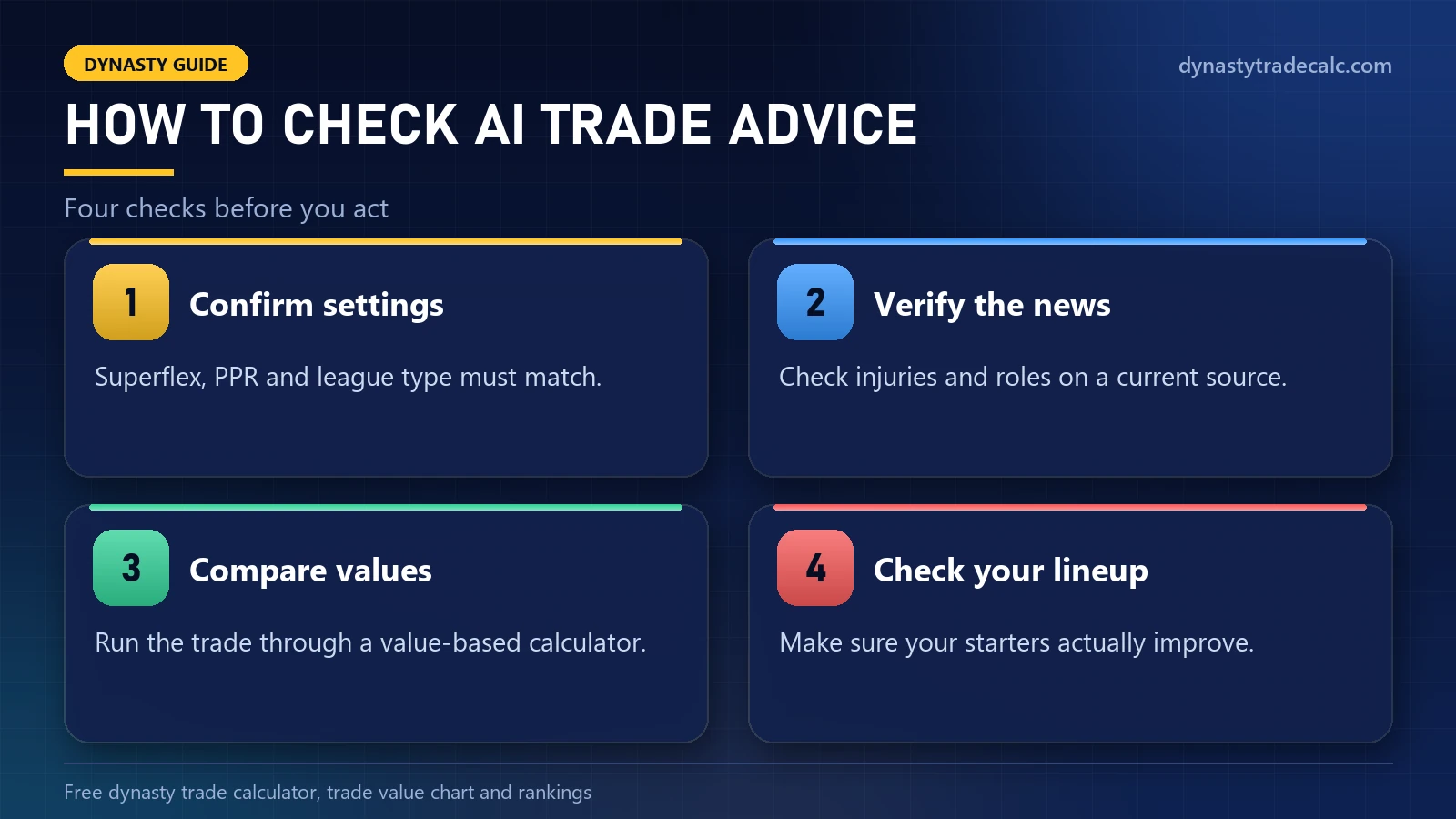
- Confirm the settings: Superflex or 1QB, PPR, league size and league type.
- Verify the news: check injuries and depth charts on Pro Football Reference or team reports.
- Compare values: run the same trade through a value-based calculator.
- Check your lineup: make sure your starters actually improve.
If the AI answer and the values agree, you can act with confidence. If they disagree, look at the players driving the gap and read the latest news on them.
Writing Good Prompts
If you use a general AI assistant, the quality of your question decides the quality of the answer. Give it everything it needs in one message.
- League type: dynasty, keeper or redraft.
- Scoring and lineup: PPR or half PPR, Superflex or 1QB, number of teams.
- Both full sides of the trade, including picks with their year and round.
- Your roster and direction: contending or rebuilding.
- Ask for reasons, not just a winner, so you can check them.
A fantasy football trade analyzer AI answer is only as good as the details you give it, so a short, complete prompt saves time and mistakes.
AI Tools vs Value Calculators
A value calculator gives the same answer every time for the same inputs, which makes it easy to compare offers. An AI tool gives a written opinion that can change between runs. The two work well together: use the calculator for the numbers and the AI for the explanation. Our trade analyzer guide compares the main types of tools.
Common Mistakes
- Trusting a confident answer. AI can sound sure and still be wrong.
- Leaving out settings. The tool will guess, often wrongly.
- Skipping the news check. Injuries change values overnight.
- Asking only who wins. Ask why, so you can verify the reasons.
Types of AI Trade Tools
Competing pages often treat every AI tool as the same thing. In practice there are three kinds, and they differ in how current their information is.
| Type | How it works | Main risk |
|---|---|---|
| General chat assistant | You describe the trade in a message | May not know recent news |
| AI built into a fantasy site | Combines a model with the site’s own data | Only as good as that data |
| League-connected AI tool | Reads your rosters and settings | Needs access to your league |
A fantasy football trade analyzer AI tool that connects to your league saves typing, but read what access it asks for before you link an account.
Privacy and League Access
- Read-only access is usually enough for trade advice.
- Avoid sharing passwords; use official league connections where offered.
- Check what the tool stores and whether you can remove it.
Value-based tools like ours need no league access at all: you enter the players yourself. That is slower in big trades but keeps your league data private.
Example: Checking an AI Answer
Say a fantasy football trade analyzer AI tool tells you to accept a running back for a receiver. Before you act, check three things. First, is the running back still the starter, or did the depth chart change after the model’s collected its data? Second, does the fantasy football trade analyzer AI answer use your scoring, or did it assume full PPR? Third, do the values in a calculator show the same winner?
If all three line up, the advice is probably sound. If one fails, ask the tool again with the corrected details, or rely on the values. Treat each fantasy football trade analyzer AI result as one opinion among several, the same way you would treat advice from a league mate.
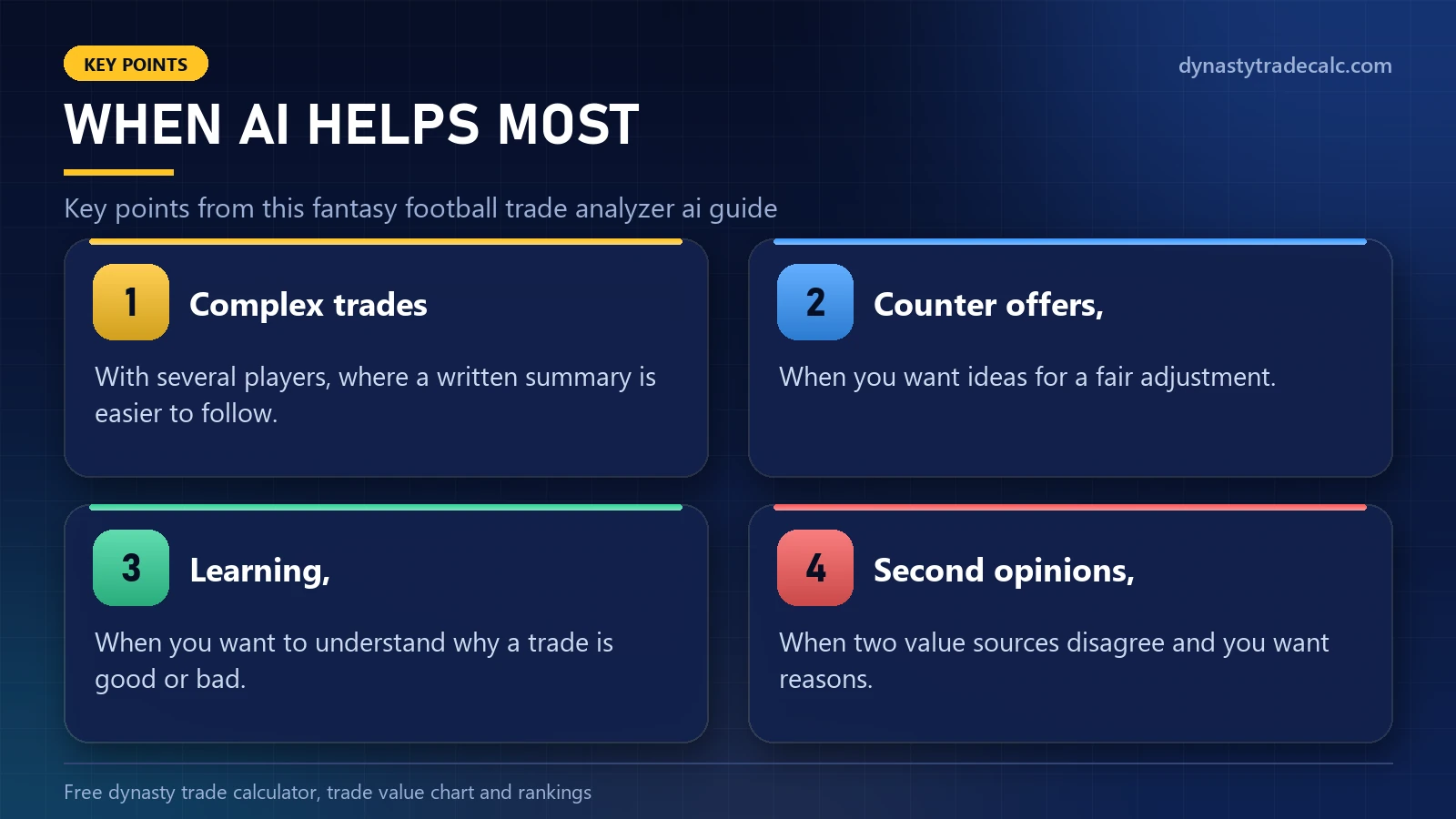
When AI Helps Most
- Complex trades with several players, where a written summary is easier to follow.
- Counter offers, when you want ideas for a fair adjustment.
- Learning, when you want to understand why a trade is good or bad.
- Second opinions, when two value sources disagree and you want reasons.
In each case, a fantasy football trade analyzer AI tool works best next to current values, not in place of them.
Frequently Asked Questions
What is a fantasy football trade analyzer AI tool?
It is a tool that uses artificial intelligence, often a large language model, to explain a trade in plain language. It can list pros and cons quickly, but its information may be out of date.
Is AI good at fantasy football trades?
AI is good at explaining a trade and spotting obvious roster fit. It is weaker on the latest news and exact values, so check its advice with current sources.
Can AI tell me who wins a trade?
It can give an opinion, but it may use old values or miss an injury. Use a value-based calculator to compare the totals and treat the AI answer as a second view.
Is this site’s calculator an AI tool?
No. Our dynasty trade calculator uses player and pick values on one scale, not an AI model. It adds up both sides so you can see the gap clearly.
How do I check AI trade advice?
Confirm the settings match your league, check injuries and depth charts on a current source, compare values in a calculator and look at your starting lineup.
Will AI replace trade calculators?
Probably not soon. AI is useful for explanations, while calculators give consistent numbers. Many managers will use both together, one for the reasons and one for the numbers.
Conclusion
A fantasy football trade analyzer AI tool is a fast second opinion, not a final answer. Give it full details, verify the news and compare the trade in a value-based calculator before you accept. Used that way, AI can make your trade decisions quicker and better informed.
Related Guides
- Trade analyzer fantasy football: types of trade tools.
- Free trade analyzer: the best free tools.
- Analyze a fantasy trade: a routine for every offer.
- Dynasty trade analyzer free: free dynasty tools compared.
- Fantasy trade grader: check an AI answer against a grade.
- Redraft trade calculator: rest-of-season checks.
Compare With Other Sources
Our values are estimates, not quotes. Before a big trade, compare the same players against KeepTradeCut crowd-sourced dynasty values, FantasyCalc and FantasyPros dynasty rankings.
