


Table of Contents
- What Is a Fantasy Football Trade Finder?
- How to Find a Trade Partner Step by Step
- Who to Trade With
- Using a Dynasty Trade Finder Approach
- Building the Offer
- Timing Your Search
- Common Mistakes
- Reading Rosters Like a Trade Finder
- Fantasy Football Trade Finder Examples
- Trade Finder Tools vs Doing It by Hand
- Talking to Trade Partners
- Frequently Asked Questions
- Conclusion
- Related Guides
- Compare With Other Sources
A fantasy football trade finder helps you answer the question that comes before any offer: who should I trade with? The best trades happen between teams with opposite needs. This guide shows a simple method to find those partners in any league, then price the deal before you send it.
What Is a Fantasy Football Trade Finder?
Some sites offer a trade finder tool that scans rosters and suggests deals. You can get the same result by hand: list where you have extra starters, find the teams that are short there, and check what they have that you need. A fantasy football trade finder approach turns a guess into a short list of real partners.
How to Find a Trade Partner Step by Step
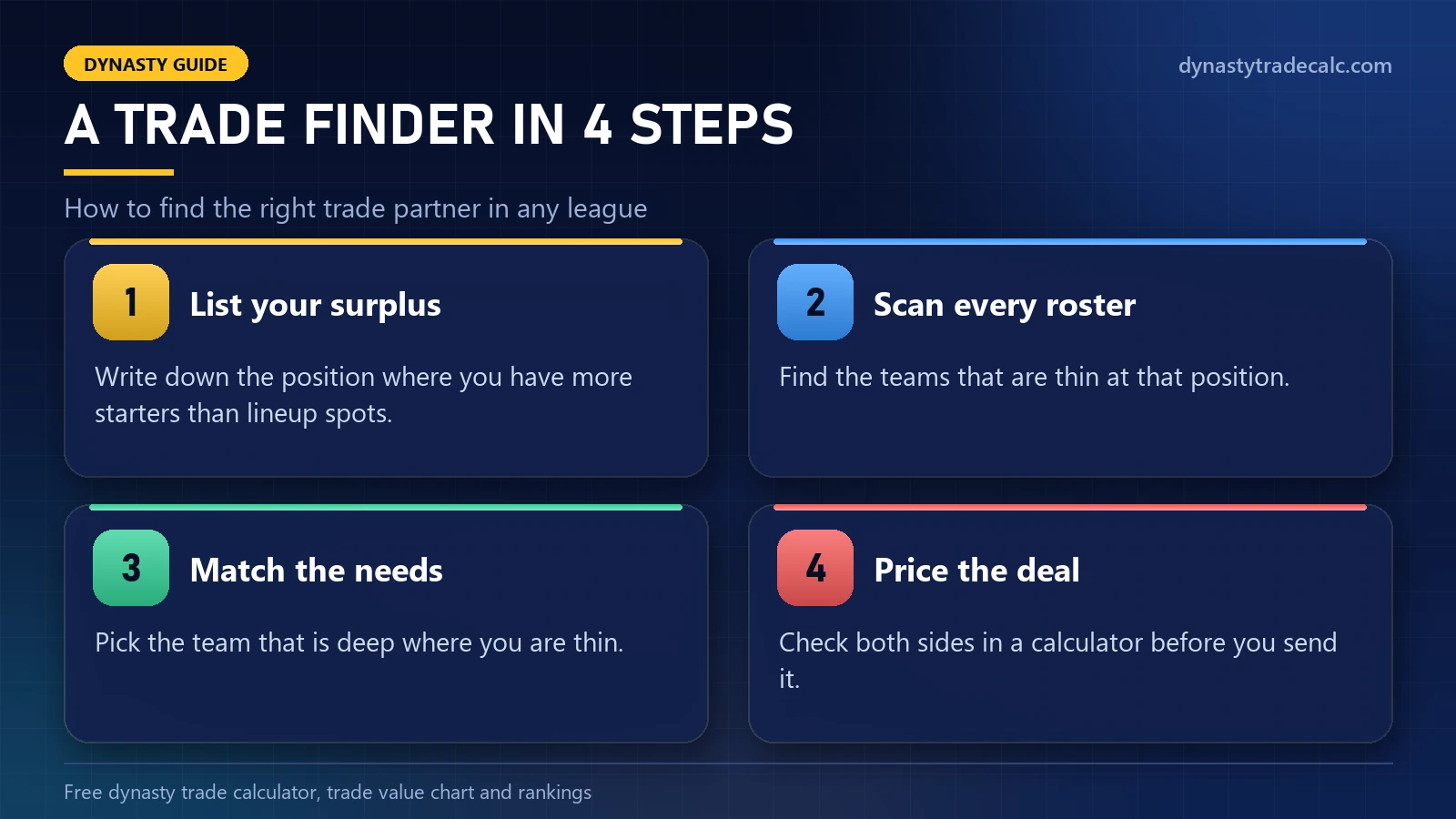
- List your surplus. Count the starters at each position against your lineup spots.
- Scan every roster. Note who is thin where you are deep.
- Match the needs. The best partner is deep where you are thin.
- Price the deal. Put both sides into our free dynasty trade calculator and adjust until the totals are close.
- Send a fair, specific offer with one line on how it helps them.
Who to Trade With
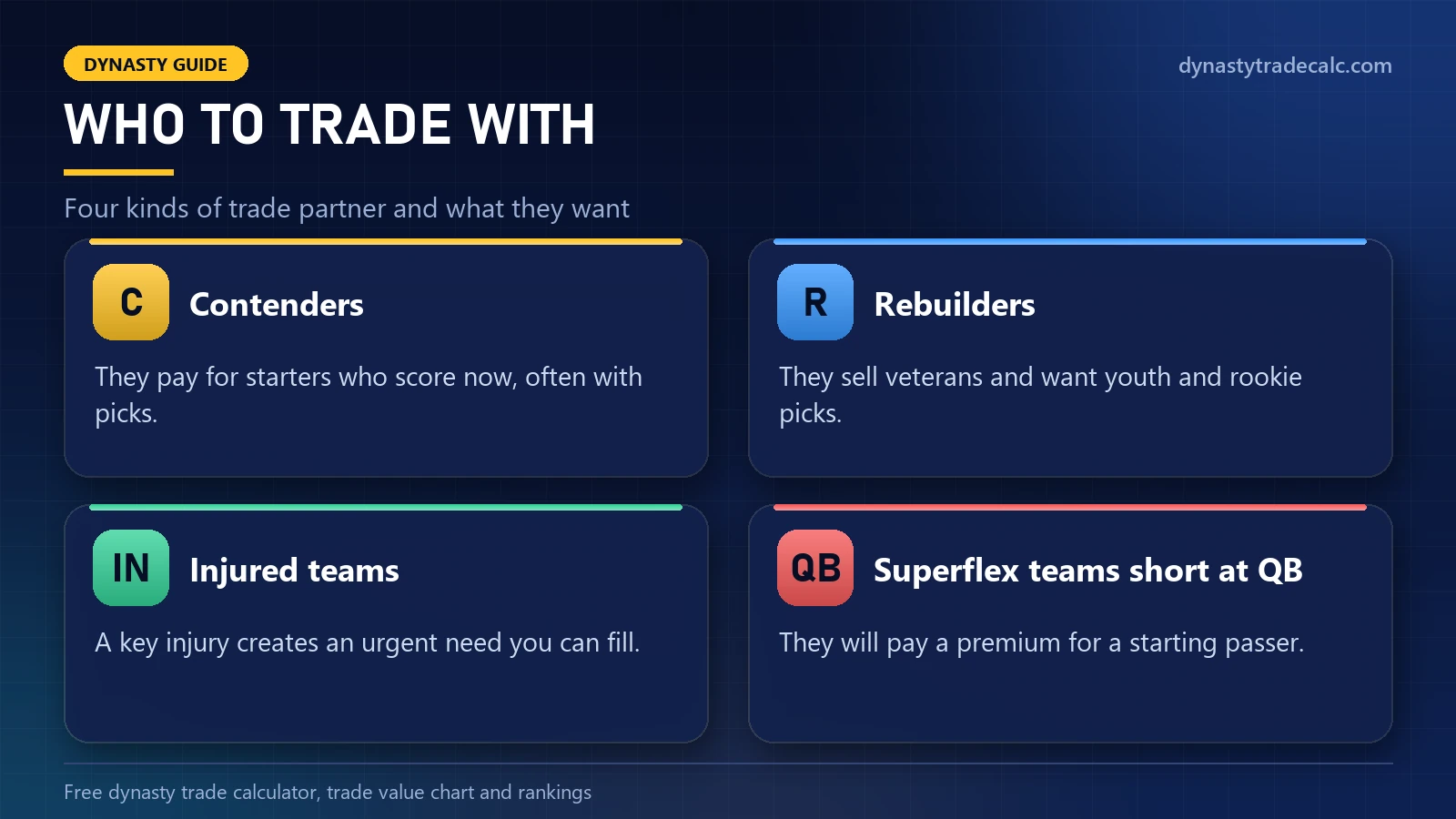
Team direction matters as much as positions. A contender will pay for points now; a rebuilder wants youth and picks. In Superflex, a team without two starting quarterbacks is often the most motivated buyer in the league.
| Partner | What they want | What to offer |
|---|---|---|
| Contender | Starters who score now | A proven player from your surplus |
| Rebuilder | Youth and rookie picks | Young players or picks for a veteran |
| Injured team | An immediate replacement | A steady starter at their weak spot |
| Superflex team short at QB | A starting quarterback | Your third quarterback, at a premium |
Using a Dynasty Trade Finder Approach
In dynasty, a trade finder method also looks at age and timing. Rebuilding teams sell veterans before their value drops; contenders buy them before the deadline. Picks are useful currency here: a second-round pick often closes a small gap. Current prices are on our rookie pick values page.
Building the Offer
Once you have a partner, keep the first offer close on value and specific. Explain how the trade helps their lineup, and leave room for a small counter. Our fantasy trade calculator guide covers building and countering offers in more detail.
Timing Your Search
- After injuries: teams with a new hole are the most willing to deal.
- Bye-week crunches: short-term needs create quick trades.
- Before the trade deadline: contenders pay the most for points.
- Near the rookie draft: pick values peak in dynasty.
Common Mistakes
- Messaging every team. Focus on the two or three best fits.
- Ignoring direction. Offering veterans to a rebuilder rarely works.
- Lowball first offers. They end conversations.
- Skipping the price check. A good partner can still be a bad deal.
More examples are in the biggest dynasty trade mistakes. Our how to trade fantasy football guide covers every step from finding a partner to getting the trade processed.
Reading Rosters Like a Trade Finder
A good fantasy football trade finder method starts with a quick roster audit of every team, not just yours. Open each roster and write one line per team: where they are deep, where they are thin and whether they are contending or rebuilding. Ten or twelve lines are enough to see the whole market.
Look for three signals. First, a team starting a weak player at a position where you have a strong bench player. Second, a team with three or more starters at one position. Third, a team whose record does not match its roster: a strong team that has lost close games often wants to act fast.
| Signal | What it tells you | Your move |
|---|---|---|
| Weak starter where you have depth | Clear need you can fill | Offer your bench player first |
| Three or more starters at one spot | Surplus they cannot use | Ask for one of them |
| Good roster, poor record | Pressure to act now | Offer a proven starter |
| Old roster, losing record | Likely to sell veterans | Offer youth or picks |
Fantasy Football Trade Finder Examples
These examples show how a fantasy football trade finder approach turns a roster note into an offer. The names change every season, but the logic stays the same.
- Deep at receiver, thin at running back: find the team with four starting backs and one weak receiver. Offer your fourth receiver for their third back.
- Contender with a bye-week hole: offer a steady starter who plays that week, and ask for a future pick in return.
- Rebuilder with an aging star: offer a young player and a mid-round pick. Rebuilders value time more than points.
- Superflex team with one quarterback: your backup quarterback is worth more to them than to anyone else, so price him high.
In each case, the fantasy football trade finder step is the same: find the opposite need first, then build the offer around it.
Trade Finder Tools vs Doing It by Hand
Some sites offer an automatic fantasy football trade finder that connects to your league and suggests deals. These can save time in large leagues, but they usually suggest trades that look even on value without knowing the other manager’s plans. Doing it by hand takes ten minutes and adds what tools miss: who is active in your league, who likes which players and who has just lost a starter to injury.
The best approach mixes both. Use a tool or your own notes to build a short list, then check each idea in a calculator. Our dynasty league analyzer guide shows how to audit rosters, and the dynasty trade value chart shows current prices.
Talking to Trade Partners
How you message a partner matters as much as who you pick. Keep the note short, name the need you are filling and leave room for a counter. A line such as “You are thin at running back and I have depth there; would this help?” gets more replies than an offer with no message. Our fantasy football trade creator guide covers how to build a balanced offer from your target and your surplus.
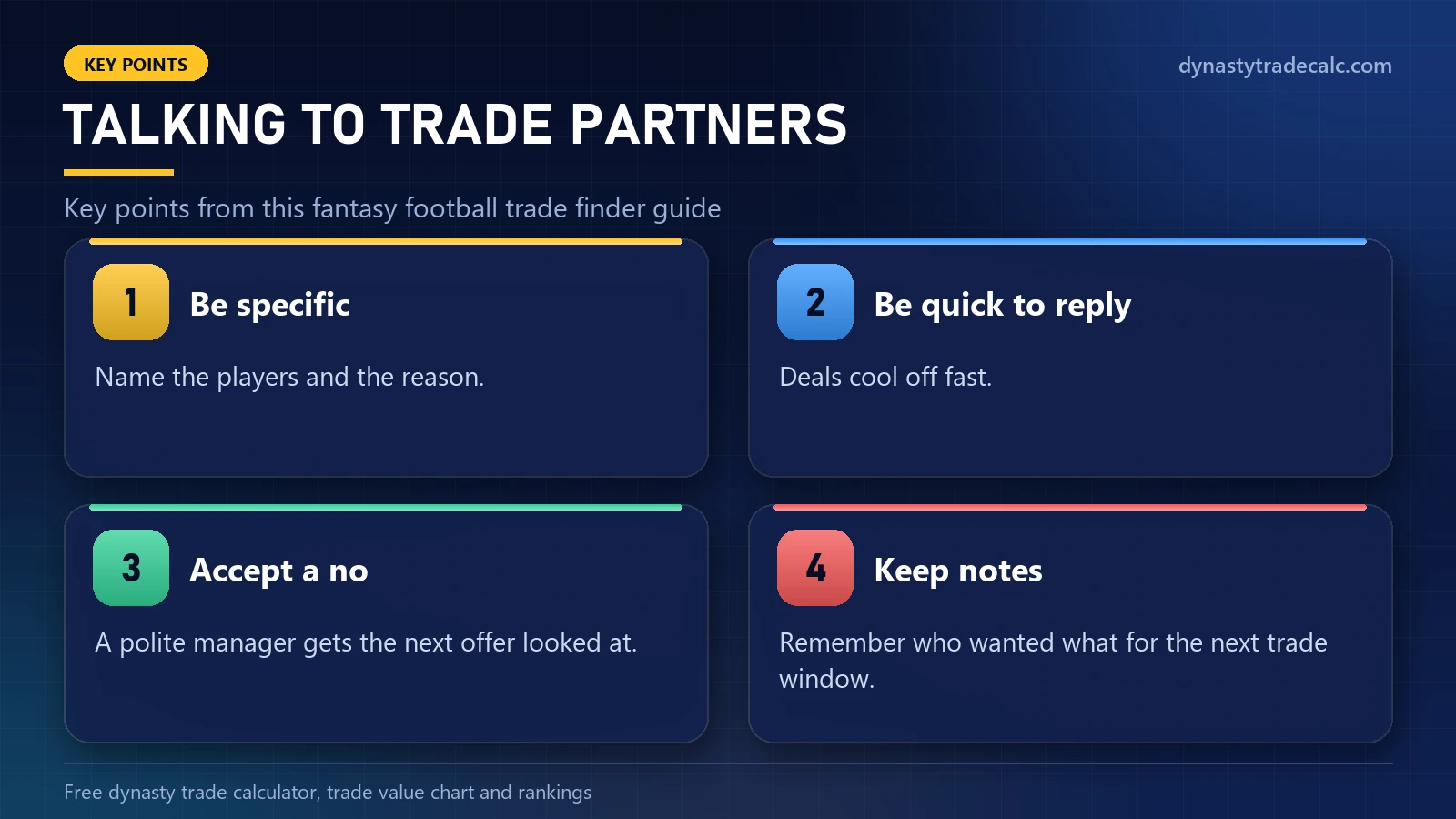
- Be specific. Name the players and the reason.
- Be quick to reply. Deals cool off fast.
- Accept a no. A polite manager gets the next offer looked at.
- Keep notes. Remember who wanted what for the next trade window.
Over a season, this habit makes the fantasy football trade finder process faster, because you already know each manager’s needs and style. It also keeps your league active, which helps every team find trades.
Frequently Asked Questions
What is a fantasy football trade finder?
It is a way to find the right trade partner: you match the position where you have extra starters with a team that is short there. Some sites automate it; you can also do it by hand in minutes.
How do I find trade partners in fantasy football?
List your surplus, scan every roster for the opposite need, and start with the manager who fits best. Teams with injuries or a weak position are usually the most willing to deal.
Is there a dynasty trade finder?
A dynasty trade finder works the same way, but also looks at team direction. Contenders want starters and rebuilders want youth and picks, so match your offer to their plan. Our how does dynasty fantasy football work guide covers startup drafts, rookie drafts, taxi squads and trading.
Who is the best trade partner in my league?
Usually the team whose strengths are your weaknesses. If you are deep at receiver and thin at running back, look for a team with the reverse problem.
Should I message every manager with an offer?
No. Start with the two or three teams that fit best and send a fair, specific offer. A short note on how it helps them gets more replies than mass messages.
When is the best time to look for a trade?
Right after injuries, bye-week crunches or a losing streak, when managers have a clear need. Before the trade deadline, contenders are the most willing to pay.
Conclusion
A fantasy football trade finder method is simple: know your surplus, find the team with the opposite need, match their direction and price the deal. Do that before every offer and managers will accept more of your trades.
Related Guides
- Fantasy trade calculator: build and counter offers.
- Analyze a fantasy trade: check a deal before you accept.
- Dynasty league analyzer: audit your roster first.
- The biggest dynasty trade mistakes: what to avoid.
- Fantasy football trade ideas: offers to send once you find a partner.
- 3 way trade calculator: when two teams cannot match.
- Dynasty Fantasy Football Trade Targets: a related guide.
- How to Trade Fantasy Football: a related guide.
Compare With Other Sources
Our values are estimates, not quotes. Before a big trade, compare the same players against KeepTradeCut crowd-sourced dynasty values, FantasyCalc and FantasyPros dynasty rankings.
