

Table of Contents
- What Is a Fantasy Trade Grader?
- A Simple Grade Scale
- The Four Checks Behind the Grade
- Why Grades Differ Between Sites
- Grading Examples
- Common Mistakes
- How a Fantasy Trade Grader Scores a Deal
- Grading Packages and Picks
- Grading for Contenders vs Rebuilders
- Using Two Sources
- Frequently Asked Questions
- Conclusion
- Related Guides
- Compare With Other Sources
A fantasy trade grader turns a trade into a simple grade, so you can tell at a glance whether a deal is a win, fair or an overpay. Grades from different sites often disagree, so this guide shows you how to grade any fantasy football trade yourself with four checks.
What Is a Fantasy Trade Grader?
It is a tool or method that scores both sides of a trade and turns the gap into a letter, from A to D. Some managers call it a fantasy trade rater. The grade is quick to read, but it is only as good as the values behind it and the settings you choose.
A Simple Grade Scale
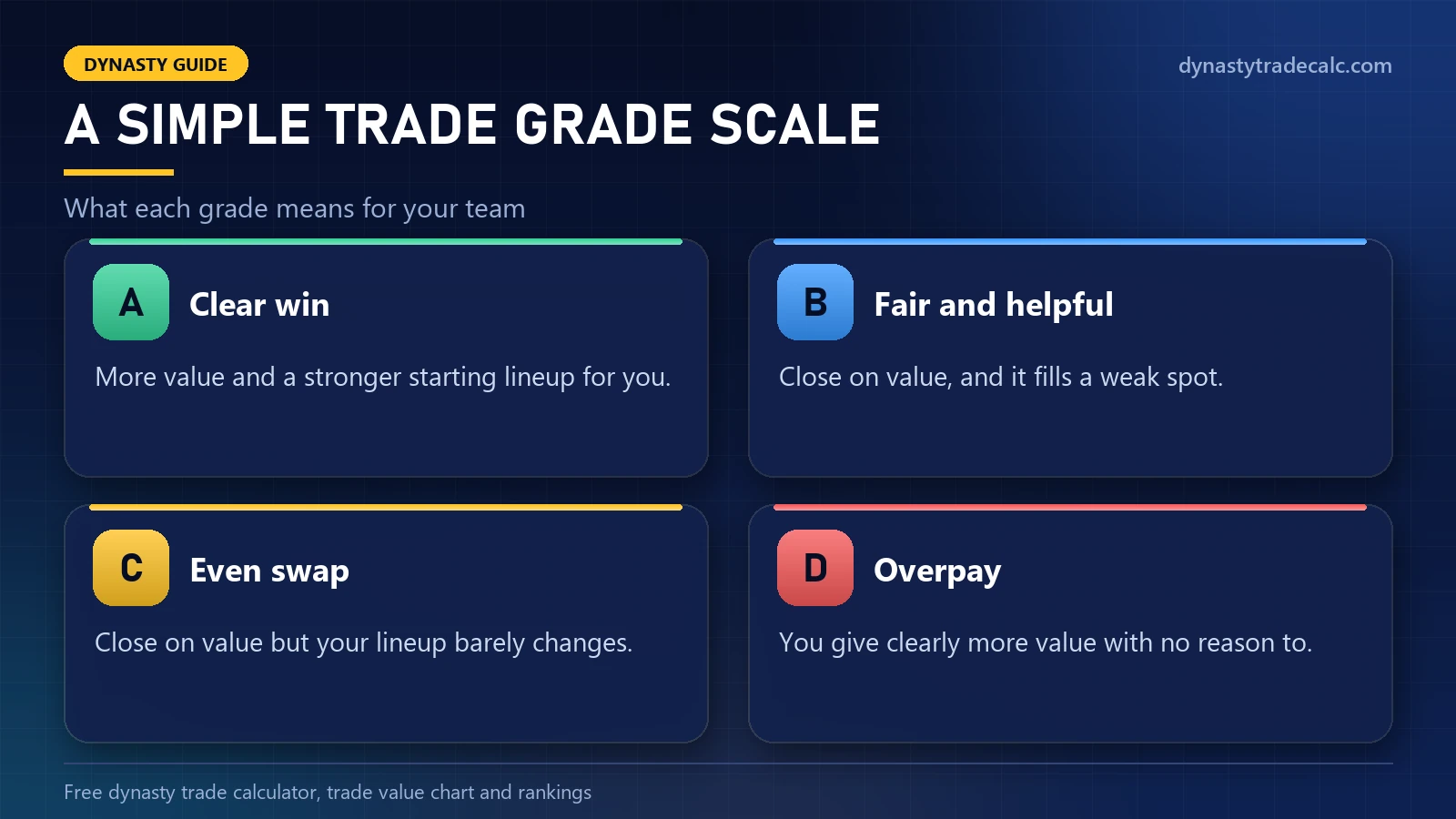
Use this fantasy trade grader scale for any league:
| Grade | What it means | What to do |
|---|---|---|
| A | More value and a stronger lineup for you | Accept |
| B | Close on value, fills a weak spot | Accept or ask for a small add |
| C | Even, but your lineup barely changes | Only if it fits your plan |
| D | You give clearly more value | Counter or decline |
The Four Checks Behind the Grade
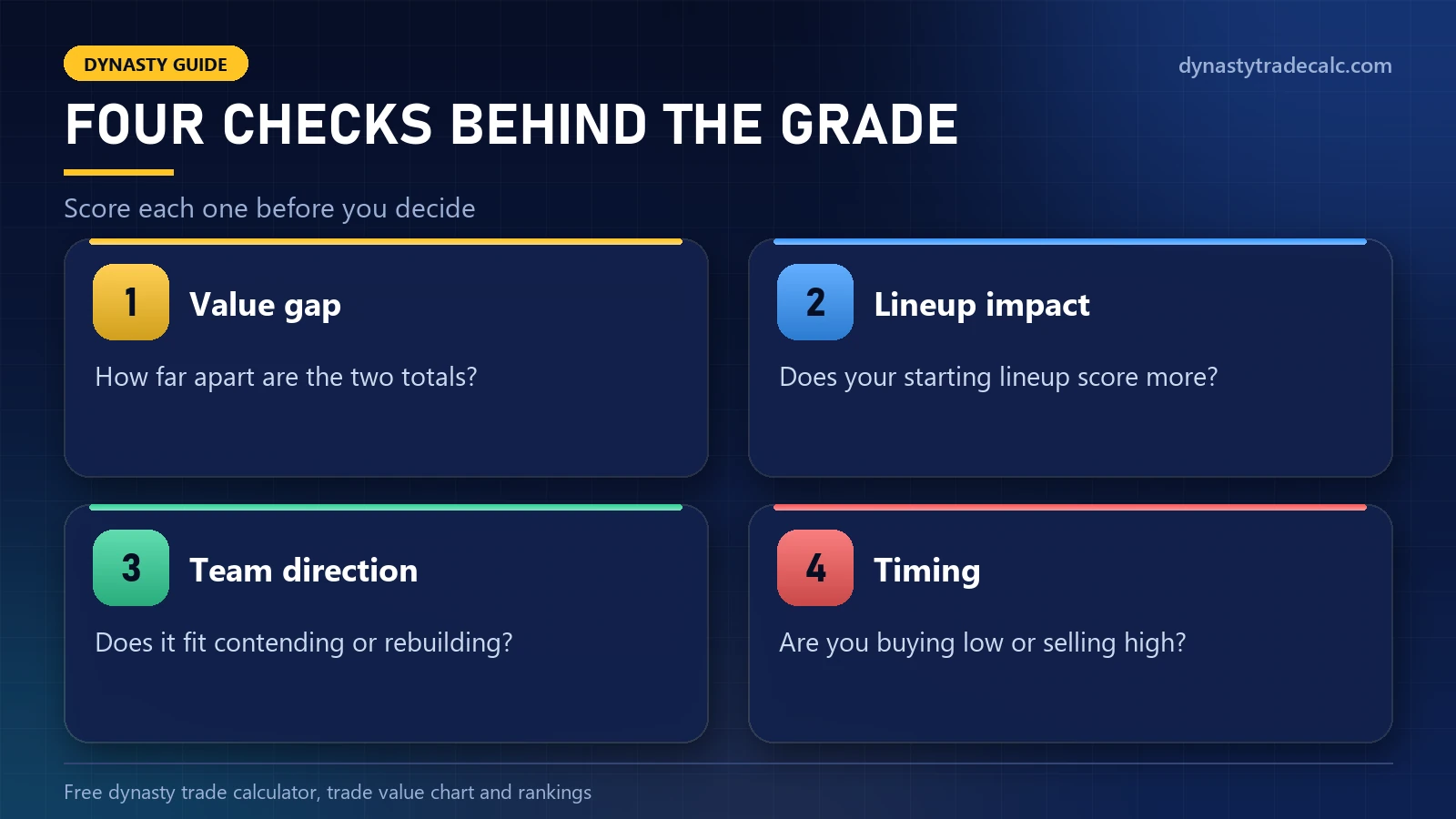
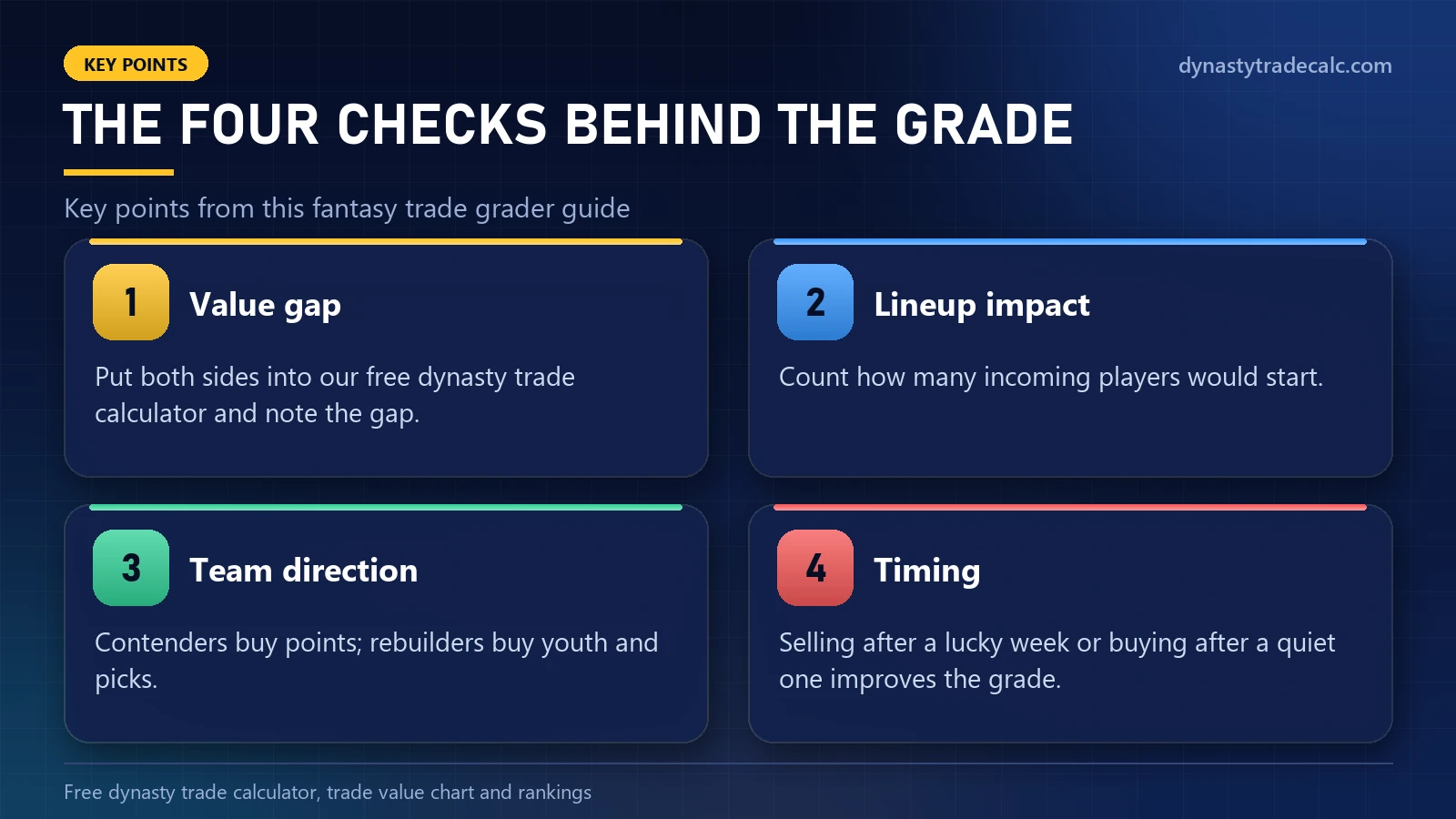
- Value gap. Put both sides into our free dynasty trade calculator and note the gap.
- Lineup impact. Count how many incoming players would start.
- Team direction. Contenders buy points; rebuilders buy youth and picks.
- Timing. Selling after a lucky week or buying after a quiet one improves the grade.
A fantasy football trade grader that only looks at the value gap misses three of these checks, which is why grades from different tools can disagree.
Why Grades Differ Between Sites
Each site builds its values differently: crowd votes, completed trades or expert rankings. Settings matter too: Superflex, PPR and league size all change the result. Before you trust any grade, check that the format matches your league and compare it with a second source such as KeepTradeCut crowd-sourced dynasty values or FantasyCalc.
Grading Examples
- Two bench players for one starter: often a B or A for the side getting the starter, because only starters score.
- A late first for a veteran running back: an A for a contender, a D for a rebuilder.
- An even swap at the same position: a C unless it fixes a bye-week hole.
Common Mistakes
- Trusting one letter. Check the four inputs, not just the result.
- Wrong settings. A 1QB grade is wrong in Superflex.
- Ignoring the other side. A trade that looks like a robbery can hurt future deals.
For a full trade review, see how to analyze a fantasy trade and our trade analyzer guide.
How a Fantasy Trade Grader Scores a Deal
Most tools follow the same three steps. They look up a value for every player and pick, add up each side and turn the gap into a grade. A small gap becomes a B or C; a large gap becomes an A for one side and a D for the other. Some tools also adjust for package size, because two average players are rarely worth one star when only one of them can start.
The weak point is the first step. If the values are old, built for a different format or based on a different scoring system, the grade will be wrong even if the math is right. That is why a fantasy trade grader should always show its settings and when it last updated its values.
Grading Packages and Picks
Trades with three or more pieces are where grades go wrong most often. Adding bench players can make one side look bigger without helping that team score more. Rookie picks add another layer: an early first is worth far more than a late first, and picks from weak teams usually gain value as the season goes on.
| Situation | Common grade mistake | Better check |
|---|---|---|
| Two-for-one | Sum of parts looks bigger | Count starters on both sides |
| Picks for a veteran | Picks treated as all the same | Check the round and likely draft slot |
| Injured player included | Full healthy value used | Discount for missed games |
| Superflex quarterback | 1QB values used | Use Superflex values |
Current pick prices are on our rookie pick values page.
Grading for Contenders vs Rebuilders
The same trade can deserve two grades depending on team direction. A contender who adds a top running back for a future first may get an A for this season and a C for later years. A rebuilder who makes the opposite trade may get a C now and an A later. A good fantasy trade grader asks which timeline you care about before it scores the deal.
- Contenders: weight this season’s points more than future value.
- Rebuilders: weight age, picks and the next two seasons.
- Middle teams: pick a direction before grading, or every trade looks like a C.
Using Two Sources
When a trade is close, check it against a second set of values. If both sources agree, you can trust the grade. If they disagree by a full letter, look at which players drive the gap and read recent news about them. Our free dynasty trade analyzer guide compares several free tools you can use for that second check.
A fantasy trade grader works best as a quick filter. Use it to reject clear overpays and to spot clear wins, and spend your thinking time on the close calls in the middle.
Keep a short record of the trades you grade and how they turned out. After a season, you will see which checks matter most in your league and whether your grades were too generous or too strict.
Frequently Asked Questions
What is a fantasy trade grader?
It is a way to give a trade a simple grade, such as A to D, based on value, lineup impact and timing. Some sites show a letter grade; you can grade a deal yourself with four checks.
How do I rate my fantasy trade?
Compare the value of both sides in a calculator, then check whether your starting lineup improves and whether the deal fits your plan. If you want to rate my fantasy trade quickly, use the A to D scale in this guide.
Is a fantasy football trade grader accurate?
A fantasy football trade grader is only as good as its values and settings. Grades can differ between sites, so treat any grade as a starting point and check your roster too.
What is a fantasy trade rater?
A fantasy trade rater is another name for a trade grader. It scores both sides of a deal and turns the gap into a rating, usually a letter or a number.
Can a C grade trade still be worth doing?
Yes. An even trade can still help if it fixes a bye-week problem or moves you toward your plan. Grades measure value; your roster decides whether the deal is useful.
Does an A grade mean I should accept?
Usually, but check one more thing: whether the other manager will feel tricked. A fair trade keeps future deals possible, which matters in leagues you play for years.
Conclusion
A fantasy trade grader is useful when you know what is behind the letter. Check the value gap, your lineup, your direction and the timing, and you can grade any trade yourself in a couple of minutes.
Related Guides
- Analyze a fantasy trade: a routine for every offer.
- Trade analyzer fantasy football: pick the right type of tool.
- Free trade analyzer: the best free tools.
- Trade calculator: price both sides of a deal.
- Fair trades in fantasy football: what makes a deal fair.
- Sleeper trade calculator: grade trades in Sleeper leagues.
- PPR Trade Value Chart: a related guide.
- Redraft Trade Analyzer: a related guide.
- Dynasty Trade Database: a related guide.
- Fantasy Football Trade Analyzer AI: a related guide.
Compare With Other Sources
Our values are estimates, not quotes. Before a big trade, compare the same players against KeepTradeCut crowd-sourced dynasty values, FantasyCalc and FantasyPros dynasty rankings.
