


Table of Contents
- What Are Fantasy Trade Sheets?
- How to Read a Trade Sheet
- Trade Sheets vs Other Value Sources
- Build Your Own Trade Sheet
- Using Trade Sheets in Negotiations
- Dynasty vs Redraft Sheets
- Common Mistakes
- Tier Example From a Trade Sheet
- Weekly Sheet Routine
- Where to Find Trade Sheets
- Frequently Asked Questions
- Conclusion
- Related Guides
- Compare With Other Sources
Fantasy trade sheets are lists of player values, usually in tiers, that help you compare trades quickly. Many analysts publish them weekly, and many managers keep their own. This guide explains how to read fantasy trade sheets, when to trust them and how to build a simple sheet for your league.
What Are Fantasy Trade Sheets?
A trade sheet ranks players and often rookie picks by trade value. Some use numbers; others use tiers or both. They are close cousins of trade value charts, but sheets are often updated weekly and include short notes on who to buy or sell. Our dynasty trade value chart page works the same way for dynasty leagues.
How to Read a Trade Sheet
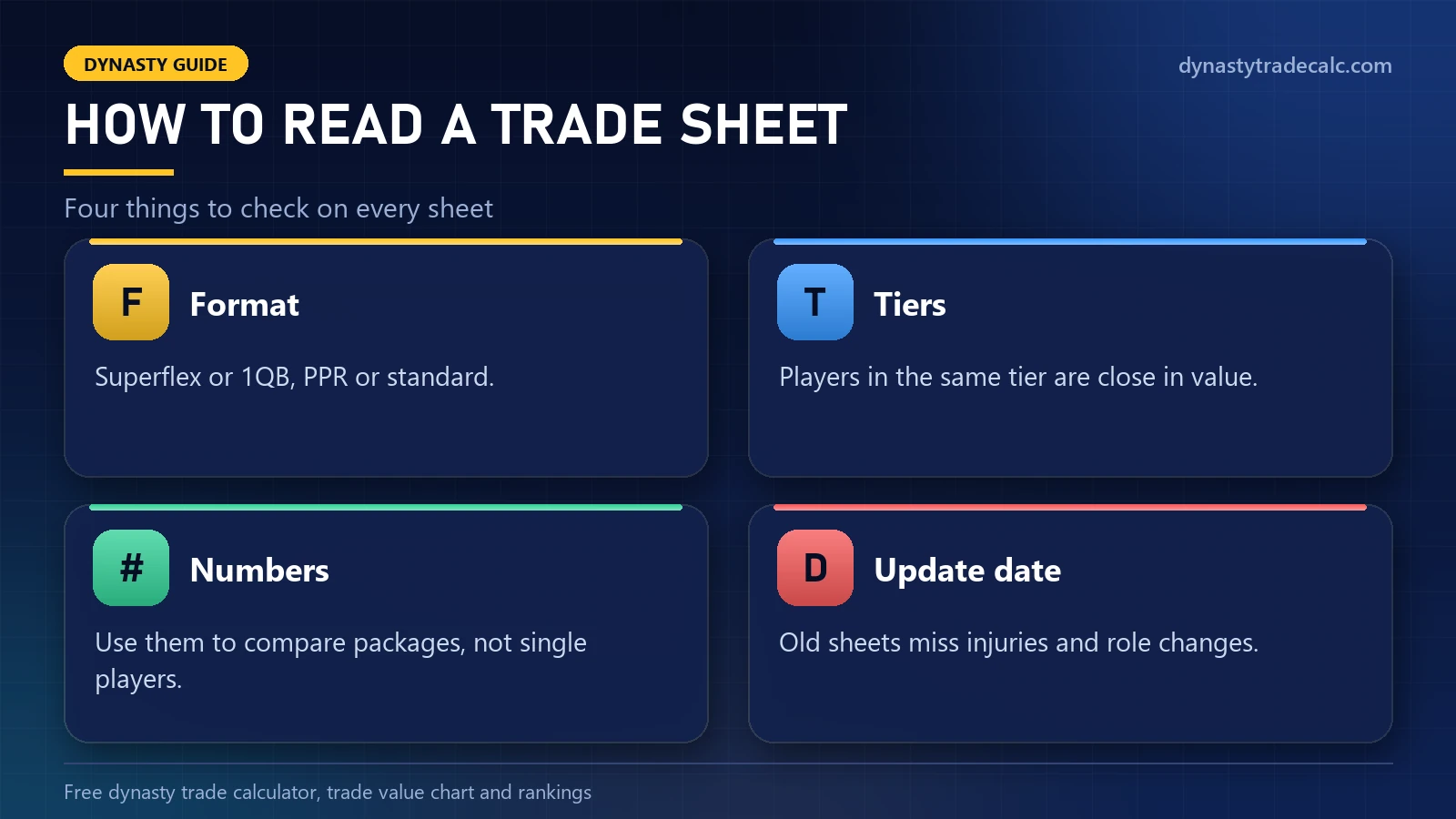
- Check the format. A Superflex sheet is wrong for a 1QB league, and the reverse.
- Read the tiers first. Players in the same tier are close enough that roster need decides.
- Use the numbers for packages. Add up both sides of multi-player trades.
- Check the update date. An old sheet misses injuries and role changes.
Most problems with fantasy trade sheets come from skipping the first and last steps: the wrong format or an out-of-date sheet.
Trade Sheets vs Other Value Sources
| Source | How analysts make values | Best for |
|---|---|---|
| Analyst trade sheet | One expert’s view, often weekly | Quick checks with buy and sell notes |
| Crowd-sourced values | Votes from many managers | Seeing the market’s view |
| Trade-based values | Completed trades in real leagues | Real prices |
| Your own sheet | Any source adjusted for your league | Trades with your league mates |
Comparing a sheet with KeepTradeCut crowd-sourced dynasty values or FantasyCalc shows whether one source is out of line.
Build Your Own Trade Sheet
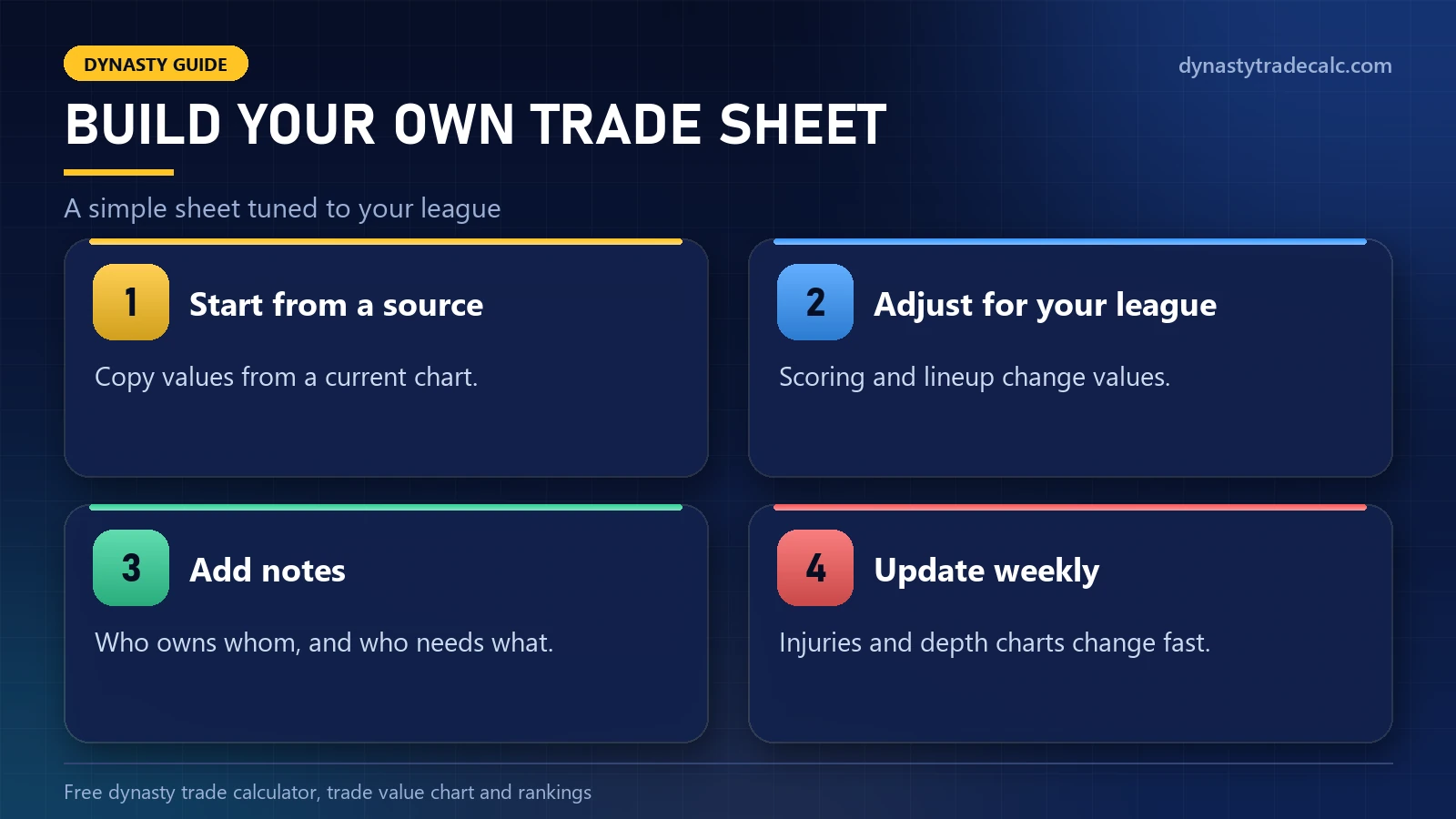
A simple spreadsheet is often the most useful sheet you can have, because it fits your league exactly.
- Start from a current source: copy values for the players in your league.
- Adjust for your scoring and lineup: raise quarterbacks in Superflex and receivers in PPR.
- Add league notes: who owns each player and what each team needs.
- Group players into tiers so close calls are easy to see.
- Update every week during the season.
When you are ready to test a trade, enter both sides in our free dynasty trade calculator and compare the result with your sheet.
Using Trade Sheets in Negotiations
Trade sheets give both managers a shared starting point. If you and your league mate use the same source, you can talk about tiers instead of arguing about opinions. When values differ, ask which sheet the other manager uses and compare. Being open about your source builds trust and makes future trades easier. Our josh allen dynasty trade value guide covers where he ranks and whether to buy, hold or sell.
- Share the source, not just the conclusion.
- Use tiers to explain why two players are close.
- Leave room for roster need; sheets do not know your lineup.
Dynasty vs Redraft Sheets
Dynasty sheets value age, future seasons and rookie picks. Redraft sheets value only the current season and usually change faster week to week. Using a redraft sheet in a dynasty league makes older players look too valuable; the reverse makes young bench players look too valuable. For dynasty pick values, see our rookie pick values.
Common Mistakes
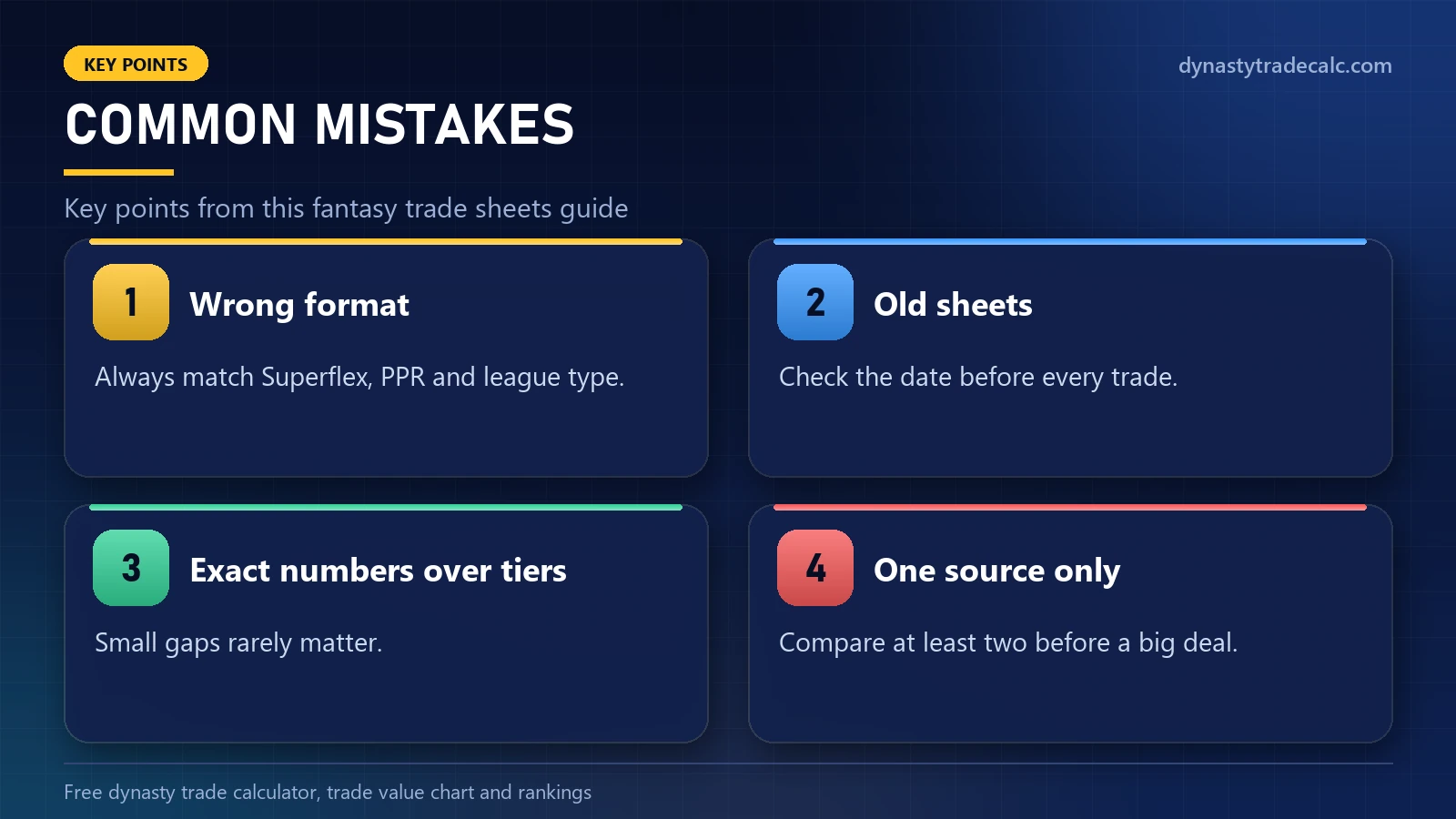
- Wrong format. Always match Superflex, PPR and league type.
- Old sheets. Check the date before every trade.
- Exact numbers over tiers. Small gaps rarely matter.
- One source only. Compare at least two before a big deal.
More on reading values is in our fantasy trade value chart guide.
Tier Example From a Trade Sheet
Most fantasy trade sheets group players into tiers. This simple example shows how to read them in a trade, using placeholder players.
| Tier | Example players | How to trade within it |
|---|---|---|
| Tier 1 | Elite young starters | Rarely traded; only for another tier 1 player plus value |
| Tier 2 | Strong starters | Swap one-for-one based on roster need |
| Tier 3 | Solid starters and top picks | Two tier 3 pieces can buy a tier 2 player |
| Tier 4 | Depth and late picks | Use to balance small gaps |
The key rule: moving up a tier usually costs more than two pieces from the tier below, because only starters score points.
Weekly Sheet Routine
- Check injuries and depth chart news after each game day.
- Move players up or down a tier when their role changes, not after one game.
- Note which managers need which positions.
- Mark two or three buy targets and sell candidates for the week.
Ten minutes a week keeps your fantasy trade sheets current and gives you an edge on managers who rely on old values. Compare your tiers with KeepTradeCut crowd-sourced dynasty values now and then to spot where your league differs from the wider market. Our aj brown dynasty trade value guide covers his move to the Patriots, his injury and the buy-low case.
Where to Find Trade Sheets
Many fantasy analysts and sites publish weekly fantasy trade sheets, especially during the season. Look for a sheet that states its format, its update date and how it builds values. Crowd-sourced values such as FantasyCalc are useful as a second check.
- Analyst sheets: good notes, but one person’s view.
- Crowd and trade-based values: broad samples, fewer notes.
- Your league’s own history: the most local view of all.
No single sheet is perfect. Using two fantasy trade sheets side by side, plus your own notes, gives you the most reliable picture before a big trade. Where the sources agree, you can move quickly; where they disagree, slow down and look at the players causing the gap.
Frequently Asked Questions
What are fantasy trade sheets?
They are lists of player values, often in tiers, that help you compare trades. Many analysts publish weekly sheets, and some managers build their own in a spreadsheet.
Are fantasy trade sheets the same as trade value charts?
Mostly yes. A trade sheet and a trade value chart both rank players by value. Sheets are often updated weekly and may include notes on buying and selling.
How often should you update a trade sheet?
Weekly during the season, because injuries and depth chart changes move values fast. In the offseason, monthly updates are usually enough. Our cmc dynasty trade value guide covers his lighter workload and the running back age curve.
Can I make my own fantasy trade sheet?
Yes. Start from a current value source, adjust for your scoring and lineup, add notes about your league and update it each week.
Should I trust one trade sheet?
Not alone. Sheets use different methods, so compare at least two sources before a big trade and look for agreement.
Do trade sheets work for dynasty leagues?
Yes, if the sheet targets dynasty. Dynasty sheets include rookie picks and value age, while redraft sheets only value the current season.
Conclusion
Fantasy trade sheets make trade talks faster when you read them right: match the format, read tiers first, check the date and compare more than one source. A simple sheet built for your own league is often the best one of all.
Related Guides
- Fantasy trade value chart: how to read any chart.
- Dynasty trade value chart: values by position.
- Superflex trade value chart: quarterback-heavy values.
- TradeCutKeep: how crowd-sourced values work.
- Dynasty trade database: real trades behind a sheet.
- Redraft trade calculator: use a sheet in one-season leagues.
- Fantasy Buy Sell Guide: a related guide.
Compare With Other Sources
Our values are estimates, not quotes. Before a big trade, compare the same players against KeepTradeCut crowd-sourced dynasty values, FantasyCalc and FantasyPros dynasty rankings.
