

Table of Contents
- What Is a PPR Trade Value Chart?
- Who Gains in a PPR Trade Value Chart
- Standard vs Half PPR vs Full PPR
- How to Use a PPR Chart in a Trade
- Running Backs in PPR
- Tight Ends and Tight End Premium
- Common Mistakes
- How Much a Catch Is Worth
- Dynasty Values Over Time
- Comparing Two Players
- Reception Scoring in Superflex Leagues
- Selling and Buying Around Reception Scoring
- Frequently Asked Questions
- Conclusion
- Related Guides
- Compare With Other Sources
A PPR trade value chart lists player values for point-per-reception leagues, where every catch scores a point. That one rule changes which players are worth the most in a trade. This guide shows who gains, how half PPR differs and how to use the chart to price a deal.
What Is a PPR Trade Value Chart?
It is a ranked list of trade values built for PPR scoring. Compared with a standard chart, it moves receivers and pass-catching running backs up and touchdown-only players down. Our main dynasty trade value chart page shows current values; this guide explains how reception scoring shapes them.
Who Gains in a PPR Trade Value Chart
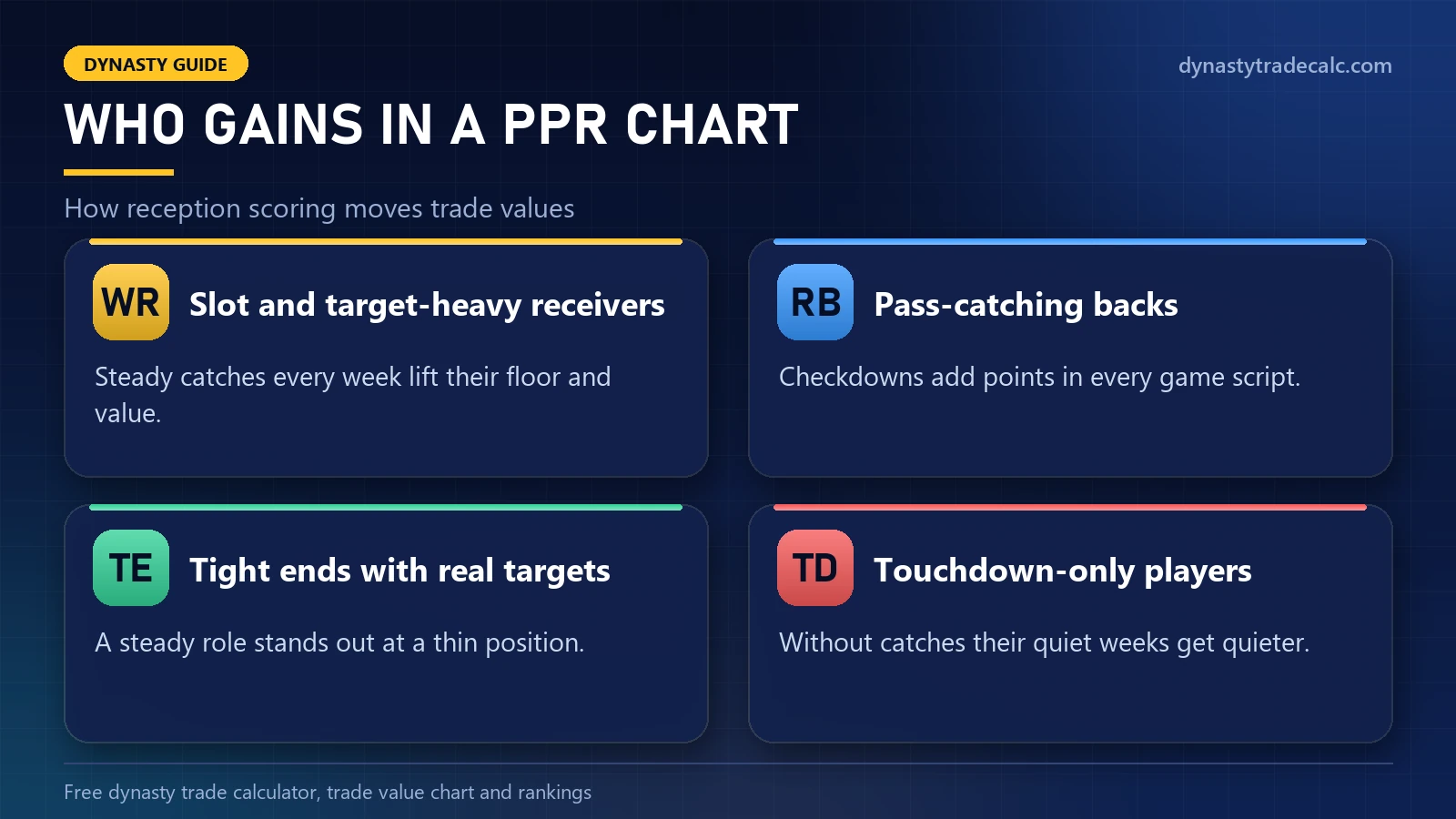
Six catches a week add six points in full PPR and none in standard. Over a season, that is the gap between a bench player and a starter. Our dynasty trade calculator PPR guide shows the points from catches in each format.
Standard vs Half PPR vs Full PPR
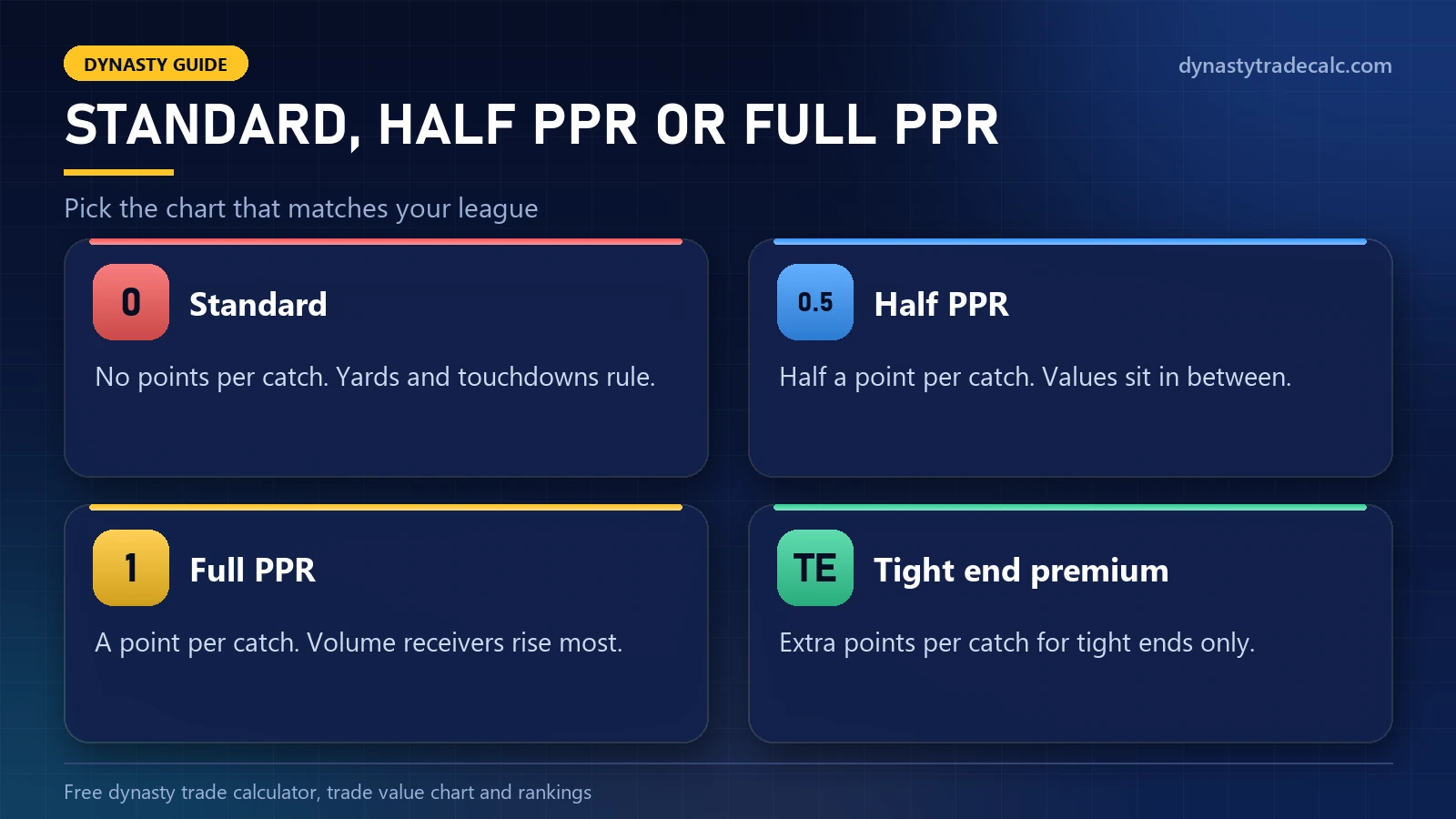
| Format | Points per catch | Who rises | Who falls |
|---|---|---|---|
| Standard | 0 | Touchdown scorers, big-yardage backs | Short-area receivers |
| Half PPR | 0.5 | Balanced volume players | Pure touchdown scorers, slightly |
| Full PPR | 1 | Slot receivers, pass-catching backs | Touchdown-only players |
A half PPR trade value chart sits between the two. If your league uses half a point per catch, use that version; a full PPR chart will overrate pure possession receivers.
How to Use a PPR Chart in a Trade
- Pick the right version: full PPR, half PPR or tight end premium.
- Look up every player and pick in the offer.
- Compare tiers first, then the numbers.
- For packages, add up both sides in our free dynasty trade calculator with PPR scoring selected.
- Check your lineup before you accept.
Running Backs in PPR
PPR is where receiving backs earn their value. A back with steady checkdown targets has a higher weekly floor than one who needs a touchdown. When you compare two backs on a PPR trade value chart, look at their targets as well as their carries; usage on Pro Football Reference shows both.
Tight Ends and Tight End Premium
Most tight ends score little, so a tight end with a real target share stands out. In tight end premium leagues, each catch by a tight end scores extra, which pushes the top few far up the chart. Check whether your league uses it before you trade for or away a tight end. Our half ppr trade analyzer guide covers how half a point per catch changes trade values.
Common Mistakes
- Using the wrong chart. A standard chart misprices every pass catcher in PPR.
- Chasing touchdowns. Volume is more stable than scoring luck.
- Forgetting format changes. Superflex still raises quarterbacks in PPR leagues.
How Much a Catch Is Worth
A simple example shows why the format matters. Imagine two receivers who each score about the same in standard leagues. One catches six short passes a week; the other catches three long ones. In full PPR, the first player earns three extra points every week, or around fifty over a season. That gap can move him up a full tier.
| Weekly catches | Extra points in half PPR | Extra points in full PPR | Over 17 games (full) |
|---|---|---|---|
| 3 | 1.5 | 3 | 51 |
| 5 | 2.5 | 5 | 85 |
| 7 | 3.5 | 7 | 119 |
These are example numbers, not projections. They show why steady target volume is the main driver of value in reception leagues.
Dynasty Values Over Time
In dynasty leagues, reception scoring also changes how age affects value. Possession receivers often keep their role longer than deep threats, because their game depends less on speed. Pass-catching backs, on the other hand, can lose value quickly if a younger player takes over third-down work. When you use a chart in a dynasty trade, ask whether the player’s role is likely to last two or three more seasons.
Rookie picks also shift. A pick that is likely to land a slot receiver or a receiving back is a little more useful in these leagues. Current pick prices are on our rookie pick values page.
Comparing Two Players
- Check the tier. Players in the same tier are close enough that roster need decides.
- Check targets per game. More targets usually means a safer weekly floor.
- Check the role. Is the player on the field for most passing downs?
- Check age and contract. These matter more in dynasty than in redraft.
- Check the trade cost. A small gain is not worth a large overpay.
Reception Scoring in Superflex Leagues
Many leagues use both reception scoring and Superflex. In that mix, quarterbacks still sit at the top of the board because a second starting passer is so valuable, and catches then sort the receivers and backs below them. Our Superflex trade calculator guide covers the quarterback side. For the rest of the roster, the rules in this guide still apply.
Whatever the format, check that your chart and your calculator use the same settings. Mixing a reception chart with a standard calculator gives you two different answers for the same trade.
Selling and Buying Around Reception Scoring
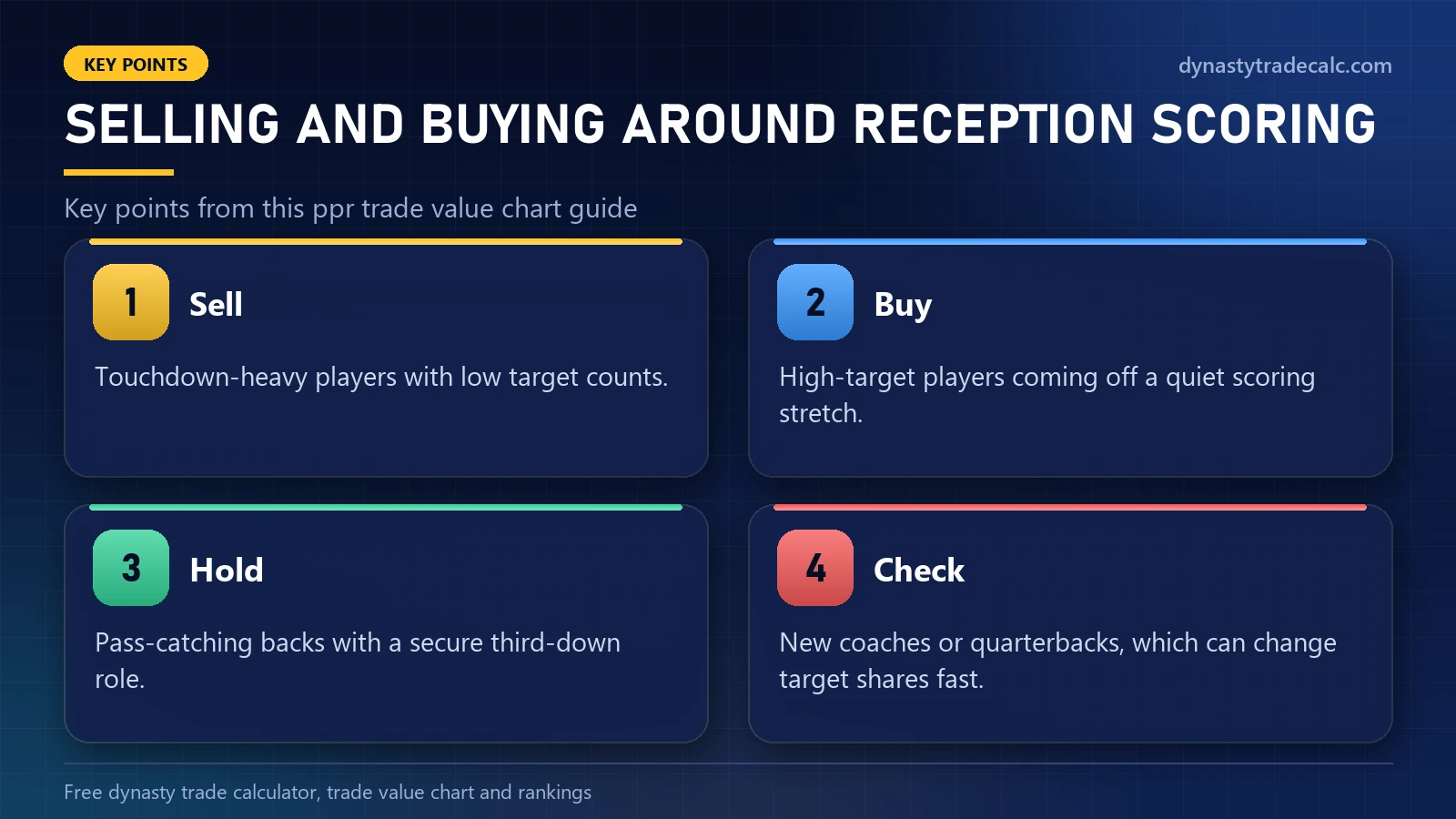
Reception scoring creates simple buy and sell windows. Sell a receiver after a run of touchdowns when his targets have not grown, because the scoring will usually fall back. Buy a receiver whose targets are rising but whose touchdowns have not come yet, because the catches already give him a steady floor.
- Sell: touchdown-heavy players with low target counts.
- Buy: high-target players coming off a quiet scoring stretch.
- Hold: pass-catching backs with a secure third-down role.
- Check: new coaches or quarterbacks, which can change target shares fast.
Target share data on our dynasty rankings and usage notes from team reports help you spot these windows before other managers do. Small edges like this add up over a season, and they matter most in deep leagues where every starter counts.
Frequently Asked Questions
What is a PPR trade value chart?
It is a trade value chart built for point-per-reception leagues. Every catch is worth a point, so receivers and pass-catching running backs rank higher than in standard scoring.
Is there a half PPR trade value chart?
Yes. A half PPR trade value chart gives half a point per catch, so its values sit between standard and full PPR. Use the version that matches your league’s scoring.
Who gains the most value in a PPR league?
Slot receivers and other target-heavy players gain the most, followed by running backs who catch passes. Players who rely on touchdowns lose value.
Can I use a standard chart in a PPR league?
Not reliably. A standard chart undervalues pass catchers and overvalues touchdown-only players, so trades can look fair when they are not.
How do I use a trade value chart PPR version for a trade?
Look up every player on the PPR version, compare tiers first, then the numbers. For trades with several players, add up both sides in a calculator set to PPR.
Does tight end premium change a PPR chart?
Yes. Tight end premium adds extra points per catch for tight ends only, so the top tight ends move up even further than in normal PPR.
Conclusion
A PPR trade value chart rewards volume. Use the version that matches your scoring, value receivers and backs by targets as well as points, and add up packages in a calculator set to PPR before you trade.
Related Guides
- Dynasty trade calculator PPR: points from catches by format.
- Fantasy trade value chart: how to read any chart.
- Dynasty trade value chart: values by position.
- Trade fantasy analyzer: PPR settings in an analyzer.
- Fantasy trade grader: grade PPR trades quickly.
- IDP Trade Calculator: a related guide.
- Dynasty Trade Database: a related guide.
- Half PPR Trade Analyzer: a related guide.
Compare With Other Sources
Our values are estimates, not quotes. Before a big trade, compare the same players against KeepTradeCut crowd-sourced dynasty values, FantasyCalc and FantasyPros dynasty rankings.
