

Table of Contents
- What Makes a Good Trade Target?
- Four Kinds of Trade Target
- Targets by Team Direction
- How to Find Targets Step by Step
- Players to Trade For in Fantasy Football by Position
- Paying the Right Price
- Selling Targets You Already Own
- Common Mistakes
- Age Curves and Trade Targets
- Using Contracts and Coaching Changes
- Building a Target List
- Frequently Asked Questions
- Conclusion
- Related Guides
- Compare With Other Sources
Dynasty fantasy football trade targets are players worth buying now because their price is lower than their likely future value. Finding them is the core skill of dynasty trading. This guide shows where buy-low value usually hides, how to match targets to your team and how to pay a fair price.
What Makes a Good Trade Target?
A good target has a gap between price and outlook. His role, measured by snaps, routes or targets, is steady or growing, but his points or reputation have not caught up. When that gap closes, his value rises and you have bought early. The best dynasty fantasy football trade targets combine a secure role with a price that other managers have pushed down.
Four Kinds of Trade Target
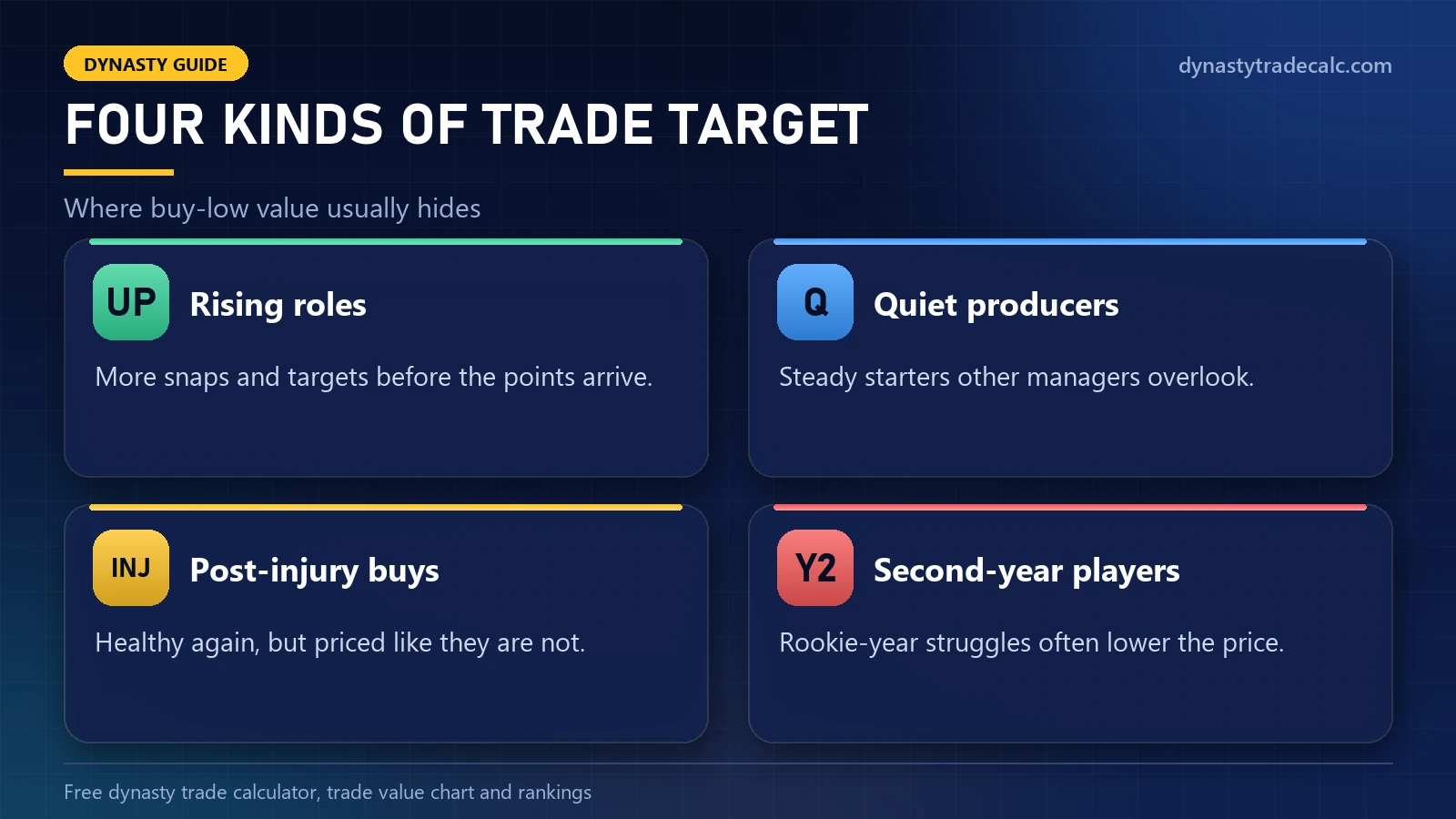
| Target type | Why the price is low | What to check |
|---|---|---|
| Rising role | Points have not caught up with usage | Snap share and targets over recent weeks |
| Quiet producer | No big games, so few managers notice | Weekly floor and role security |
| Post-injury buy | Managers still remember the injury | Health and return to full role |
| Second-year player | Slow rookie season lowered the price | Draft capital and depth chart |
Usage data on Pro Football Reference shows which players are on the field more than their points suggest.
Targets by Team Direction
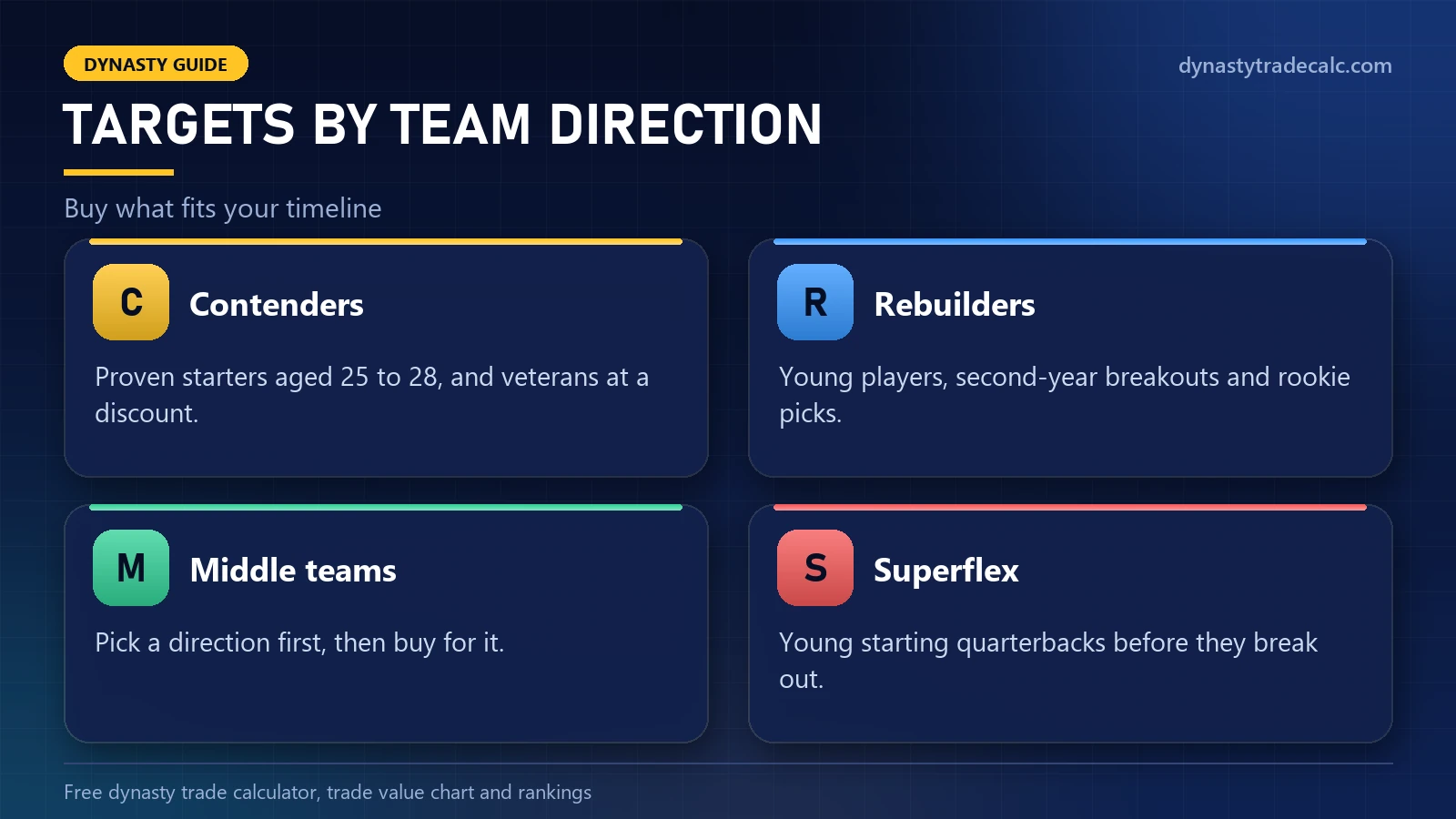
The right target depends on your timeline. A contender needs players who score now; a rebuilder needs players who will peak in two or three seasons. If you are in the middle, choose a direction first, because buying for both usually leaves you with neither.
- Contenders: proven starters in their prime and veterans whose price fell because of age.
- Rebuilders: young players, second-year breakouts and rookie picks.
- Superflex teams: young starting quarterbacks before they break out.
Our dynasty league analyzer guide helps you decide which direction fits your roster.
How to Find Targets Step by Step
- List players with rising usage from recent box scores.
- Compare their price on a value chart with their role.
- Check who owns them and whether that team needs what you have.
- Price the deal in our free dynasty trade calculator.
- Make a fair, specific offer and leave room for a counter.
Current values are on our dynasty rankings and the dynasty trade value chart.
Players to Trade For in Fantasy Football by Position
- Quarterbacks: young starters with rushing ability, especially in Superflex.
- Running backs: backs gaining passing-down work, and young backs behind aging starters.
- Receivers: second-year players with growing target shares.
- Tight ends: young players already running many routes; the position develops slowly.
These are the general profiles of players to trade for in fantasy football; names change every season, so check current usage before you buy.
Paying the Right Price
Buying a target is only a win if the price is fair. Pay for what the player is today plus a small premium for his outlook, not for the breakout you hope for. If the other manager asks for full breakout value, move on: there are always other dynasty fantasy football trade targets. Our auction draft fantasy football guide covers budgets, nominations and bidding without overpaying.
- Use current values as the base price.
- Add picks to close small gaps, not to overpay.
- Walk away when the price assumes the breakout already happened.
Selling Targets You Already Own
The same logic works in reverse. When one of your players has a big stretch that his role does not support, his price is at its peak. That is a good time to sell him for a player with a stronger long-term role. Our guide to the biggest dynasty trade mistakes covers selling too late.
Common Mistakes
- Chasing last week’s points. Buy roles, not box scores.
- Buying for the wrong timeline. Rebuilders do not need 30-year-old backs.
- Overpaying for hype. Popular breakout names are rarely cheap.
- Ignoring roster fit. A great target at a full position does not help.
Age Curves and Trade Targets
Competitor guides often list names but skip the age curves that decide when a player is worth buying. Each position peaks at a different age, and dynasty prices tend to drop before production does.
| Position | Typical peak years | Buy window | Sell window |
|---|---|---|---|
| Running back | About 22 to 26 | Rookie and second year | Around 26 or 27 |
| Wide receiver | About 24 to 29 | Second and third year | Around 29 or 30 |
| Tight end | About 25 to 30 | Second and third year | Around 30 |
| Quarterback | About 26 to 34 | Early career, before a breakout | Mid 30s |
These are rough ranges, not rules. Use them to sort dynasty fantasy football trade targets by timeline: rebuilders buy the early part of each window, contenders buy the peak.
Using Contracts and Coaching Changes
A new contract, a new coach or a change at quarterback can lift a player’s role before his price moves. Watch the offseason news and buy players whose situation improved while their value stayed flat. Usage data on Pro Football Reference confirms whether the new role is real once the season starts. Players whose situation improves this way are often the best dynasty fantasy football trade targets of the year.
Building a Target List
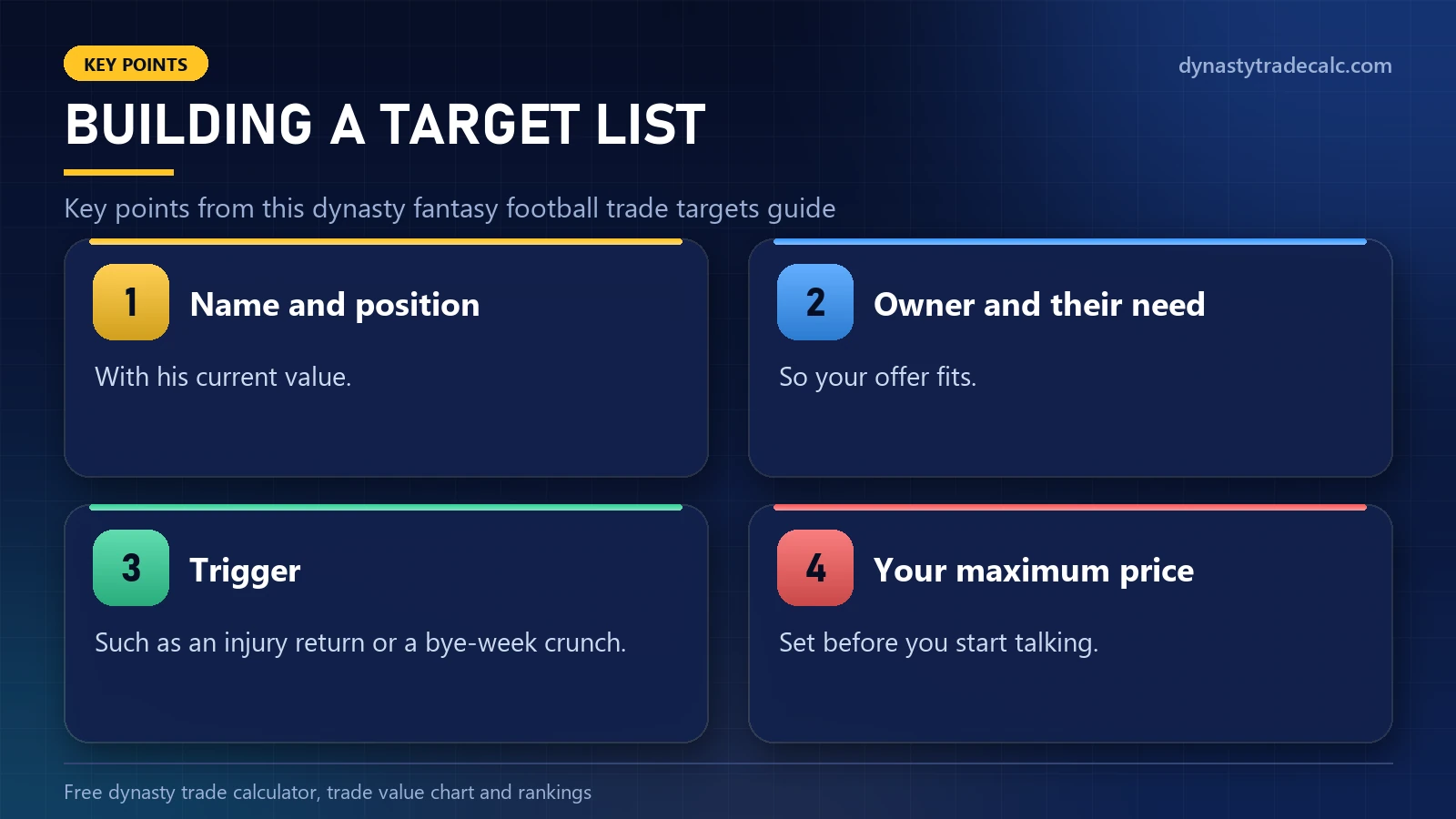
Keep a short list of dynasty fantasy football trade targets and review it every week. Five to eight names are enough. For each one, note his current price, the team that owns him and what that team needs. When the moment is right, after a quiet game or a roster change on their side, you can act quickly.
- Name and position, with his current value.
- Owner and their need, so your offer fits.
- Trigger, such as an injury return or a bye-week crunch.
- Your maximum price, set before you start talking.
A written list stops you from chasing dynasty fantasy football trade targets on impulse, and it keeps your offers fair. Over a season, the best dynasty fantasy football trade targets are usually the ones you tracked early, before other managers noticed them.
Frequently Asked Questions
What are dynasty fantasy football trade targets?
They are players worth trying to buy in dynasty leagues because their price is lower than their likely future value. Rising roles and quiet producers are common examples.
Which players should I trade for in fantasy football?
Look for players whose role is growing but whose points have not caught up yet. Those are the best players to trade for in fantasy football, because you pay before the breakout.
How do I know if a player is a buy-low target?
His usage, such as snaps, routes or targets, is steady or rising while his points are down. That gap usually closes, and his price goes up when it does.
Should contenders and rebuilders target different players?
Yes. Contenders buy proven starters who score now, while rebuilders buy youth and picks. A good target fits your team’s timeline.
When is the best time to buy trade targets?
After a quiet stretch, an injury return or a rookie season that started slowly. Prices are lowest when other managers are worried.
How much should I pay for a trade target?
Pay a fair price based on current values, not on what you hope he becomes. Check the deal in a calculator and avoid paying for the breakout before it happens.
Conclusion
Dynasty fantasy football trade targets are players whose role is ahead of their price. Look for rising usage, quiet producers and second-year players, match targets to your team direction and pay a fair price based on current values.
Related Guides
- Dynasty rankings: current player values.
- Dynasty league analyzer: find your team’s direction.
- The biggest dynasty trade mistakes: what to avoid.
- Dynasty rookie rankings: young players to watch.
- Fantasy football trade finder: find who owns your targets.
- Dynasty trade database: what managers really pay.
Compare With Other Sources
Our values are estimates, not quotes. Before a big trade, compare the same players against KeepTradeCut crowd-sourced dynasty values, FantasyCalc and FantasyPros dynasty rankings.
