

Table of Contents
- Why Trading Matters
- Step 1: Check Your League Settings
- Step 2: Find the Right Trade Partner
- Step 3: Price the Deal Before You Send It
- Step 4: Send the Offer in Your App
- Step 5: Write a Message That Gets Replies
- What Happens After You Send It
- How to Handle a Counter Offer
- Redraft vs Dynasty Trading
- Trade Etiquette and Collusion Rules
- Common Mistakes
- Frequently Asked Questions
- Conclusion
- Related Guides
- Compare With Other Sources
Knowing how to trade fantasy football players well is one of the fastest ways to improve a team after the draft. A good trade fixes a weak starting spot, uses your bench depth and leaves the other manager happy enough to deal again. This guide walks through every step, from checking your settings to sending the offer and getting it processed.
Why Trading Matters
The draft builds your roster once; fantasy football trades let you keep improving it all season. Injuries, breakouts and bye weeks change every team’s needs, and the managers who trade well turn those changes into points. In dynasty leagues, where rosters carry over, trading is even more important, because you can move players before they lose value and buy young talent before it rises.
Step 1: Check Your League Settings
Before any fantasy football trade, read the rules that decide player value. Scoring changes everything: in PPR, every catch adds a point, so pass catchers gain value. Lineup format matters too: in Superflex, a second starting quarterback is worth far more than in a 1QB league.
| Setting | Why it matters in a trade |
|---|---|
| Scoring (Standard, Half PPR, PPR) | Changes the value of receivers and pass-catching backs |
| Lineup (1QB or Superflex) | Superflex makes quarterbacks much more valuable |
| Roster size and bench spots | Decides whether you must drop a player to complete a two-for-one |
| Trade deadline | The last day you can make deals |
| Review or veto rules | How long a trade waits before the platform processes it |
Step 2: Find the Right Trade Partner
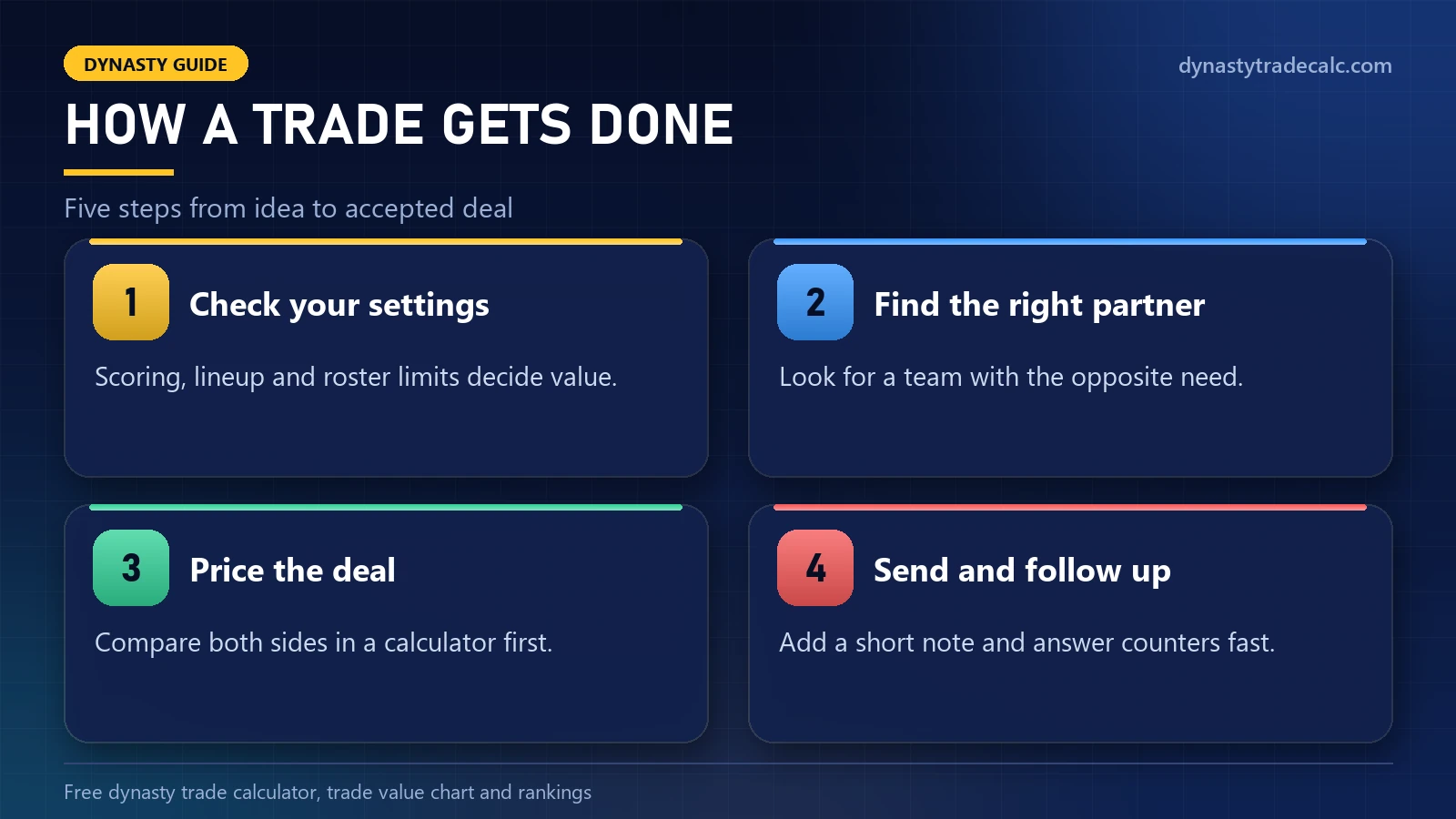
The best fantasy football trade partner is a team that is deep where you are thin. Open every roster and note where each team has extra starters and where it is weak. A manager with four starting running backs and one weak receiver is a natural partner if you have the opposite problem. Team direction matters as well: contenders pay for points now, while rebuilders want youth and picks.
Our guide to auditing your roster shows how to spot your own surplus and needs first.
Step 3: Price the Deal Before You Send It
Put both sides into our free dynasty trade calculator and look at the gap. A small gap is normal; a large one needs a reason, such as a clear roster need. Then check your starting lineup: count how many incoming players would start for you. Two bench players rarely beat one starter, because only starters score. Our fantasy football trade creator guide covers how to build a balanced offer from your target and your surplus.
For a second opinion, compare the same players on a fantasy trade value chart or KeepTradeCut crowd-sourced dynasty values. If two sources agree, you can offer with confidence.
Step 4: Send the Offer in Your App
Most fantasy football apps handle a trade the same way, even though menus differ. Open the other team’s roster or the player’s card, choose the trade option, select the players on each side and add a message. If your roster would go over the limit, the app will ask you to choose who to drop.
- Open the other manager’s team page or the player you want.
- Choose the option to propose a trade.
- Select the players you send and the players you receive.
- Pick a player to drop if the trade leaves you over the roster limit.
- Add a short message and send it.
Platform menus change over time, so check your app’s help page if a button has moved. Tips for ESPN leagues are in our ESPN trade guide.
Step 5: Write a Message That Gets Replies
A short, friendly note gets far more replies than a silent fantasy football trade offer. Name the need you are filling and leave room to talk. For example: “You are thin at receiver and I have depth there. Would this help your lineup? Happy to adjust.”
- Be specific about why the deal helps them.
- Keep it short; two or three lines are enough.
- Reply quickly to counters, because deals cool off fast.
What Happens After You Send It
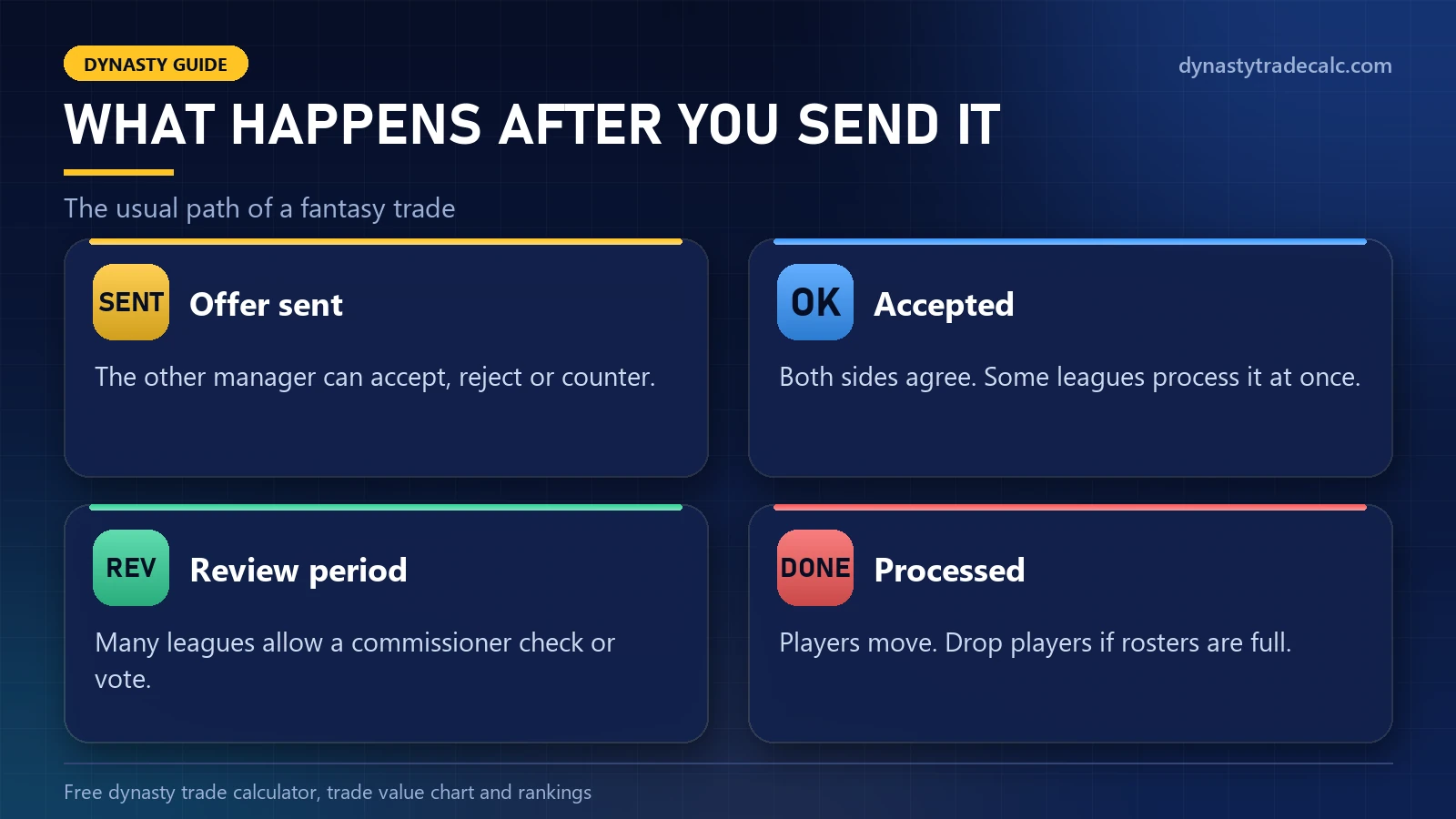
The other manager can accept, reject or counter. If they accept, many leagues hold the trade in a review period, often one or two days, so the commissioner or league can check it. After that, the players move to the new rosters. Trades that process after games start may not count until the next week, so send offers early.
How to Handle a Counter Offer
A counter to your fantasy football trade means the other manager is interested, which is a good sign. Check the new version in the calculator again. If the gap is small, accept or ask for a small add, such as a bench player or a late pick. If it is large, explain which part does not work for you and suggest a fix. Our auction draft fantasy football guide covers budgets, nominations and bidding without overpaying.
Redraft vs Dynasty Trading
| Redraft | Dynasty | |
|---|---|---|
| Time frame | This season only | Several seasons |
| Age | Matters little | Matters a lot |
| Rookie picks | Not used | Key trade currency |
| Best trades | Points for the playoffs | Long-term value and timing |
Knowing how to trade fantasy football picks matters too: in dynasty, rookie picks are part of most deals. Current prices are on our rookie pick values page.
Trade Etiquette and Collusion Rules
Every fantasy football league depends on fair trades. Collusion means two managers working together to help one team, such as a lopsided deal between friends. Most platforms and leagues ban it, and commissioners can reverse such trades. Trade to win, keep offers honest and avoid spamming the same manager.
Common Mistakes
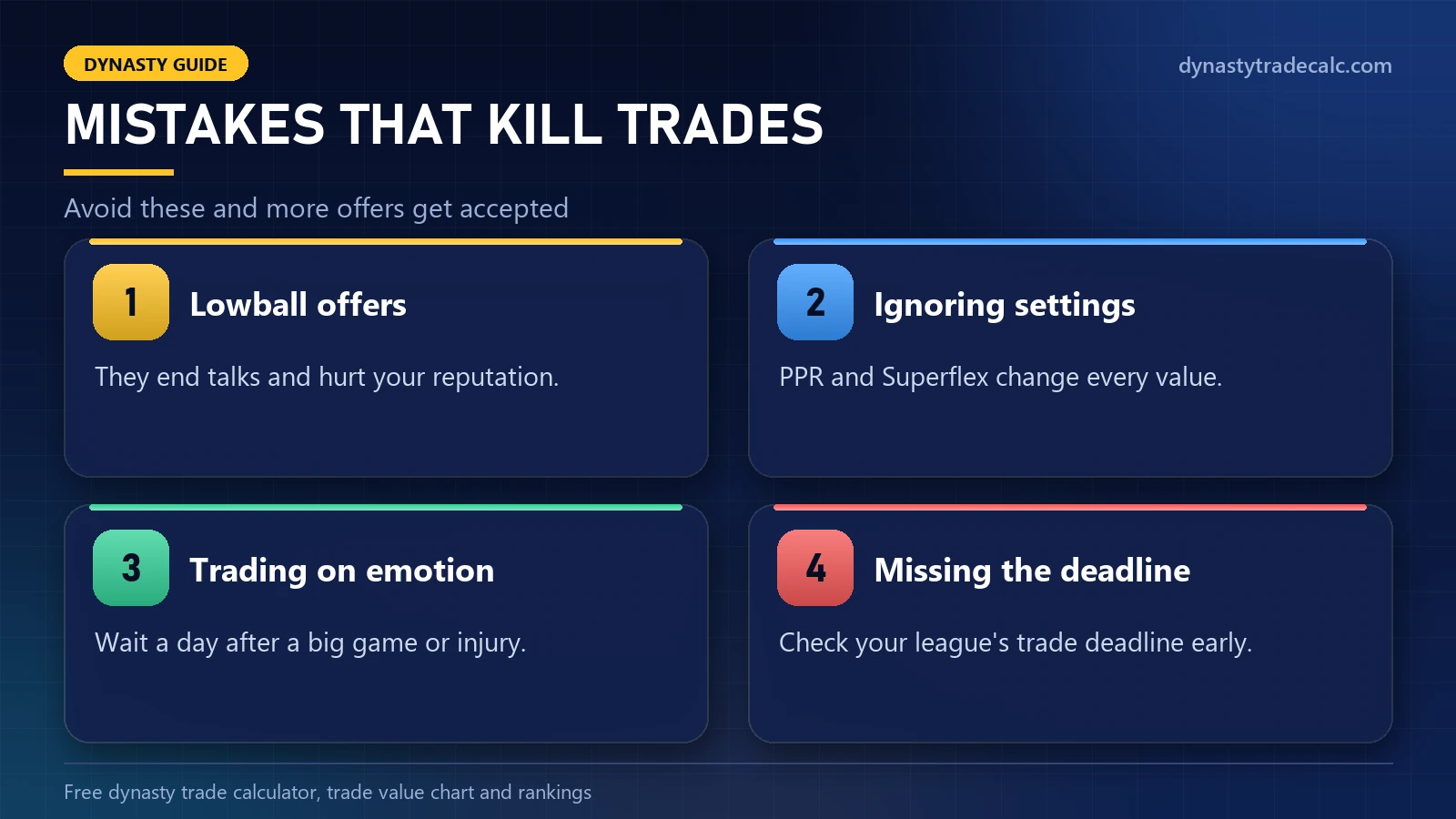
- Lowball offers. They end the conversation.
- Ignoring settings. A PPR or Superflex league changes values.
- Trading on emotion. Wait a day after a big game or injury.
- Missing the deadline. Mark it in your calendar.
More examples are in the biggest dynasty trade mistakes.
Frequently Asked Questions
How do you trade in fantasy football?
Open the other team’s roster in your league app, choose the trade option, pick the players on both sides and send the offer. The other manager can accept, reject or counter it.
How do I make a trade offer the other manager accepts?
Make it fair, solve a need on their roster and add a short note on how it helps them. Managers accept offers that improve both lineups far more often than lopsided ones.
How long does a fantasy football trade take to process?
It depends on your league settings. Some trades process right away, while many leagues use a review period of one to two days so the commissioner or league can check it.
Can my league veto a fantasy football trade?
Yes, if your league allows it. Leagues should save vetoes for collusion or clearly unfair deals, not for trades that one manager simply dislikes.
When is the fantasy football trade deadline?
Each league sets its own deadline, usually a few weeks before the fantasy playoffs. Check your league settings early so you are not caught out late in the season.
Do I need to drop a player to make a trade?
Only if the trade would put you over your roster limit. A two-for-one deal often means the team getting more players must drop someone before it processes.
Conclusion
Learning how to trade fantasy football players comes down to five steps: check your settings, find a partner with the opposite need, price the deal, send a clear offer and handle the counter. Do that for every trade and your team will keep getting stronger through the season.
Related Guides
- Fantasy trade calculator: build and counter offers.
- Analyze a fantasy trade: check a deal before you accept.
- Fantasy trade value chart: how to read player values.
- The biggest dynasty trade mistakes: what to avoid.
- Fair trades in fantasy football: what a fair offer looks like.
- Fantasy football trade finder: pick the right partner.
- Sleeper trade calculator: trading in Sleeper leagues.
Compare With Other Sources
Our values are estimates, not quotes. Before a big trade, compare the same players against KeepTradeCut crowd-sourced dynasty values, FantasyCalc and FantasyPros dynasty rankings. Player usage and stats are on Pro Football Reference.
