

Table of Contents
- The Mistakes at a Glance
- Why These Mistakes Cost So Much
- Mistake 1: Paying for Last Season
- Mistake 2: Pricing Rookie Picks by Dream
- Mistake 3: Ignoring League Format
- Mistake 4: Selling Young Breakouts Too Early
- Mistake 5: Holding Aging Veterans Too Long
- Mistake 6: Trading on Emotion
- Mistake 7: Skipping the Calculator
- Mistake 8: No Team Direction
- Mistake 9: Overvaluing Depth
- How to Avoid the Biggest Dynasty Trade Mistakes
- Frequently Asked Questions
- Conclusion
- Related Guides
The biggest dynasty trade mistakes rarely look bad on the day. You may win the next two weeks and lose two seasons of value. This guide lists the biggest dynasty trade mistakes managers make with player value, rookie picks, format and timing, and the simple routine that avoids them.
The Mistakes at a Glance
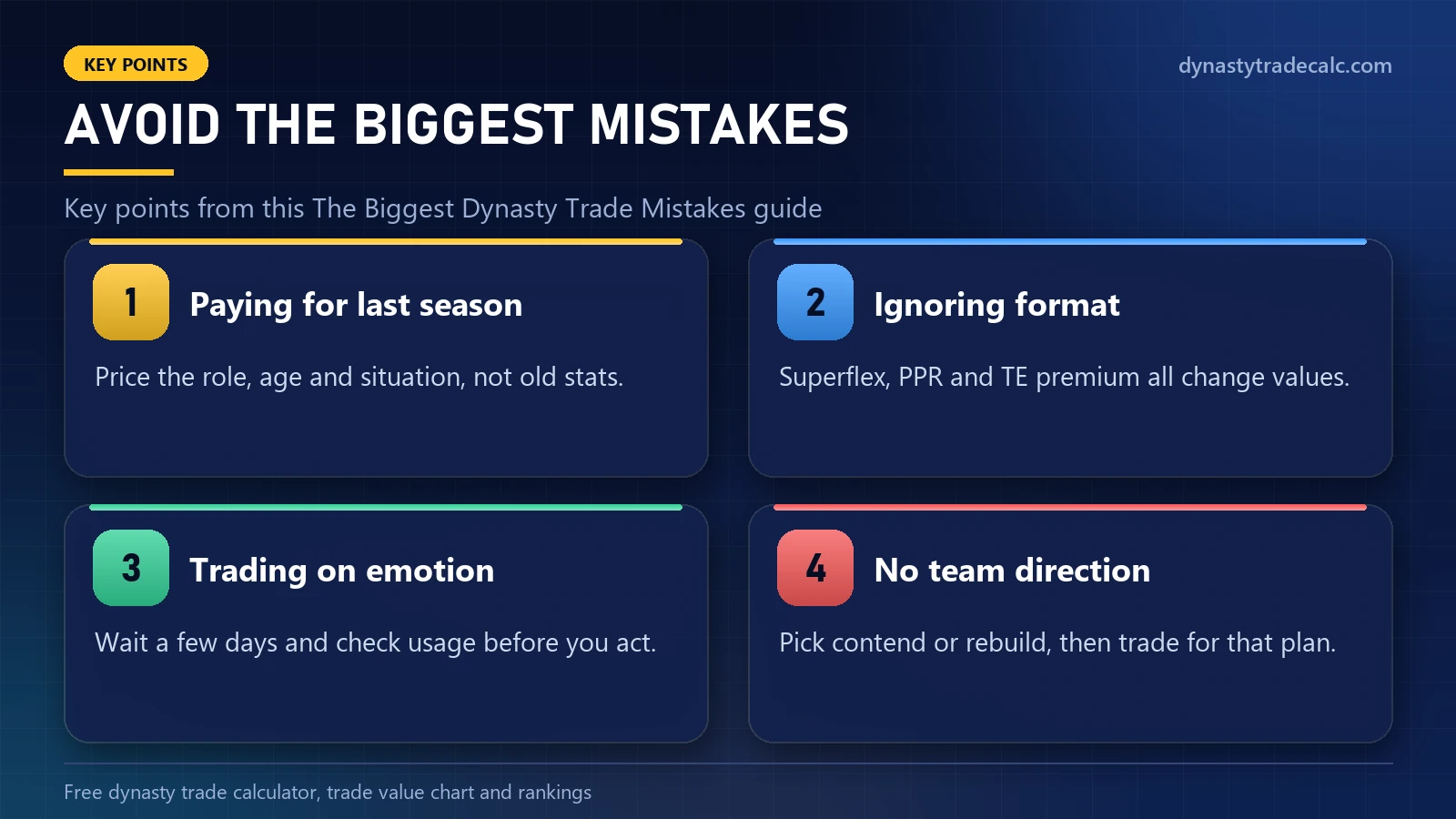
Short on time? Here are the biggest dynasty trade mistakes covered below, each with its fix:
| Mistake | The fix |
|---|---|
| Paying for what a player was last season | Compare role, age, contract, competition and scoring format |
| Pricing rookie picks by dream | Price draft capital by range: early firsts are strong, late firsts are riskier |
| Ignoring league format | Let your league settings guide the final call |
| Selling or keeping a breakout on one game | Study usage first: routes, targets, snaps, touches and red-zone work |
| Holding aging veterans on a rebuilding team | Plan exits early, before the market gets cold |
| Trading on emotion | Use a cooling-off rule before accepting a big offer |
| Skipping the calculator | Check the deal in a calculator, then use judgment for fit |
| Switching plans every month | Pick a lane: rebuild or contend |
Why These Mistakes Cost So Much
In dynasty you keep your players for years, so a bad trade keeps hurting long after the season ends. The biggest dynasty trade mistakes all share one feature: they trade long-term value for a short-term feeling, such as safety, excitement or relief after a bad week.
Mistake 1: Paying for Last Season
Player value changes because football changes. A new coach can lift a receiver, a rookie running back can take a veteran’s job, and an injury can turn a star into a weekly guess. Paying for what a player did last year instead of what his role looks like now is one of the biggest dynasty trade mistakes. Compare role, age, contract and competition before you buy.
Mistake 2: Pricing Rookie Picks by Dream
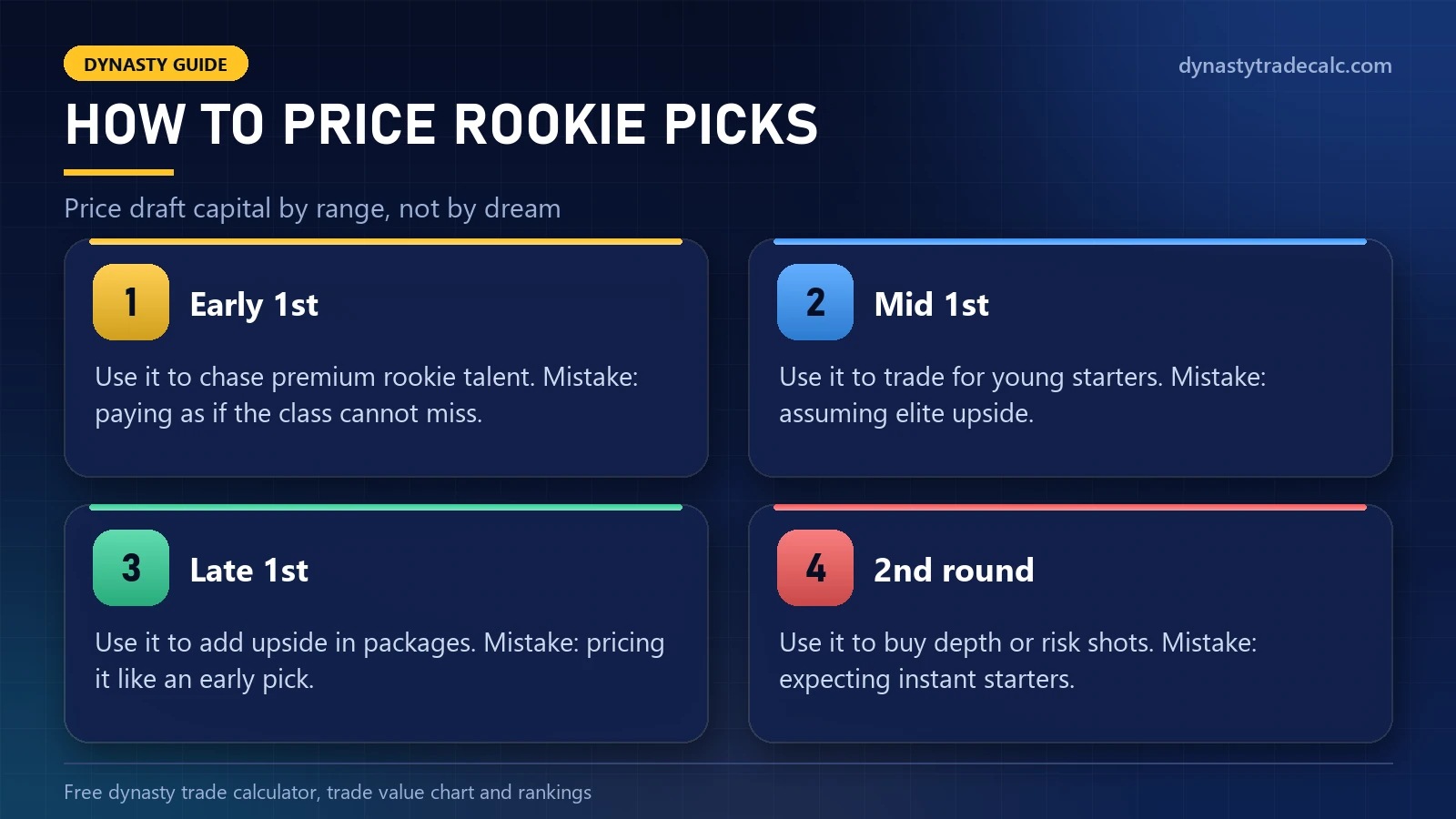
Rookie picks are fun because they carry imagination, and imagination gets expensive. Price picks by range: early firsts are strong assets, late firsts are risky and seconds are sweeteners. Current values are on our dynasty rookie pick value chart 2026.
Mistake 3: Ignoring League Format
| League Format | What Gains Value | What Loses Value |
|---|---|---|
| Superflex | Starting quarterbacks | Bench receivers with weak roles |
| 1QB | Elite RBs and WRs | Mid-tier quarterbacks |
| TE Premium | Target-heavy tight ends | Touchdown-only tight ends |
| Start 11 | Usable depth | Empty bench stash players |
| Start 8 | Elite starters | Replaceable depth |
A trade that works in 1QB can fail in Superflex. Ignoring format is among the biggest dynasty trade mistakes because it makes every value in the deal wrong at once. See the Superflex trade calculator guide.
Mistake 4: Selling Young Breakouts Too Early
One manager says sell high, another says never sell. The answer is in the usage. If routes, targets and snaps are all rising, the breakout is real; hold. If the role came from an injury to a teammate or a low snap rate, the production may be fragile; selling at the peak can be smart.
Mistake 5: Holding Aging Veterans Too Long
Veterans can win titles, and a strong veteran starter can carry a contender. The problem begins when a rebuilding team holds them. Running backs lose value fastest, so sell them a season early while contenders still pay for points. Holding too long is one of the biggest dynasty trade mistakes rebuilders make.
Mistake 6: Trading on Emotion
One bad Sunday can turn a good player into trade bait, and one huge game can make a bench player look like treasure. Wait a few days, check the usage and then decide. Emotional trades after a single game are among the biggest dynasty trade mistakes we see.
Mistake 7: Skipping the Calculator
A calculator will not make you a genius, but it stops obvious errors. Run every serious offer through our free dynasty trade calculator and a second source such as KeepTradeCut crowd-sourced dynasty values. If both say you are overpaying by a lot, you probably are.
Mistake 8: No Team Direction
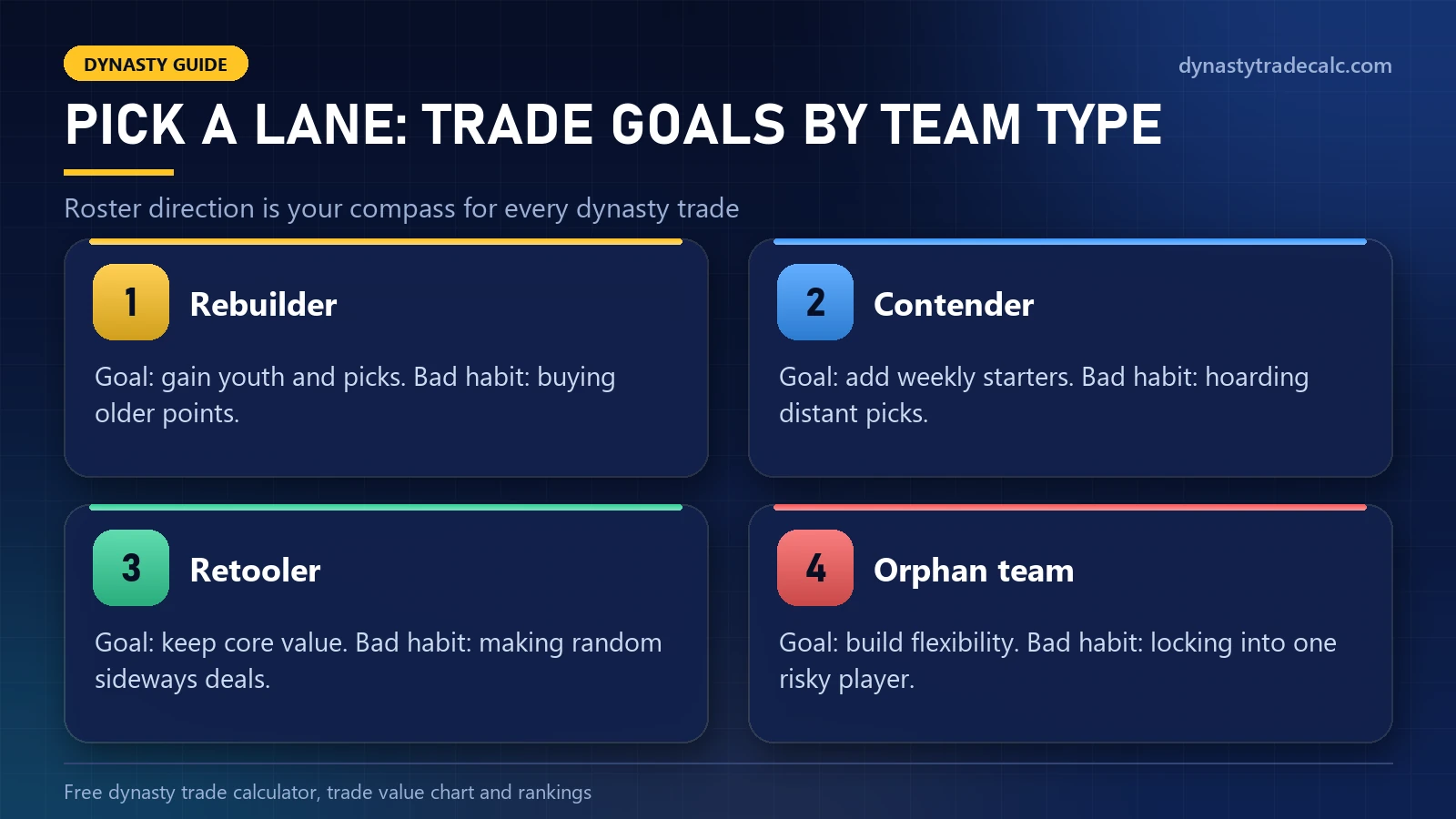
Roster direction is your compass. Rebuilders should chase youth, picks and flexible value. Contenders should chase weekly starters and stop hoarding distant picks. Middle teams that make random sideways deals lose value on both ends.
Mistake 9: Overvaluing Depth
Three good bench players feel like a lot, but only starters score. Trading one star for several average players usually weakens your lineup, even when the totals match. Overvaluing depth belongs on any list of the biggest dynasty trade mistakes. Turn depth into stars when you can, and keep only enough backups to survive injuries and bye weeks.
How to Avoid the Biggest Dynasty Trade Mistakes
Build a trade routine and use it on every offer:
| Trade Check | Question To Ask |
|---|---|
| Direction | Am I rebuilding or contending? |
| Format | Does scoring change this player’s value? |
| Timing | Am I buying high or selling low? |
| Role | Does this player have stable volume? |
| Exit value | Can I trade this asset later? |
If a trade passes every check, it is probably good for your team, whatever the headline names look like.
Frequently Asked Questions
What is the biggest dynasty trade mistake?
Trading without a clear team direction. If you do not know whether you are rebuilding or contending, every offer looks attractive, and you end up buying and selling at the same time.
Should I trade rookie picks for veterans?
Yes if you are contending and the veteran gives real weekly points. No if you are rebuilding and need long-term value. Picks are flexible; veterans score now but lose value fast.
When should I sell a young breakout player?
Sell when the market prices him like a future star but his role looks fragile. Hold when usage supports the breakout: routes, targets, snaps and touches all rising.
Why do dynasty managers overpay for rookie picks?
Because picks carry imagination. A future first feels like a mystery box that could become a superstar. Price picks by range instead, from strong early firsts to risky late ones.
Is a trade calculator always accurate?
No. It shows market value and rough balance, but it cannot know your lineup, your league’s habits or your risk level. Use it as a check, not a decision.
How do I avoid bad dynasty trades?
Build a routine: decide your direction, check your league format, compare value, role and timing, then ask whether the trade improves your points, flexibility or future value.
Conclusion
The biggest dynasty trade mistakes come from paying for the past, dreaming about picks, ignoring format and trading without a plan. Pick a direction, check every offer with the same routine and a calculator, and you will avoid most of them.
Related Guides
Compare With Other Sources
Where this page cites player production or market movement, the underlying data comes from KeepTradeCut crowd-sourced dynasty values and Pro Football Reference. For this season’s values, see our dynasty trade calculator 2026 guide.
