


Table of Contents
- What It Can Calculate
- Dynasty vs General Fantasy Tools
- How to Use It
- How Scoring Format Shifts Values
- Fair Does Not Always Mean Equal
- Rookies and Draft Picks
- What Moves Player Value
- How Values Change During the Season
- Multi-Player Trades
- Strategies for Contenders and Rebuilders
- Common Mistakes
- Frequently Asked Questions
- Conclusion
- Related Guides
A dynasty calculator puts a number on players and picks so you can compare a trade before you accept it. People also call it a dynasty fantasy football calculator, a dynasty football calculator or a dynasty fantasy calculator; it is the same tool. This guide shows what it can calculate, how to use it and how to read the result.
What It Can Calculate
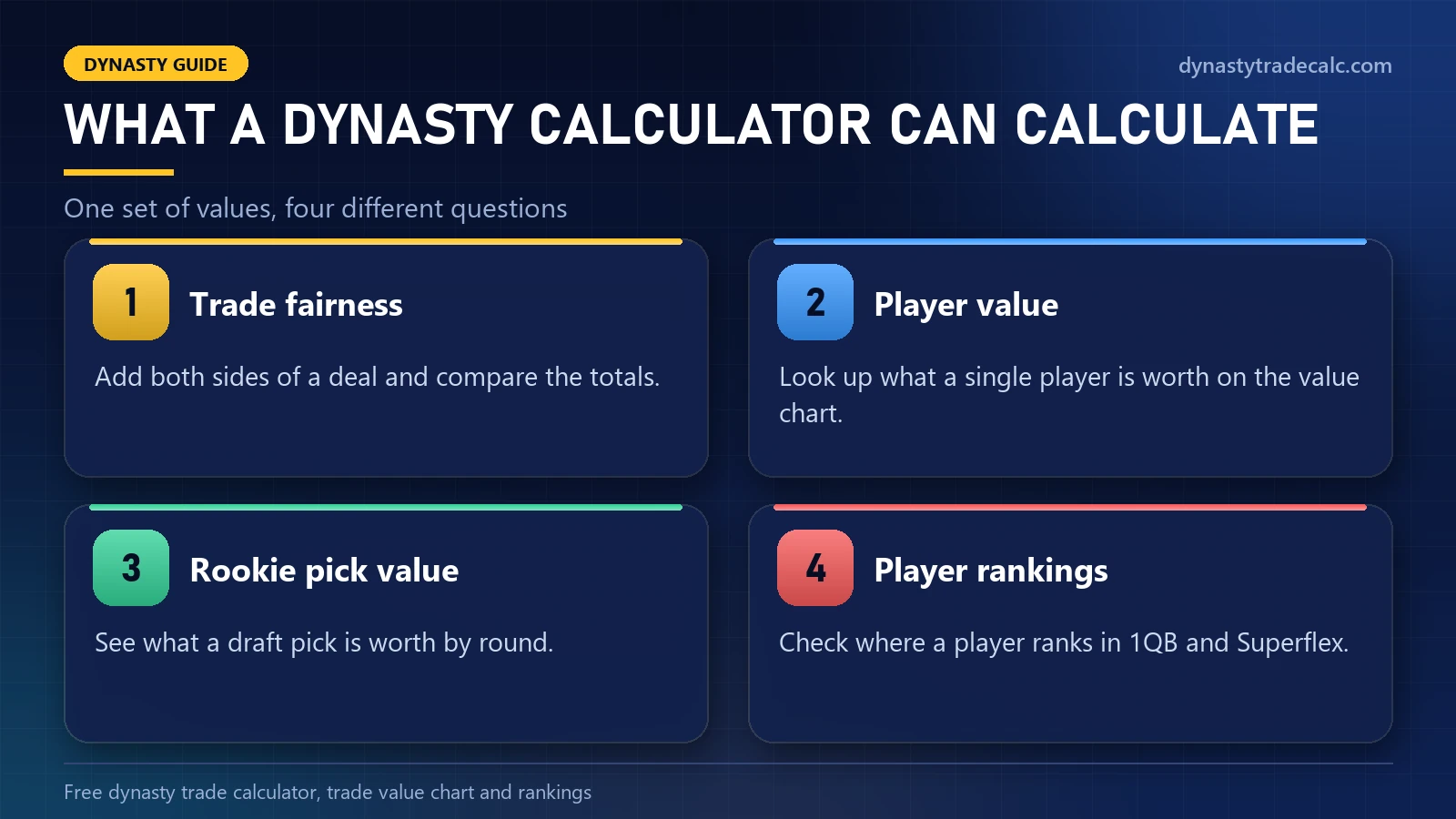
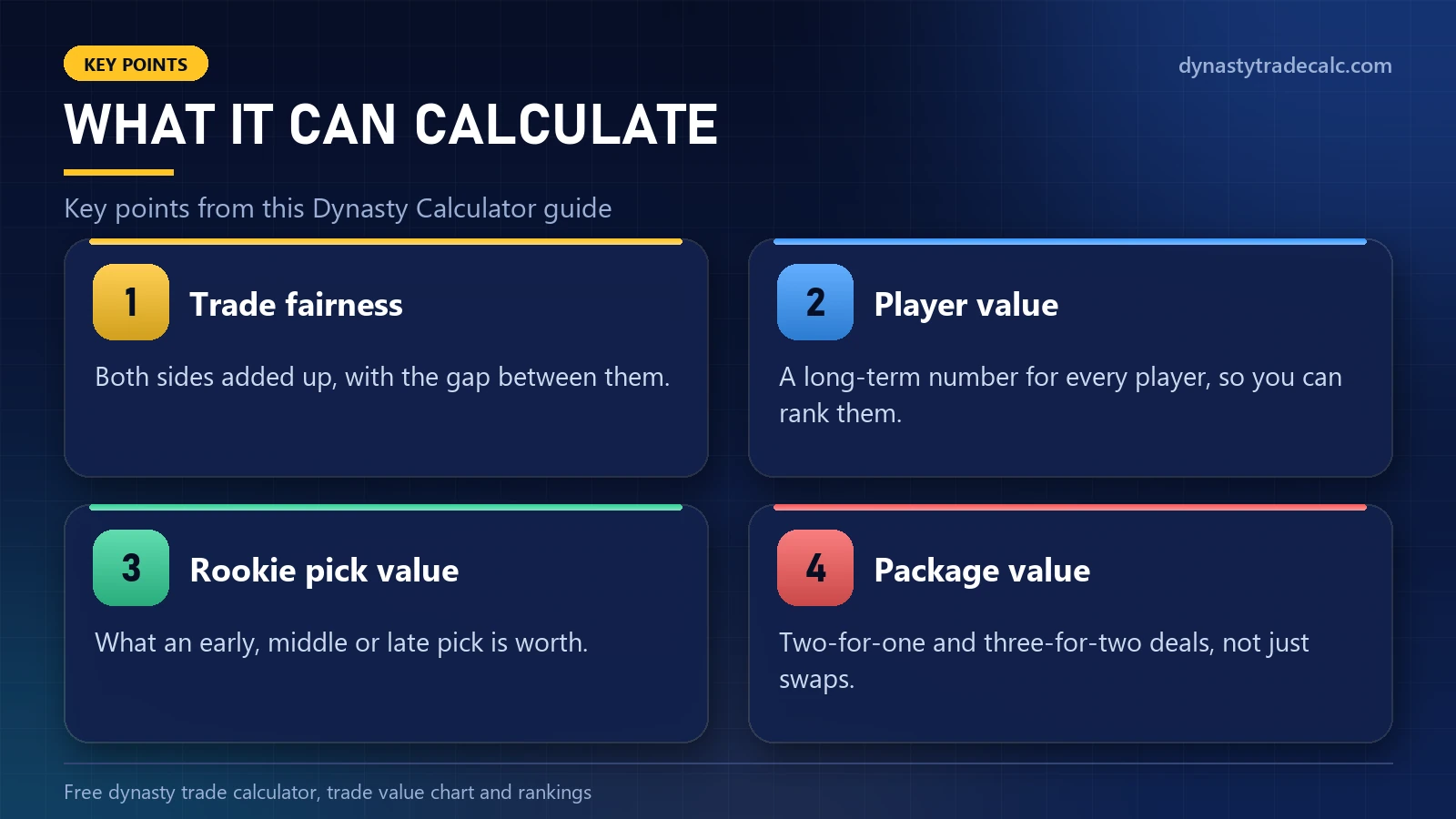
- Trade fairness: both sides added up, with the gap between them.
- Player value: a long-term number for every player, so you can rank them.
- Rookie pick value: what an early, middle or late pick is worth.
- Package value: two-for-one and three-for-two deals, not just swaps.
Our free calculator does all four and needs no account.
Dynasty vs General Fantasy Tools
A general fantasy calculator is usually built for redraft leagues and values this season only. In dynasty, a young receiver and an aging receiver with the same weekly points are not worth the same, because one has several good seasons left. Only a tool built for dynasty shows that gap, which is why the type you choose matters more than the site.
How to Use It
- Match your settings: team count, quarterback format and scoring.
- Enter every player and pick on both sides.
- Read the totals and the gap.
- Check your roster: who starts after the trade?
- Decide by your direction: contending or rebuilding.
How Scoring Format Shifts Values
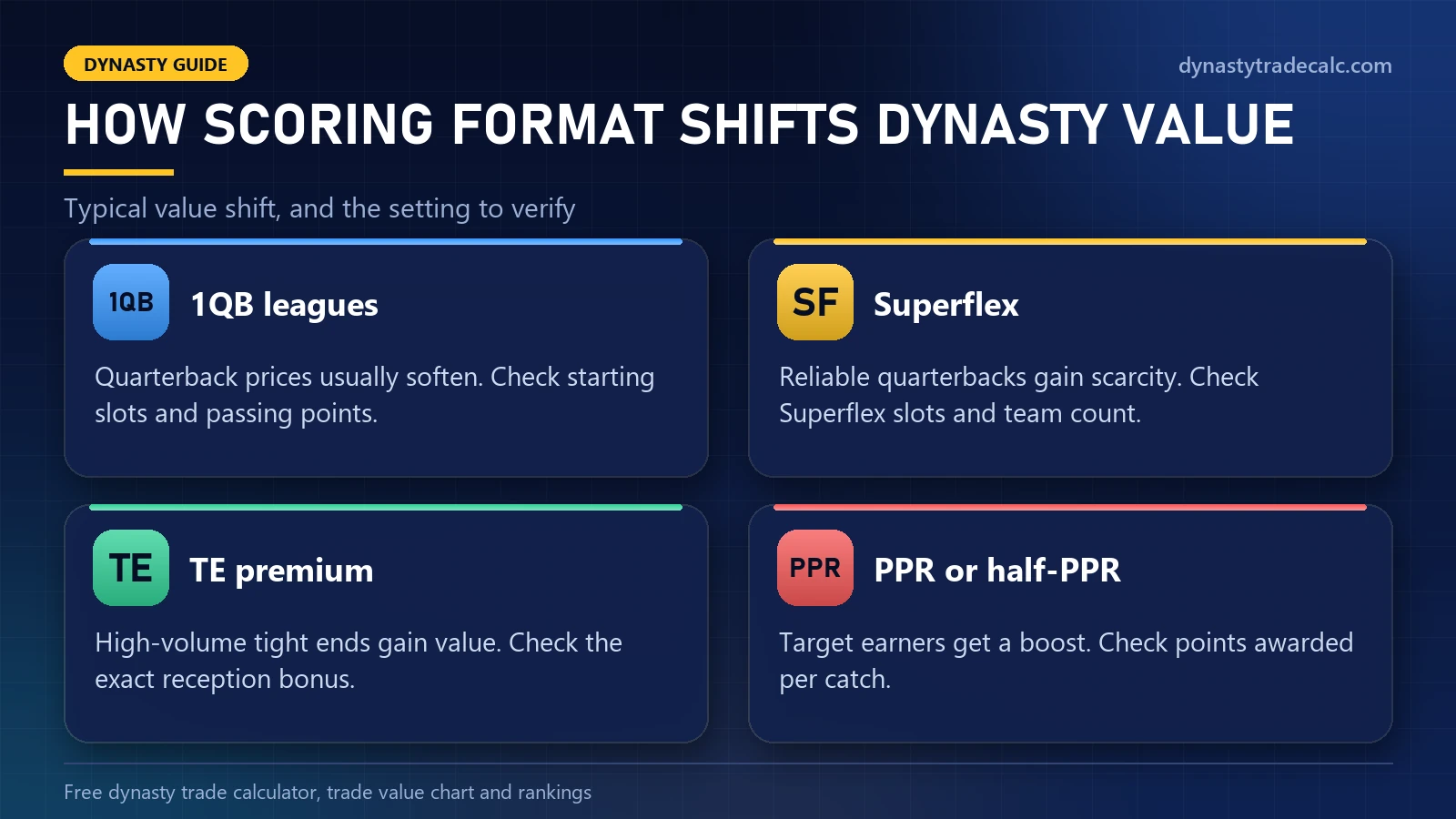
| League format | Typical value shift | Setting to verify |
|---|---|---|
| 1QB | Quarterback prices usually soften | Starting slots and passing points |
| Superflex | Reliable quarterbacks gain scarcity | Superflex slots and team count |
| TE premium | High-volume tight ends gain value | Exact reception bonus |
| PPR or half-PPR | Target earners receive a boost | Points awarded per catch |
Scoring rules change the whole market. In 1QB leagues, usable quarterbacks are plentiful; in Superflex, reliable starters gain scarcity. PPR lifts pass catchers, and tight end premium lifts the few tight ends with real targets. See our Superflex guide for the biggest effect.
Fair Does Not Always Mean Equal
A rebuilding manager may prefer three flexible assets, while a contender wants one star who starts every week. Both can win the same trade. Numbers that look equal can hide a bad deal if one side gets only bench players, and numbers that look uneven can be fair if one side gets the best player.
Rookies and Draft Picks
Rookie picks behave like mystery boxes with an expiry date. Their value rises as the NFL Draft and rookie drafts approach, then turns into one player with one set of risks. Current prices are on our rookie pick values page.
What Moves Player Value
Age matters in every long-term valuation, but opportunity moves faster. Track snap share, targets and touches: a young player with a growing role is rising, and an older player with a shrinking role is falling, whatever last week’s points say. Values also move with free agency, the NFL Draft, training camp and injuries.
How Values Change During the Season
Player prices rarely sit still. Free agency, the NFL Draft and training camp move them in the offseason; injuries and weekly usage move them during the season. A backup who takes over a starting job can double in value in a week, and a star with a long injury can lose a third. Check values again before every serious offer, and compare them with a second source such as KeepTradeCut crowd-sourced dynasty values when the gap is close.
Multi-Player Trades
Packages need more than addition. Four modest players may add up to a star’s number, yet they take four roster spots and may not start. Count how many incoming players would actually play for you before you accept a package. If only one of them starts, the side giving up the best player usually loses the trade.
Strategies for Contenders and Rebuilders
- Contenders: trade uncertain picks for reliable starters.
- Rebuilders: sell aging production for youth and picks a season early.
- Middle teams: choose a direction before you trade.
Common Mistakes
- Chasing yesterday’s points. Buying after a career game usually means overpaying.
- Wrong format. 1QB values undersell quarterbacks in Superflex.
- Treating the number as the answer. Your roster decides whether a fair trade is a good one.
More examples are in the biggest dynasty trade mistakes.
Frequently Asked Questions
What does a dynasty calculator calculate?
It gives each player and draft pick a long-term value, then adds up both sides of a trade so you can see which side is ahead. You can also use it to rank players or price a pick.
Is a fantasy calculator the same as a dynasty calculator?
No. A fantasy calculator for redraft leagues values the current season only. A dynasty calculator values several future seasons, so age, role and rookie picks all change the number.
What is a dynasty value calculator?
It gives each player and rookie pick a number that reflects long-term worth. You compare the numbers to rank players, price a pick or check whether a trade is close.
Is a dynasty calculator the same as a dynasty trade calculator?
Mostly, yes. Dynasty calculator is a short name for a dynasty trade calculator. Both put a value on players and picks and compare the two sides of a deal.
How should I value early rookie picks?
Early firsts deserve stronger prices because they give access to the best prospects. Later picks carry more risk, so price them by range rather than by the best player you hope to land.
Why do quarterbacks cost more in Superflex leagues?
Because teams can start two. Reliable starters become scarce, so their values rise far above 1QB prices. Always set the Superflex option before you compare a trade.
Does a fantasy calculator with PPR scoring change values?
Yes. A fantasy calculator set to PPR adds a point for every catch, so receivers and pass-catching backs rise. Always match the fantasy calculator PPR setting to your league.
Can I use a fantasy football calculator with PPR settings?
Yes. Choose full PPR or half-PPR before you compare players. With the fantasy football calculator PPR option on, receivers and pass-catching running backs gain value.
Conclusion
A dynasty calculator turns players and picks into numbers you can compare. Match your settings, enter every asset, read the gap and check your lineup before you accept. Used on every offer, it keeps your trades fair and your roster moving in one direction.
Related Guides
Compare With Other Sources
Our values are estimates, not quotes. Before a big trade, check the same players against KeepTradeCut crowd-sourced dynasty values and FantasyCalc. When two sources disagree, treat the gap as a sign that the market is unsettled. For redraft and keeper leagues, see our fantasy football trade calculator guide. Not sure whether to accept, reject or counter? See our free dynasty trade calculator decision guide. For how free and paid tools differ, see our free dynasty trade value calculator guide. To grow roster value over many trades, read our trade calculator dynasty guide to league value. Playing redraft as well as dynasty? Our guide to the trade calculator shows how to read any trade result.
