



Table of Contents
- What Is a Keeper League?
- How a Fantasy Keeper Calculator Works
- Worked Example
- How Keeper Rules Change the Answer
- Using a Trade Calculator for Keeper Decisions
- Trading for Keepers
- Common Keeper Mistakes
- Worked Trade Example With Real Values
- Frequently Asked Questions
- Conclusion
- Related Guides
- Compare With Other Sources
A fantasy keeper calculator answers one question: which players give you the biggest edge if you keep them? The answer is rarely just your best players. It is the players whose keeper cost is far below what they would cost in this year’s draft. This guide shows the method, a worked example and how different keeper rules change the result.
What Is a Keeper League?
In a keeper league, each team holds on to a small number of players from last season and drafts the rest. It sits between redraft, where every roster starts from zero, and dynasty, where you keep almost everyone.
Most keeper leagues attach a cost to each keeper. A common rule is that you give up the draft pick from the round where someone took the player last year, or one round earlier. That cost is what makes keeper choices interesting.
How a Fantasy Keeper Calculator Works
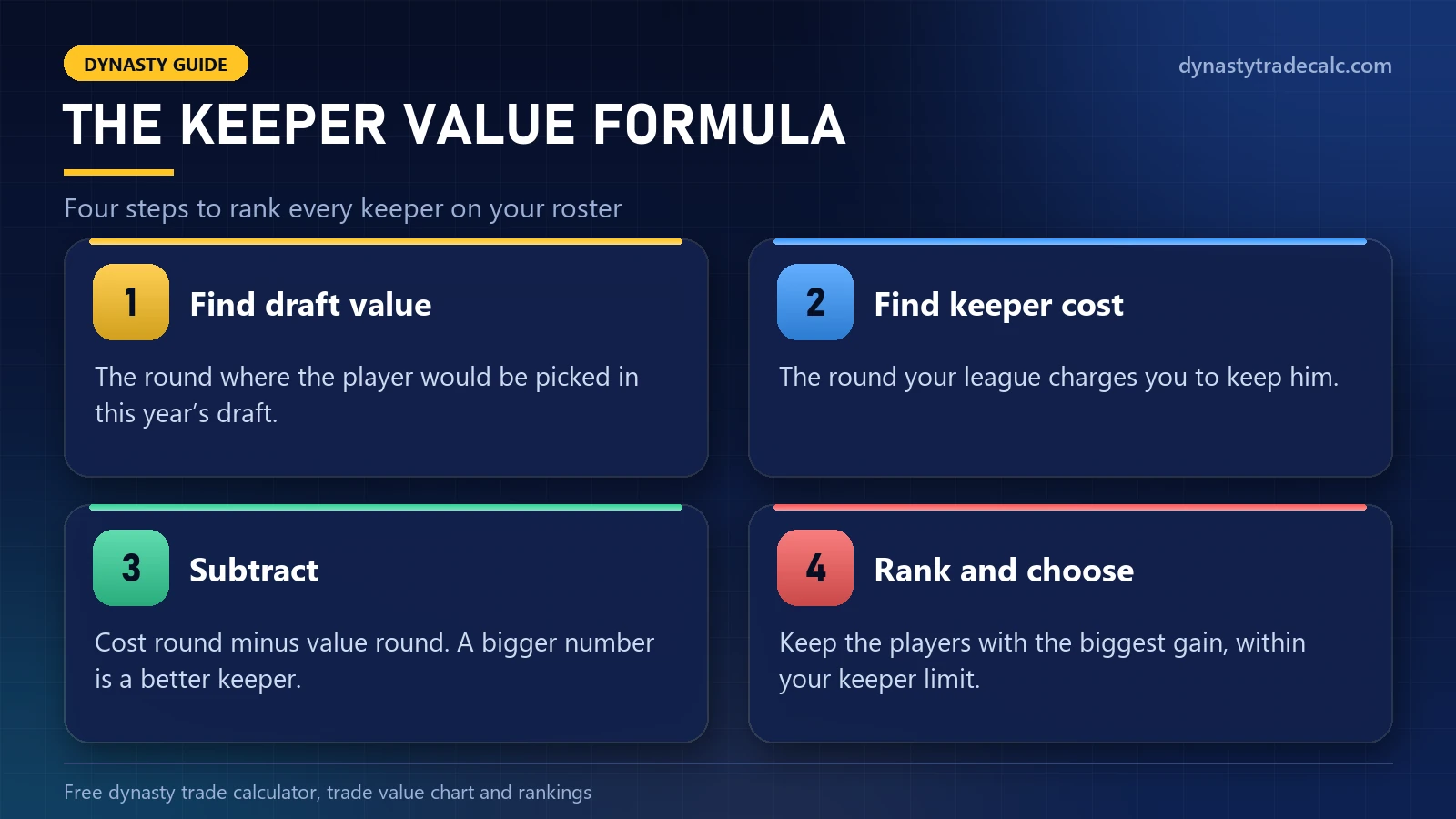
- Find the draft value. Estimate the round where managers would pick the player if he were in this year’s draft.
- Find the keeper cost. Look up the round your league charges to keep him.
- Subtract. Keeper cost round minus draft value round gives the gain in rounds.
- Rank and choose. Keep the players with the biggest gain, up to your league’s limit.
A positive number means you get the player for less than the draft would charge. Zero means no advantage. A negative number means he is cheaper to draft again than to keep. That gap is the heart of any fantasy keeper calculator.
Worked Example
The four players below are made-up examples that show how the method works. Use your own league’s rounds and costs. Our 3 way trade calculator guide covers how to check a three-team trade one pair at a time. Our NFL dynasty trade calculator guide covers player and pick values together.
| Player | Likely draft round | Keeper cost | Gain | Decision |
|---|---|---|---|---|
| Receiver A | Round 3 | Round 9 | +6 rounds | Keep |
| Running back B | Round 2 | Round 5 | +3 rounds | Keep |
| Quarterback C | Round 1 | Round 1 | 0 rounds | Only if you would draft him there anyway |
| Tight end D | Round 8 | Round 6 | -2 rounds | Throw back and redraft |
Receiver A is the best keeper here even though Quarterback C is the best player. That is the whole idea: keepers are about the gap, not the name.
How Keeper Rules Change the Answer
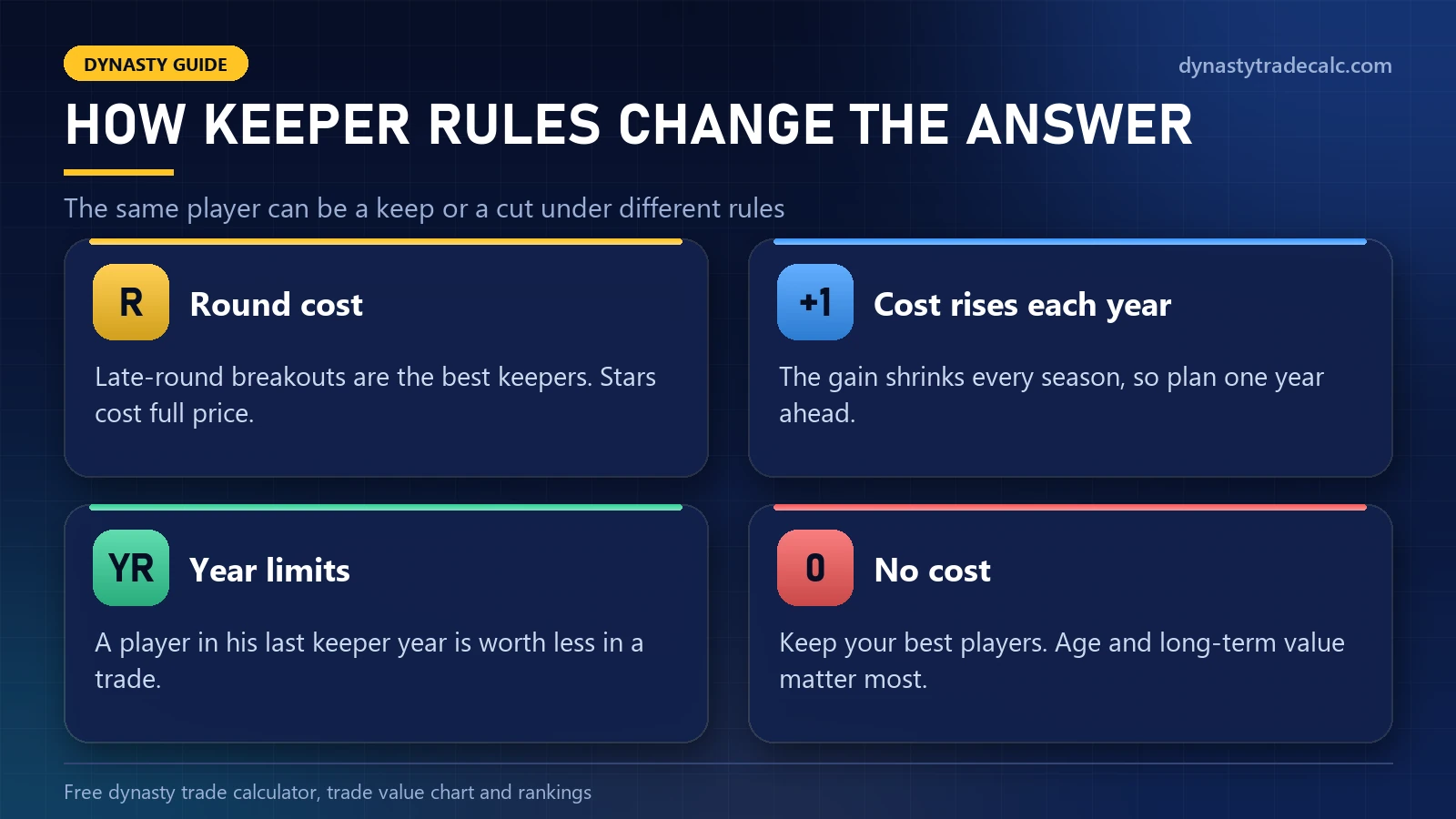
- Round cost. Players drafted late who broke out are the most valuable keepers.
- Cost that rises each year. The gain shrinks every season, so check next year’s cost as well.
- Year limits. If your league lets you keep a player for only two or three years, his value falls as the limit gets close.
- No cost. With free keepers, keep your best players and give extra weight to age.
Using a Trade Calculator for Keeper Decisions
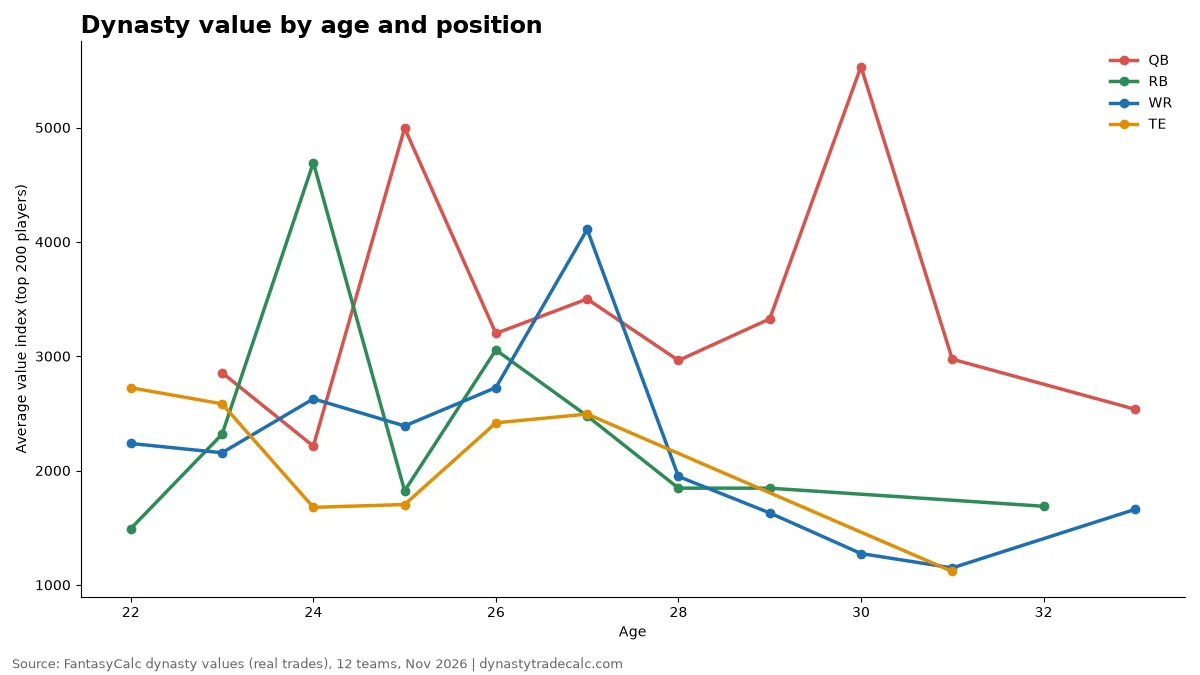
Our free dynasty trade calculator uses dynasty values, which measure several seasons at once. That makes it a useful guide for keeper leagues where you can hold players for more than one year: it shows who is likely to hold value and who is near the end.
It does not know your league’s keeper cost, so use it for the first step only. Find long-term value on the dynasty trade value chart or the dynasty rankings, then apply your keeper cost by hand with the formula above. Pair it with the fantasy keeper calculator formula above for the final call.
Trading for Keepers
Keeper value is tradeable. A team with too many good keepers must throw some back, which makes those players cheap just before the keeper deadline. A team with empty keeper slots can buy them for a mid-round pick. Run both sides through the fantasy keeper calculator method before you deal.
- If you have extra keepers: sell the surplus for picks before the deadline, when they would otherwise leave for nothing.
- If you have empty slots: ask other managers who they must drop.
- Always include the cost. A player with a late-round keeper cost is worth more in a trade than the same player at an early-round cost.
For help judging an offer, see fair trades in fantasy football and our trade calculator for fantasy football guide, which compares redraft, keeper and dynasty leagues.
Common Keeper Mistakes
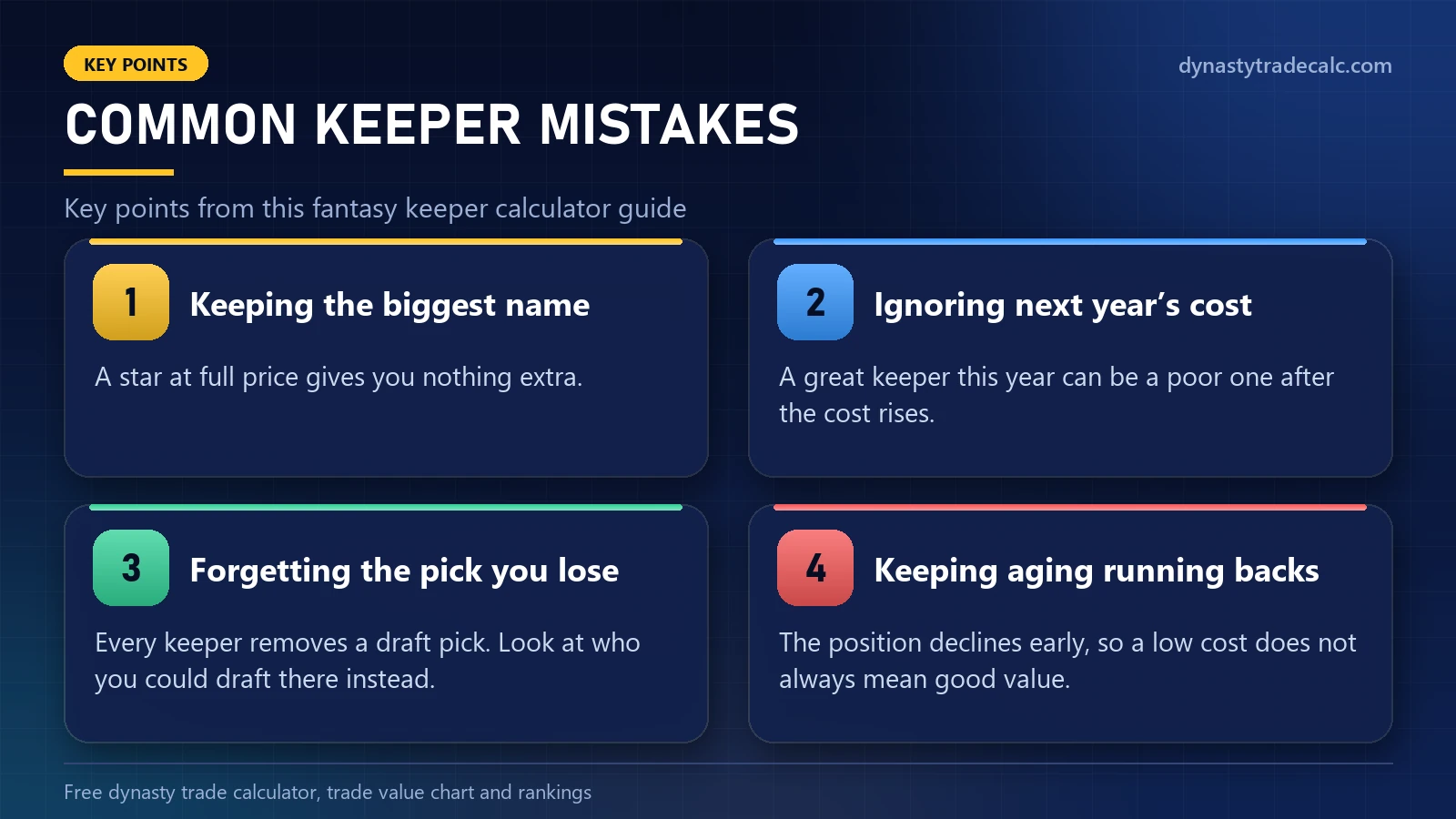
- Keeping the biggest name. A star at full price gives you nothing extra.
- Ignoring next year’s cost. A great keeper this year can be a poor one after the cost rises.
- Forgetting the pick you lose. Every keeper removes a draft pick. Look at who you could draft there instead.
- Keeping aging running backs. The position declines early, so a low cost does not always mean good value.
Worked Trade Example With Real Values
Here is a real trade priced in a 1QB, standard league, 12 teams, with FantasyCalc values from November 2026 (top player = 10,000). Run the same deal in our dynasty trade calculator to see it with your league settings.
| Team A receives | Index | Team B receives | Index |
|---|---|---|---|
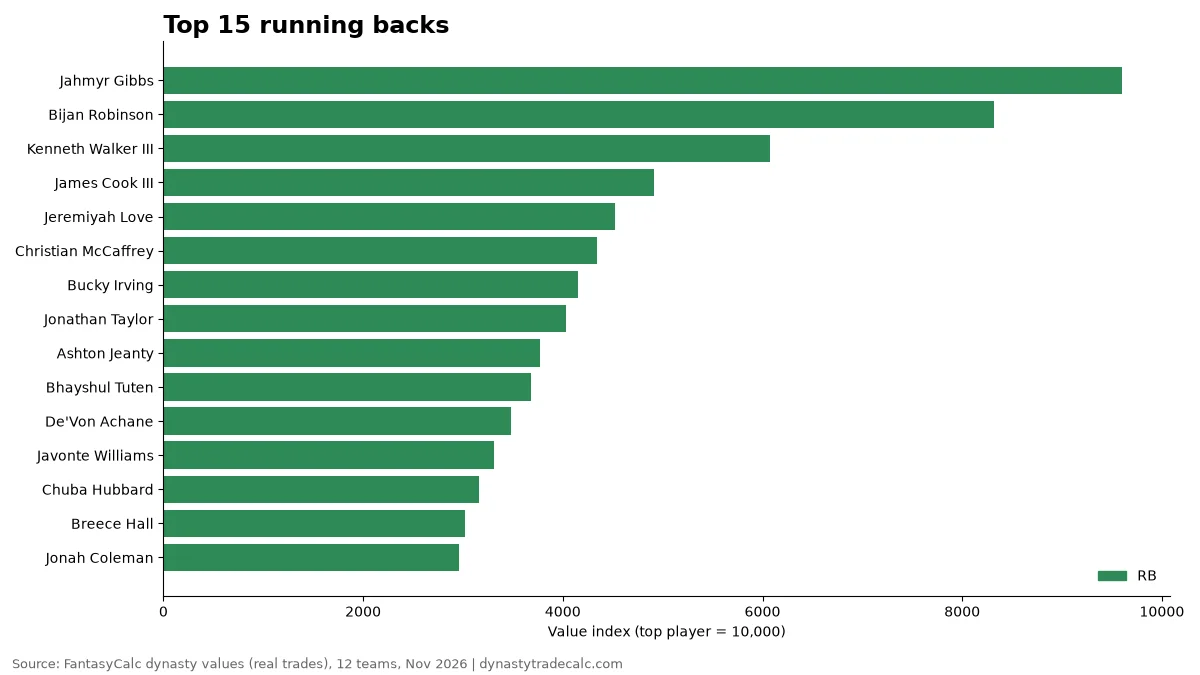
| Ashton Jeanty | 4,138 | Derrick Henry | 2,268 |
| 2027 2nd (Early) | 1,711 | ||
| Total | 4,138 | Total | 3,978 |
Team A gets 4,138 and Team B gets 3,978, a gap of 3.9%. That makes it a fair trade: the gap sits inside 5%, so league needs decide it. In a keeper league the age gap matters even more: you keep Jeanty for years, while Henry helps for about one season. Price the same deal in a Superflex, half-PPR league and Team A gets 3,770 against 4,197 for Team B, a 10% gap in favor of Team B. Same players, different format, different answer: set the format before you judge a trade.
Frequently Asked Questions
What is a fantasy keeper calculator?
A fantasy keeper calculator compares what a player is worth in this year’s draft with what it costs you to keep him. The players with the biggest gain between those two numbers are your best keepers. Our how to trade fantasy football guide covers every step from finding a partner to getting the trade processed.
How do I calculate keeper value in fantasy football?
Take the round your league charges for the keeper and subtract the round where managers would draft the player this year. A ninth-round cost for a third-round player is a gain of six rounds.
Who should I keep in a fantasy football keeper league?
Keep the players who give you the largest gain over their keeper cost, not simply your best players. A star kept at a first-round cost gives you no advantage over drafting him.
Is it worth keeping a player at a first-round cost?
Usually only if he would be one of the first picks in the draft anyway. If his cost equals his draft value there is no gain, and you may prefer the freedom to pick someone else.
Can I use a dynasty trade calculator for a keeper league?
Yes, as a guide to long-term value. A dynasty calculator shows which players hold value across seasons. It does not know your keeper cost, so apply your league’s rule by hand afterward. Our fantasy football trade creator guide covers how to build a balanced offer from your target and your surplus.
How many players can you keep in a keeper league?
It depends on the league. Many keeper leagues allow between one and five players per team. Check your league settings, because the limit changes how valuable each keeper slot is.
What is a fantasy football keeper calculator?
A fantasy football keeper calculator compares a player’s draft value with his keeper cost and shows the gain in rounds. The players with the biggest gain are your best keepers.
Is there a keeper league trade calculator?
Any trade calculator works for keeper leagues if you add the keeper cost by hand. Use a keeper league trade calculator approach: price the player, then subtract the cost of keeping him.
Conclusion
The fantasy keeper calculator method is simple: draft value, minus keeper cost, ranked from the biggest gain down. Run it for every player you could keep, check next year’s cost, and trade the keepers you cannot use before the deadline.
Related Guides
- Trade calculator fantasy football: redraft, keeper and dynasty compared.
- Fair trades in fantasy football: a four-part test for any deal.
- Dynasty rankings: long-term player rankings.
- Dynasty trade value chart: values for every player.
- What is a dynasty trade calculator: how the tool works.
- Redraft Trade Analyzer: a related guide.
Compare With Other Sources
Our values are estimates, not quotes. Before a big trade, compare the same players against KeepTradeCut crowd-sourced dynasty values, FantasyCalc and FantasyPros dynasty rankings. For draft position, check current average draft position on FantasyPros ADP.
