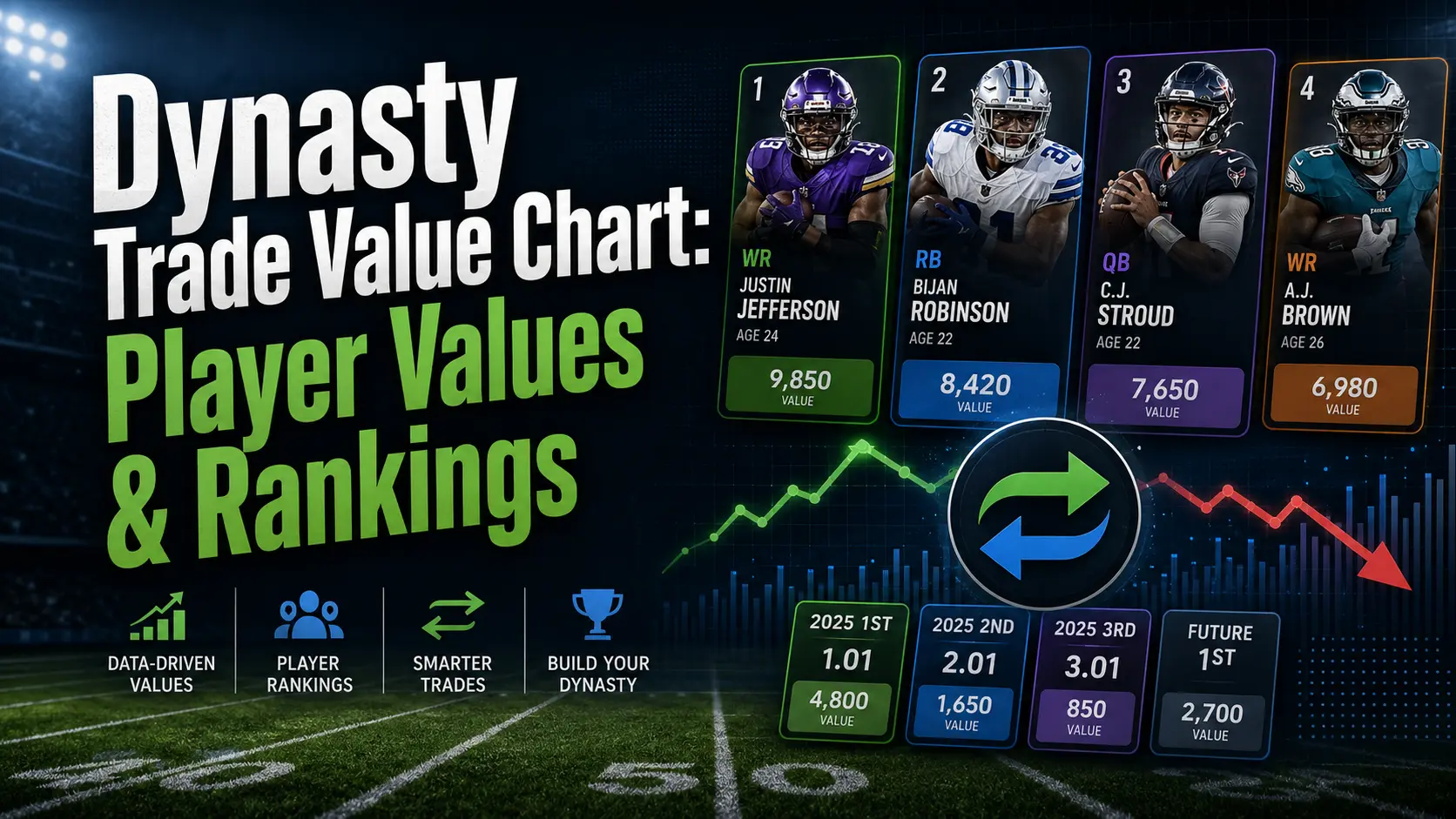
Dynasty Trade Value Chart: Player Values & Rankings
A strong fantasy trade can change your whole season. In dynasty leagues, it can also shape your neDynasty Trade Value Chart: Player Values & Rankings
A strong fantasy trade can change your whole season. In dynasty leagues, it can also shape your next three years. That is why smart managers need more than gut feeling. Instead, you need a clear value system, a calm mind, and a little street smarts.
A dynasty league is not like a redraft league. You do not wipe the board clean every year. Instead, you keep your players, build around youth, chase upside, and manage risk. So a player’s value depends on more than last week’s points. Age, role, contract security, team fit, injury history, and league settings all matter.
This is where a trade chart helps. It gives you a practical way to compare players and rookie picks. Also, it can protect you from emotional trades. We have all seen it. A player scores two touchdowns on Sunday, then half the league treats him like gold by Tuesday.
However, you should never let any chart think for you. Even the sharpest chart cannot see your exact roster plan. Also, it cannot know whether you need a title push today or a rebuild tomorrow. Use the chart as your map. Then use your brain as the steering wheel.
For deeper market checks, you can compare public values from FantasyPros, DraftSharks, and Sleeper scoring guides. These sources help you see how the larger fantasy market moves.
“A good dynasty trade is not always equal today. Sometimes it wins because it fits tomorrow.”
What Is a Dynasty Trade Value Chart?
A Dynasty Trade Value Chart is a tool that gives fantasy players and rookie picks a trade number. Then, that number helps you compare both sides of a deal. For example, one elite wide receiver may equal one young running back plus a future first-round pick.
The chart works best when you treat it like a pricing guide. However, it does not make trades for you. It simply shows market weight. In dynasty fantasy football, that matters because player value, rookie picks, and long-term upside move like stocks on Wall Street.
| Asset Type | What It Means | Why It Matters |
|---|---|---|
| Elite young player | A proven star with age on his side | He can anchor your roster for years |
| Productive veteran | A player who scores now | He helps contenders win faster |
| Rookie pick | A future player slot | It gives rebuilders flexibility |
| Depth player | A useful bench piece | He helps during injuries and bye weeks |
| Injured player | A discounted asset | He can become a buy-low target |
A chart also helps you avoid lopsided offers. For example, if one side holds three average players and the other side holds one true star, the numbers may look close. Still, the star side often wins. In dynasty, quality beats clutter more often than managers admit.
How to Use a Dynasty Trade Value Chart for Smarter Trades
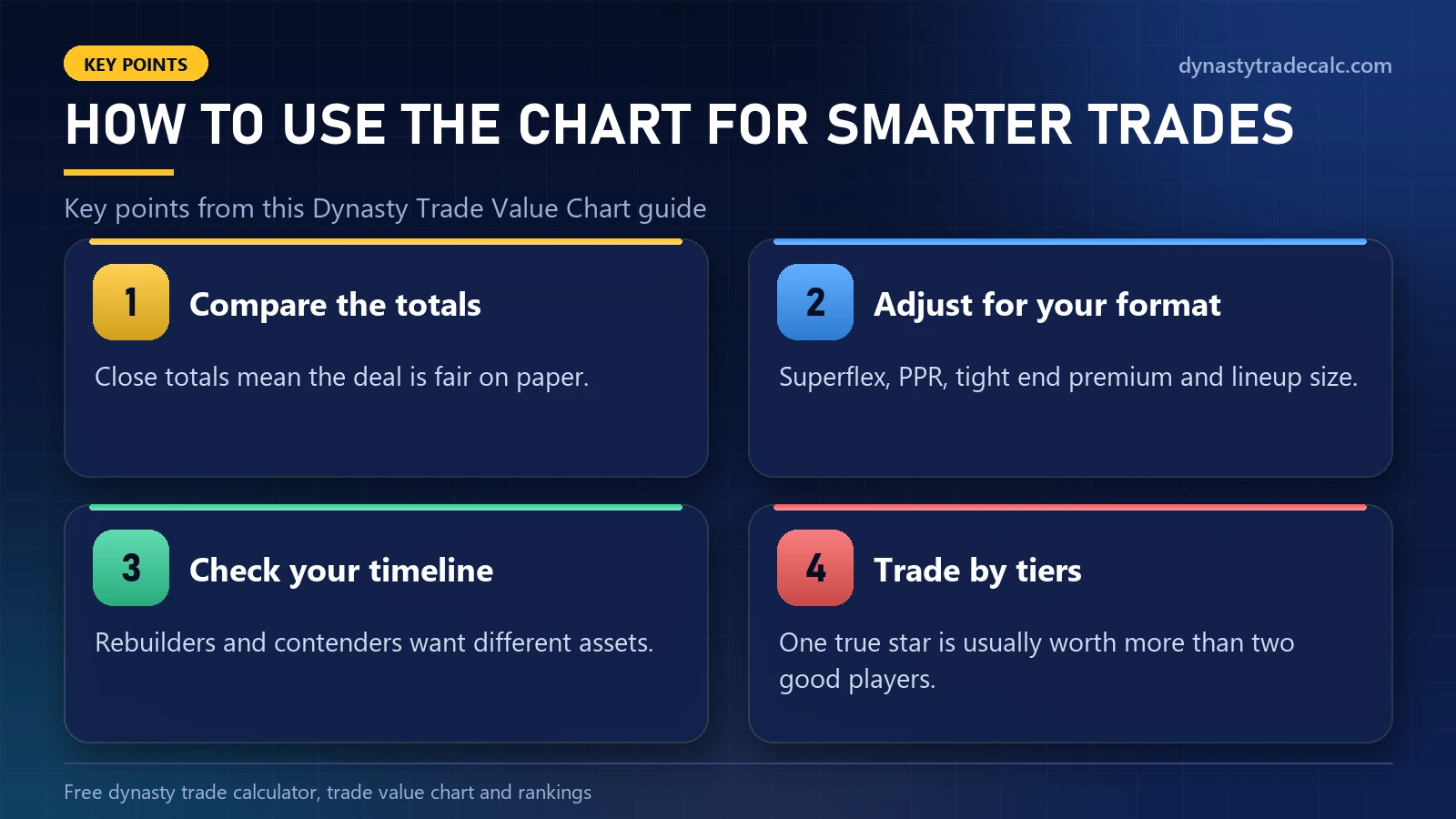
Learning how to use dynasty trade calculator tools starts with context. First, check the value of every player in the deal. Then compare the total values. After that, adjust for your format, lineup size, and team direction. The math starts the conversation. However, it should not end it.
For example, a rebuilding team may trade an older running back for a younger wide receiver and a second-round rookie pick. At first, the trade may look light for this season. However, it may fit the rebuild perfectly. The goal is not to win the trade screen. Instead, the goal is to build a better roster.
| Step | Action | Smart Question |
|---|---|---|
| One | Add player and pick values | Is the offer close on paper? |
| Two | Check your roster timeline | Am I rebuilding or contending? |
| Three | Review league settings | Does this format change the price? |
| Four | Compare positional scarcity | Is this player hard to replace? |
| Five | Make a counteroffer | Can I gain one extra asset? |
A dynasty trade calculator 2026 tool can help you see current market trends. Yet you should still think like a manager, not a machine. If your league overpays for quarterbacks, raise quarterback prices. Likewise, if your league hoards rookie picks, treat picks like premium currency.
Dynasty Trade Value Chart: Quarterback Rankings
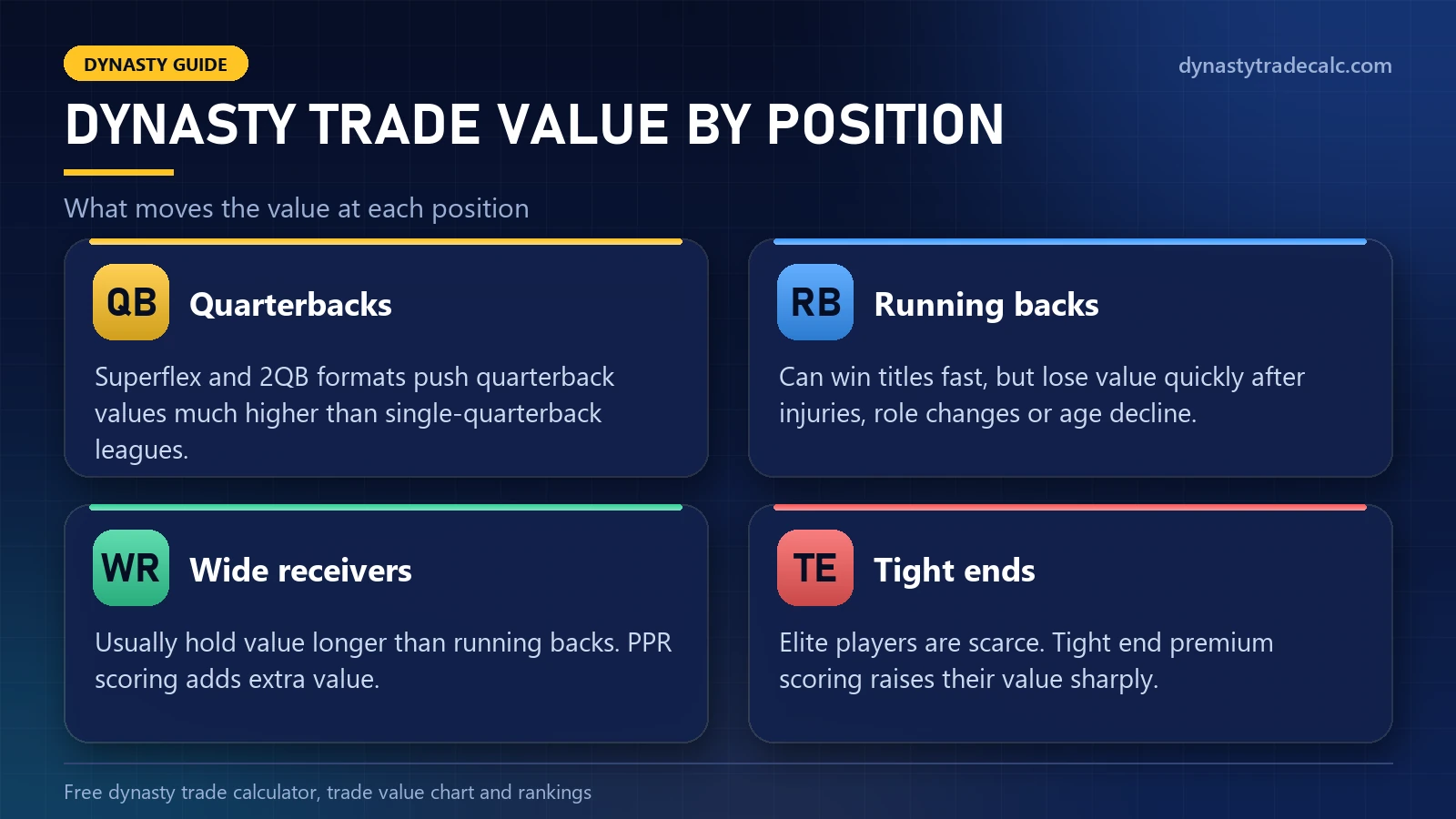
Quarterbacks carry different values in different leagues. In a single-quarterback format, many managers can find decent starters. However, in superflex, the position becomes a treasure chest. That is why dynasty trade calculator superflex values usually push quarterbacks much higher than standard formats.
In a superflex league, a stable young quarterback can be worth more than almost any running back. This is especially true when he has rushing upside. After all, a passer who gives you 250 yards, two touchdowns, and rushing points can swing matchups like a hammer.
| Quarterback Tier | Player Profile | Trade Meaning |
|---|---|---|
| Elite cornerstone | Young QB with rushing or elite passing ceiling | Very expensive in superflex |
| Strong QB1 | Safe starter with top-eight upside | Worth premium players or picks |
| Upside QB2 | Young starter with growth path | Great target before a breakout |
| Veteran QB2 | Older starter with stable role | Useful for contenders |
| Risky starter | Unclear job security | Buy only at a discount |
In dynasty trade calculator 2 qb formats, quarterbacks become even more valuable. Two-quarterback leagues create real scarcity because every team needs multiple starters. Meanwhile, in dynasty trade calculator 1 qb leagues, you should avoid overpaying unless the quarterback is truly elite.
Why Superflex Changes Quarterback Value
Superflex changes everything because it lets you start a quarterback in the flex spot. Since quarterbacks usually score more than running backs, wide receivers, and tight ends, the extra QB slot creates a huge edge. Therefore, one-QB prices and superflex prices should never look the same.
Dynasty Trade Value Chart: Running Back Rankings
Running backs are exciting, dangerous, and sometimes heartbreaking. They can win championships fast. However, they can also lose value quickly after injuries, role changes, or age decline. That makes running back trading one of the trickiest parts of dynasty fantasy football.
A young workhorse back with receiving work carries huge value. Still, you should be careful when paying peak prices. Running backs take heavy contact. Because of that, their fantasy window can be shorter than wide receivers and quarterbacks. So timing matters more at this position.
| Running Back Tier | Player Profile | Best Team Fit |
|---|---|---|
| Elite RB1 | Young back with rushing and receiving role | Any team |
| Productive RB1 | Proven scorer with strong workload | Contender |
| Upside RB2 | Young back with path to more touches | Rebuilder or contender |
| Veteran producer | Older back with weekly volume | Contender only |
| Handcuff | Backup with injury upside | Deep benches |
A dynasty trade value calculator free tool can help you avoid emotional running back deals. For example, do not sell a young back after one bad game. Also, do not buy an older back after one monster week unless your team can truly win now.
When to Buy Running Backs
Buy running backs when your roster is close to a title. They are like rocket fuel. However, you do not store rocket fuel forever. You use it when launch day arrives. If your roster is still two years away, invest more in receivers, quarterbacks, and picks.
Dynasty Trade Value Chart: Wide Receiver Rankings
Wide receivers often make the safest dynasty anchors. They usually hold value longer than running backs. Also, they depend less on weekly touches and more on skill, target share, route quality, and quarterback connection. That gives strong receivers a longer runway.
A young alpha receiver can help every roster type. Rebuilders love him because he fits the future. Meanwhile, contenders love him because he scores now. This is why elite wide receivers often cost a fortune in trade talks. The market knows they last.
| Wide Receiver Tier | Player Profile | Trade Meaning |
|---|---|---|
| Elite WR1 | Young target monster | Cornerstone asset |
| High-end WR2 | Productive player with stable role | Strong trade target |
| Upside WR3 | Young player with breakout signs | Smart buy-low option |
| Veteran scorer | Older player with weekly volume | Best for contenders |
| Boom-bust option | Big-play player with uneven targets | Risky but useful |
In dynasty trade calculator ppr formats, receivers can gain extra value because catches matter. For example, a slot receiver with ten targets may outscore a deep threat with three targets. That small scoring rule can change your whole trade board.
Why Target Share Matters
Target share shows how much a passing offense trusts a player. A receiver with steady targets can survive quiet touchdown weeks. Also, that matters in dynasty because touchdowns can wobble. Targets are usually a better signal of long-term fantasy value.
Dynasty Trade Value Chart: Tight End Rankings
Tight end can feel like a weekly guessing game. Some managers stream the position. Meanwhile, others chase one elite player and enjoy the edge. In dynasty, elite tight ends matter because very few players at the position earn steady targets every week.
A top tight end can separate your team from the pack. This is even more true in tight end premium leagues. In those formats, catches by tight ends earn extra points. Suddenly, a high-volume tight end becomes a weekly cheat code.
| Tight End Tier | Player Profile | Trade Meaning |
|---|---|---|
| Elite TE | Heavy target role and youth | Premium asset |
| Strong TE1 | Reliable starter with touchdown upside | Useful for contenders |
| Upside TE2 | Young player with athletic traits | Good stash |
| Veteran TE | Older starter with short-term role | Cheap production |
| Streamer | Low target player | Easy to replace |
Before you pay for a tight end, check the scoring rules. In standard formats, the gap between tight ends may not justify a massive trade. However, in premium formats, that gap can grow quickly. League settings turn ordinary prices into strange little puzzles.
Tight End Premium Impact
Tight end premium scoring gives extra points for tight end receptions. As a result, this can raise elite tight end values sharply. A player with seven catches can suddenly score like a strong wide receiver. That makes the position more important in trade calculators.
Rookie Draft Pick Values in Dynasty Leagues
Rookie picks are hope with a jersey number. Every offseason, managers fall in love with picks because nobody has failed yet. The mystery creates excitement. However, not every rookie becomes a star. Some become role players. Others vanish like socks in a dryer.
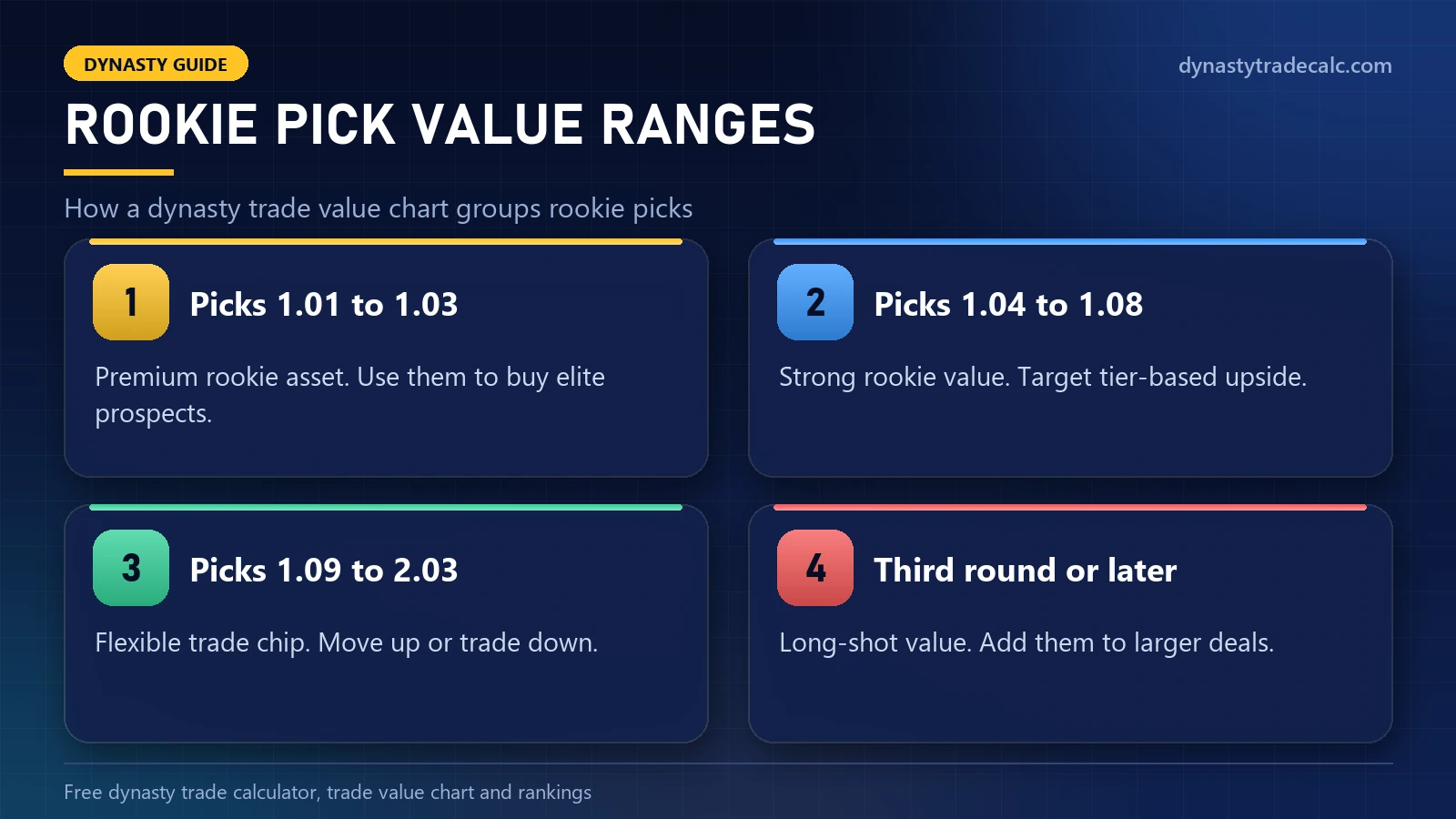
A dynasty trade calculator rookie picks feature helps you price firsts, seconds, thirds, and future selections. Early first-round picks carry the most value because they offer access to elite prospects. Later picks still matter, but they work best as throw-ins or upside swings.
| Rookie Pick Range | Common Market Value | Smart Use |
|---|---|---|
| 1.01 to 1.03 | Premium rookie asset | Buy elite prospects |
| 1.04 to 1.08 | Strong rookie value | Target tier-based upside |
| 1.09 to 2.03 | Flexible trade chip | Move up or trade down |
| Mid second | Risk and reward zone | Chase opportunity |
| Third round or later | Long-shot value | Add to larger deals |
Rookie picks gain value near rookie draft season. At that point, managers watch highlights, read reports, and imagine perfect outcomes. Because of that, you can often sell picks for more during peak hype. That is not cheating. That is just good timing.
Future Picks vs Current Players
Future picks give you flexibility. Current players give you points. Therefore, if you need wins now, a veteran may help more than a 2027 second-round pick. If your team is rebuilding, picks may offer better long-term upside and trade liquidity.
Player Age, Upside, and Risk Factors That Affect Trade Value
Age shapes dynasty value, but it does not tell the whole story. A 25-year-old bench player is not better than a 29-year-old star just because he is younger. Instead, you need age, role, talent, and opportunity together. One piece alone can fool you.
Upside also needs proof. A fast player still needs snaps. Likewise, a tall receiver still needs targets. A young running back still needs touches. Before you buy a dream, check the depth chart, coaching staff, offensive line, injury history, and contract situation.
| Risk Factor | Why It Matters | What You Should Do |
|---|---|---|
| Age | Older players can lose value faster | Match age to team timeline |
| Injury history | Repeated injuries raise risk | Demand a discount |
| Role change | New coaches can alter usage | Watch offseason reports |
| Contract status | Free agency can change opportunity | Check team control |
| Target or touch share | Volume drives fantasy points | Favor steady usage |
A trade chart can miss soft signals. For example, a player may hold high value even though his role is quietly shrinking. Meanwhile, another player may sit cheap while his opportunity grows. These hidden details create trade profit for managers who pay attention.
Best Dynasty Trade Strategies for Rebuilding and Contending Teams
Your team direction should guide every move. A rebuilding team should not chase short-term points. Instead, it should collect young players, rookie picks, and value that can grow. Think of it like planting trees. You will not sit in the shade tomorrow, but future you will smile.
A contending team should do the opposite. If you can win now, buy points. Trade some future value for stable starters. However, do not burn your whole future for one aging player. A title window matters. Reckless trading still leaves a mess.
| Team Type | Best Trade Target | Main Goal |
|---|---|---|
| Rebuilder | Young receivers and rookie picks | Grow future value |
| Contender | Productive veterans and elite RBs | Win this season |
| Middle roster | Tier-up players | Escape the middle |
| Deep roster | Consolidation trades | Turn depth into stars |
| Thin roster | Multiple usable assets | Add weekly stability |
The best dynasty trade calculator will not know your league psychology. Some leagues love rookies. Other leagues overpay for names. Meanwhile, some managers fear older players too much. Learn those habits. Then use them like a quiet advantage.
Case Study: Rebuild Trade
Imagine you roster an older running back who still scores well. Your team sits near the bottom. Then a contender offers a future first and a young receiver. The deal may hurt today. Still, it helps your timeline because the running back may decline before your team is ready.
Case Study: Contender Trade
Now imagine your team leads the league in points. Then you lose a starting running back to injury. Trading a late first for a productive veteran can make sense. That pick may become unknown value. However, the veteran gives you real points during a title run.
Common Mistakes When Using a Dynasty Trade Value Chart
The first mistake is following the chart blindly. A chart may say two sides are equal. Still, your roster may say otherwise. If you already have five good receivers and no running backs, another receiver may not help much. Balance still matters.
The second mistake is ignoring format. A player’s value can change in PPR, superflex, tight end premium, and deeper starting lineups. This is why dynasty trade calculator startup draft settings matter during new league builds. After all, your first draft creates your trade market.
| Mistake | Why It Hurts | Better Move |
|---|---|---|
| Ignoring format | Values change by scoring | Adjust for rules |
| Chasing last week | Small samples mislead managers | Study role and volume |
| Overvaluing depth | Stars win matchups | Consolidate when possible |
| Selling injured stars too cheap | Panic creates losses | Wait for fair value |
| Hoarding picks forever | Picks must become production | Use picks with purpose |
Another common mistake is treating all first-round picks the same. An early first can carry huge value. However, a late first may sit in a weaker tier. Good managers trade by tiers, not labels. “First-round pick” sounds clean, but context adds the real flavor.
FAQs
Good dynasty managers ask better questions. They know trades are not only about names. Instead, they are about timing, format, team direction, and market behavior. These answers will help you use a trade chart with more confidence and less second-guessing.
You do not need to win every deal by a mile. Instead, you need to make trades that fit your plan. If the move helps your roster score more, gain value, or build toward a clear window, you are already ahead of many managers.
What is a dynasty trade value chart?
A dynasty trade value chart is a fantasy football tool that gives values to players and rookie picks. You can use those values to compare trade offers. However, it should not replace your own judgment.
How often should dynasty trade values be updated?
Dynasty values should be updated often. During the NFL season, weekly updates work best. In the offseason, updates matter after free agency, the NFL Draft, rookie drafts, injuries, suspensions, depth chart news, and major coaching changes.
Are dynasty trade value charts useful for superflex leagues?
Yes, they are very useful in superflex leagues. Quarterbacks carry more value because you can start more than one. As a result, quarterback scarcity becomes a major trade factor. Always use superflex settings when your league includes a superflex spot.
Should I trade future rookie picks for veteran players?
You should trade future rookie picks for veterans when your team can win now. A strong veteran can help you chase a title. However, if your roster is rebuilding, keep your picks or trade them for young players with long-term upside.
How do league settings affect dynasty trade value?
League settings change trade value in a big way. PPR boosts pass catchers. Superflex boosts quarterbacks. Also, tight end premium boosts elite tight ends. Deeper starting lineups make depth more useful. Always match your calculator settings to your real league rules.
Final Thoughts
Dynasty trading rewards patience, timing, and clear thinking. The numbers help, but the best managers add context. They know when to buy injury discounts. They know when to sell hype. Also, they know when a “fair” trade still does not fit.
Use charts, calculators, rankings, and market tools together. Then trust your plan. Fantasy football should feel fun, not like tax season with shoulder pads. So make smart deals, stay flexible, and keep building a roster that can win now and later.