

Table of Contents
- What Is a Free Trade Analyzer?
- Why Use One Before Every Trade
- Features to Check
- How to Use a Free Trade Analyzer Step by Step
- Formats That Change the Result
- Free vs Paid Trade Analyzers
- Which Free Tools to Use
- Trade Targets by Team Type
- Case Study: A Rebuilding Team
- Tips for Better Results
- Common Mistakes
- Frequently Asked Questions
- Conclusion
- Related Guides
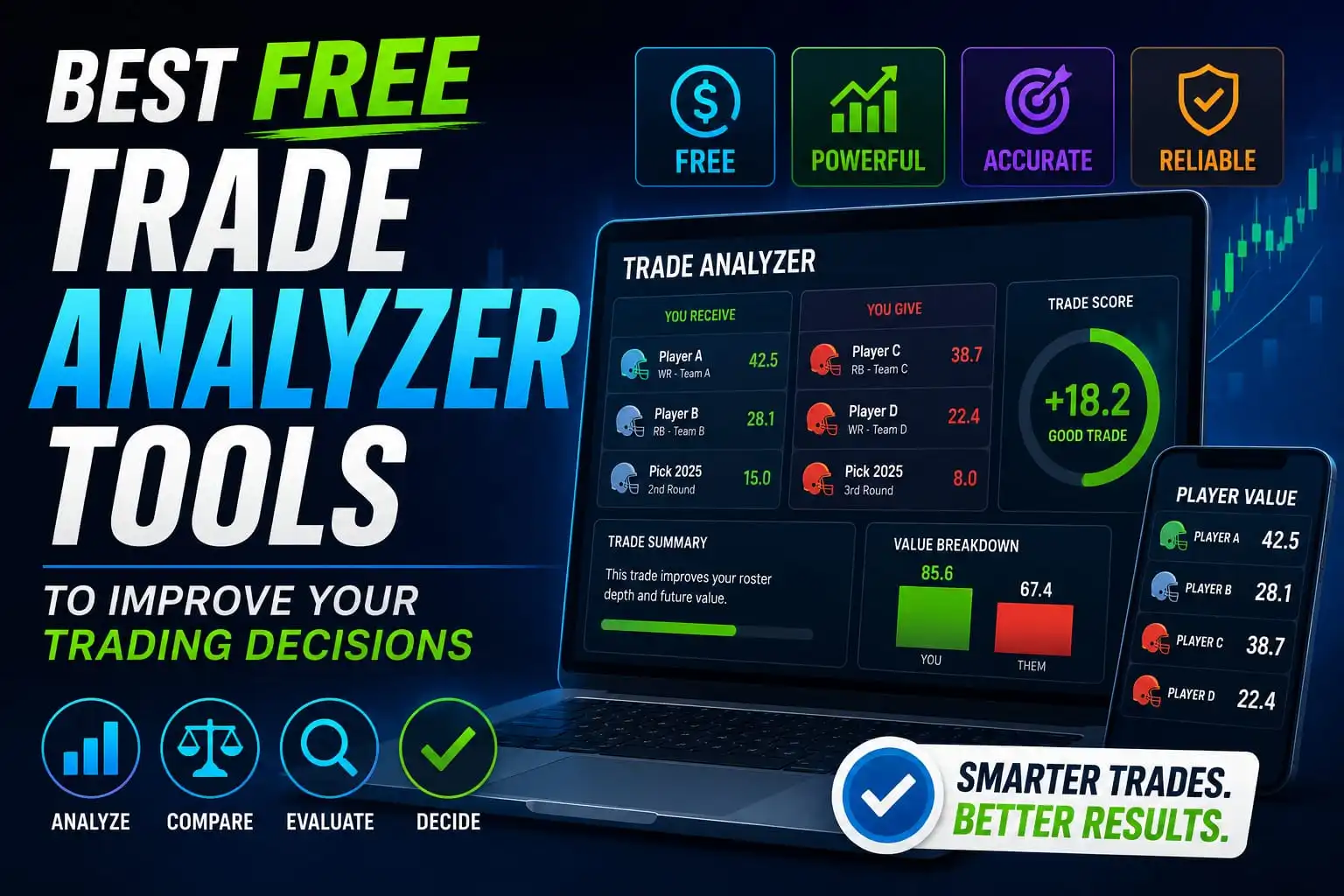
A free trade analyzer compares both sides of a fantasy trade using player values, draft picks, league format and roster needs, without costing you anything. For most managers a free tool is all they need. This guide shows what to look for, how to use one and when a paid tool is worth it.
What Is a Free Trade Analyzer?
It gives every player and pick a value score based on age, production, role and market demand, adds up both sides and shows the gap. It does not make the decision for you; it gives you a neutral second opinion before you accept or send an offer.
Our free dynasty trade calculator works this way for dynasty leagues and needs no account.
Why Use One Before Every Trade
Managers overvalue their own players; that is normal, and everyone does it. A neutral number cuts through that bias and shows where the real value sits. It also speeds up negotiations: when both managers can see the same totals, it is easier to agree on a small add, such as a later pick, to close the gap. Most importantly, it slows you down for a minute before you accept, which is when most bad trades are stopped.
Features to Check
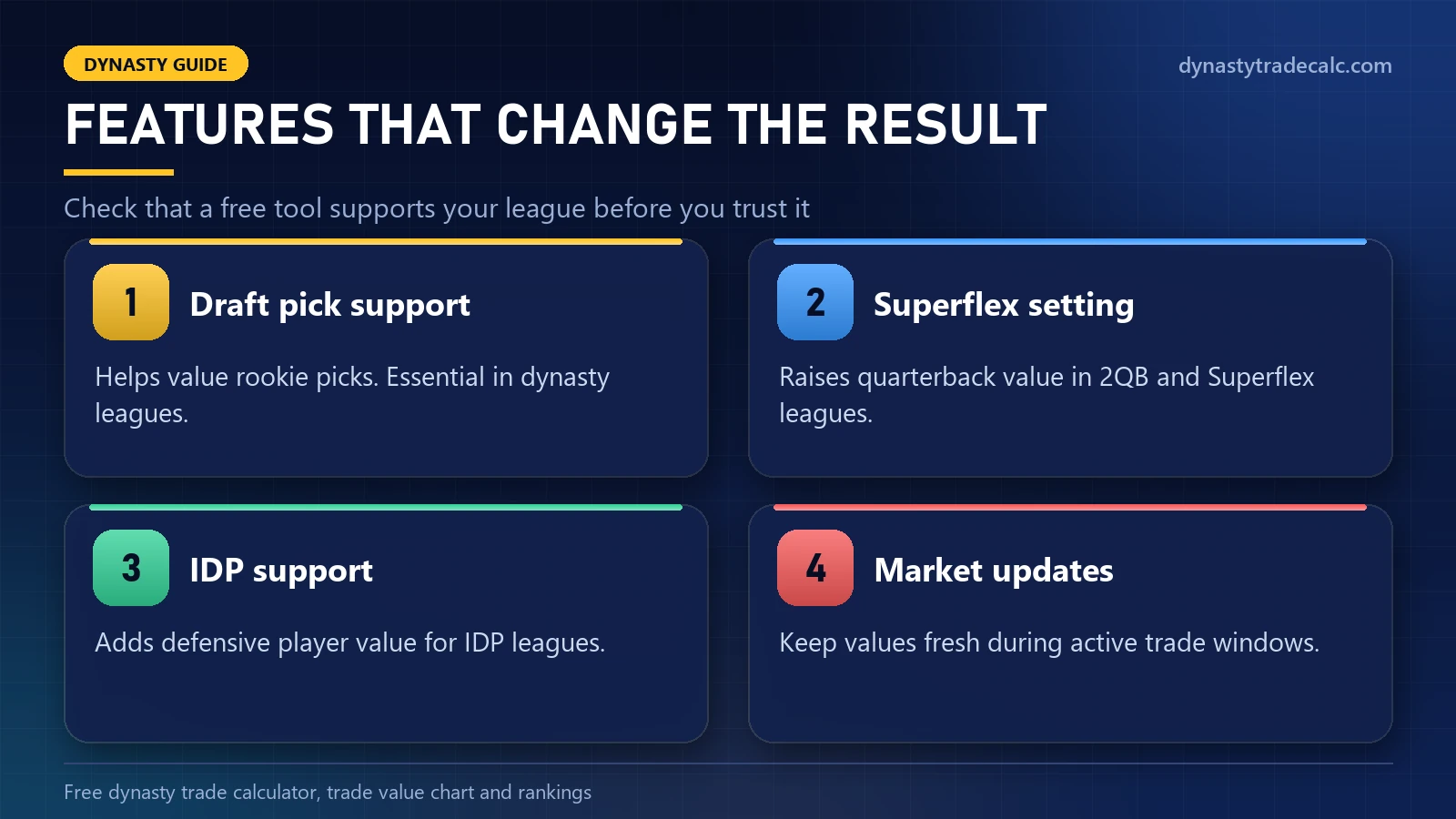
- Draft pick support: rookie and future picks on both sides.
- Superflex and 2QB settings, which change quarterback values the most.
- Scoring options: standard, half-PPR and PPR, plus tight end premium if you use it.
- Multi-player trades with both totals shown.
- A visible update date, so you know the values are current.
How to Use a Free Trade Analyzer Step by Step
- Enter every player in the deal.
- Add every pick, even a third-rounder; small pieces can change the result.
- Set your format and scoring.
- Read the gap between the two totals.
- Check your lineup before you accept or counter.
Formats That Change the Result
A 1QB trade is not the same as a Superflex trade. In Superflex, teams can start two quarterbacks, so even an average starter can be worth a good receiver. Tight end premium leagues give extra points per catch to tight ends, which lifts the few who earn steady targets. Full PPR raises slot receivers and pass-catching backs. Deep leagues with big benches make depth more valuable, because the waiver wire is thin. Set every one of these before you read a total; our Superflex guide and PPR guide explain the biggest two.
Free vs Paid Trade Analyzers
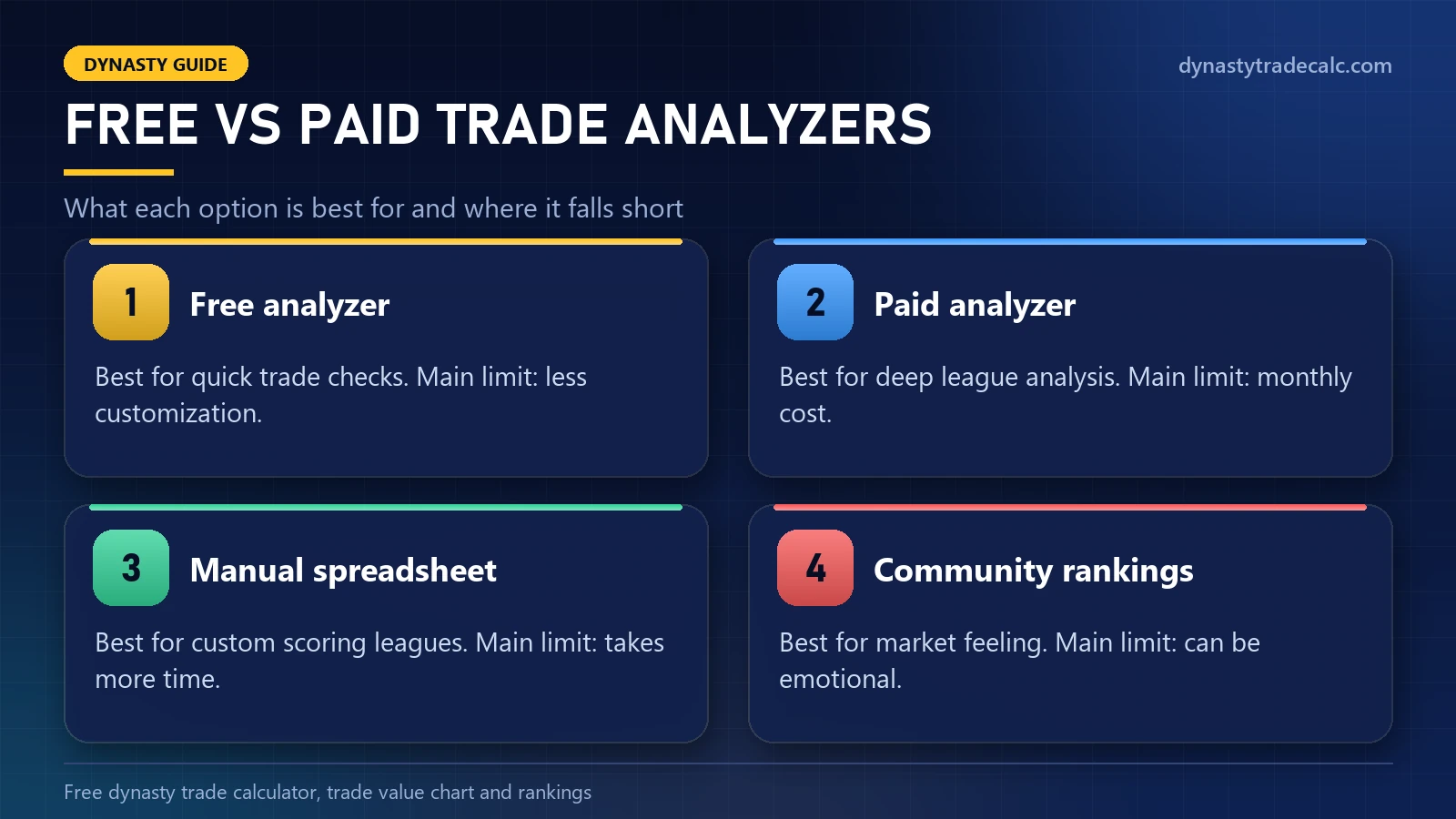
| Option | Best For | Main Limit |
|---|---|---|
| Free analyzer | Quick trade checks | Less customization |
| Paid analyzer | Deep league analysis | Monthly cost |
| Manual spreadsheet | Custom scoring leagues | Takes more time |
| Community rankings | Market feeling | Can be emotional |
| Expert rankings | Player context | May update slower |
A free trade analyzer is enough for quick checks and most normal trades. Paid tools help with league syncing, unusual scoring and deeper reports. Before you pay, check that a free tool already supports your format; if it does, spend the time checking a second free source instead.
Which Free Tools to Use
Different free tools build their values differently. KeepTradeCut crowd-sourced dynasty values reflects crowd opinion, FantasyCalc studies real fantasy trades, and expert rankings such as FantasyPros dynasty rankings follow analysts’ projections. Running one trade through two of them is the simplest way to catch a bad value.
Trade Targets by Team Type
| Team Type | Better Trade Target | Reason |
|---|---|---|
| Rebuilding team | Picks and young players | More future upside |
| Contending team | Proven starters | More weekly points |
| Middle team | Flexible assets | Easier future moves |
| Superflex team | Quarterbacks | Higher format value |
| IDP team | Elite defenders | Positional edge |
Case Study: A Rebuilding Team
You manage a rebuilding dynasty team and receive an offer: an older wide receiver for your young running back and a second-round pick. The veteran may score more this season, and a free trade analyzer may even call the deal close. But your team is not winning this year, so the young back and the pick fit your plan better. Decline, or ask for a younger piece in return.
Tips for Better Results
- Use two tools on big trades. When they disagree, the gap tells you where the market is unsure.
- Check values again after news. Injuries and depth-chart changes move prices within days.
- Count starters, not names. Three bench players rarely equal one weekly starter.
- Price likely offers in advance, so you are not deciding under pressure.
- Keep notes on trades you made and how they worked out, and learn from them.
A calculator should start the conversation, not end it. The number matters, but your roster, your league and your plan matter more.
Common Mistakes
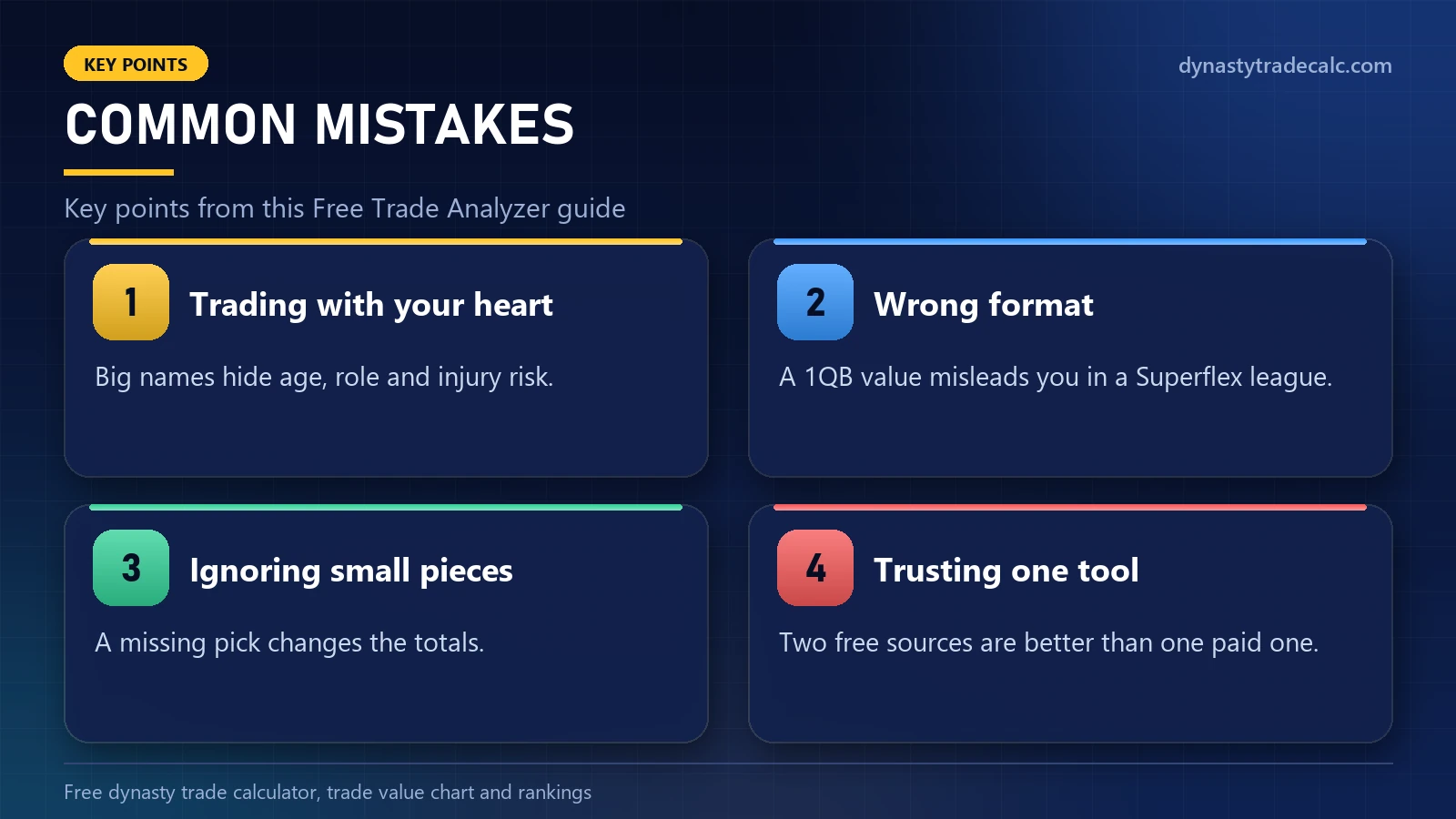
- Trading with your heart. Big names hide age, role and injury risk.
- Wrong format. A 1QB value misleads you in a Superflex league.
- Ignoring small pieces. A missing pick changes the totals.
- Trusting one tool. Two free sources are better than one paid one.
More examples are in the biggest dynasty trade mistakes.
Frequently Asked Questions
What is a free trade analyzer?
It is a free tool that compares both sides of a fantasy trade. It checks player values, draft picks and league format, and the better ones also show how the deal changes your lineup.
Which free trade analyzer is best for dynasty football?
One that supports rookie picks, Superflex and your scoring. KeepTradeCut works well for crowd market values and FantasyCalc studies real trades; our free calculator is a third option.
Do free trade analyzers include draft picks?
Many do. Look for one that supports rookie picks and future picks, because a future first can carry more long-term value than a short-term veteran in a dynasty league.
Should I use free or paid trade tools?
Start with a free one. It is enough for normal trade checks. Paid tools mainly add league syncing, custom scoring and deeper reports, which only matter in unusual leagues.
Why does Superflex change trade values?
Superflex lets teams start two quarterbacks, so steady starters become scarce and much harder to replace. That pushes quarterback values far above their 1QB prices.
Is a free trade analyzer always accurate?
No tool is perfect. Injuries, news and league settings move values quickly, so treat the result as a starting point and check your roster before you accept.
Conclusion
A free trade analyzer gives you numbers, structure and a second opinion at no cost. Pick one that supports your format and picks, check a second free source on big deals and let your roster plan make the final call.
Related Guides
Compare With Other Sources
No single analyzer is definitive. Sanity-check a close call against FantasyPros dynasty rankings and FantasyCalc. You can also run the same trade through our fantasy football trade analyzer.
