Free-Dynasty-Trade-Calculator-Instant-Trade-Values

Free Dynasty Trade Calculator | Instant Trade Values

A Free Dynasty Trade Calculator helps you judge trades before regret enters the room. It compares players through clear numerical values. As a result, you can test simple swaps or larger packages. You can also adjust the league format. That matters because one setting can change an asset’s value.

Dynasty football rewards patience and good timing. Every move can affect several future seasons. For example, a productive veteran may help you win now. However, a younger player might offer more long-term value. The right calculator shows that difference without replacing your own judgment.

Many managers search for a fantasy football calculator trade tool after receiving an offer. Meanwhile, others need a trusted fantasy football trade calculator before starting negotiations. Both groups want the same thing. Ultimately, they want a fair reference that turns a complicated deal into understandable information.

“A trade calculator should work like a compass. It should guide your direction without driving the car.”

What Is a Free Dynasty Trade Calculator?

A Free Dynasty Trade Calculator compares the estimated value of players and other dynasty assets. It places each asset on the same numerical scale. Therefore, you can compare both sides of a proposed deal. The final result shows whether one package carries more market value.

Unlike a basic fantasy calculator, a dynasty tool looks beyond one season. It considers age, future opportunity, positional demand, and long-term production. In addition, it may account for league size and scoring. These details make it useful for any serious fantasy football league nfl manager.

A calculator does not declare an official winner. Instead, it gives you a market-based estimate. Your roster still matters. For instance, a rebuilding team may value youth and draft capital. A contender, however, may prefer reliable points during the current season.

Tool purpose | What it helps you understand

Player comparison | Which player carries greater dynasty value

Package analysis | Whether several assets equal one premium player

Format adjustment | How PPR or Superflex settings affect values

Negotiation support | What you could add or remove from an offer

Roster planning | Whether a trade fits your competitive timeline

How Does the Free Dynasty Trade Calculator Work?

A Free Dynasty Trade Calculator assigns a value to each selected player. Next, it totals the assets on both sides. The calculator then compares those totals and displays the difference. In some cases, tools also suggest another asset that could create a more balanced offer.

Trade values usually come from rankings, projections, market activity, or several combined models. For example, KeepTradeCut uses crowdsourced player and pick values. Meanwhile, FantasyCalc creates values from trades completed in real leagues.

Your league settings shape the final numbers. Quarterbacks become more valuable in Superflex formats. Likewise, pass-catching running backs gain value in full PPR. Deep leagues can also increase the value of reliable starters because fewer replacements remain available.

A good trade analyzer dynasty tool performs four connected tasks. First, it gathers current player information. Next, it converts that information into comparable values. Afterward, it adjusts those values for league settings. Finally, it explains the difference between both trade packages.

Input | Why it changes trade value

Dynasty or redraft | Dynasty includes future seasons

League size | Larger leagues create greater scarcity

PPR scoring | Receptions increase value for certain players

Superflex setting | Quarterbacks gain stronger demand

Player age | Younger players may offer longer value windows

Current role | Secure starters usually carry safer value

How to Use the Free Dynasty Trade Calculator Step by Step

Using a Free Dynasty Trade Calculator takes only a few moments. First, choose dynasty mode. Next, select your league size and PPR format. After that, turn on Superflex when your lineup allows another quarterback. Finally, add every player involved in the proposed trade.

After entering both packages, compare their total values. However, do not stop at the first result. Remove one asset and calculate again. Then, add a smaller piece when the gap looks manageable. This process shows which player creates the imbalance and which counteroffer makes sense.

The table below presents a simple workflow. In other words, it replaces guesswork with a repeatable process.

Step | Action | Reason

1 | Match the calculator settings | Incorrect settings create misleading values

2 | Add every involved player | Missing assets distort the comparison

3 | Review the value difference | The gap shows the stronger package

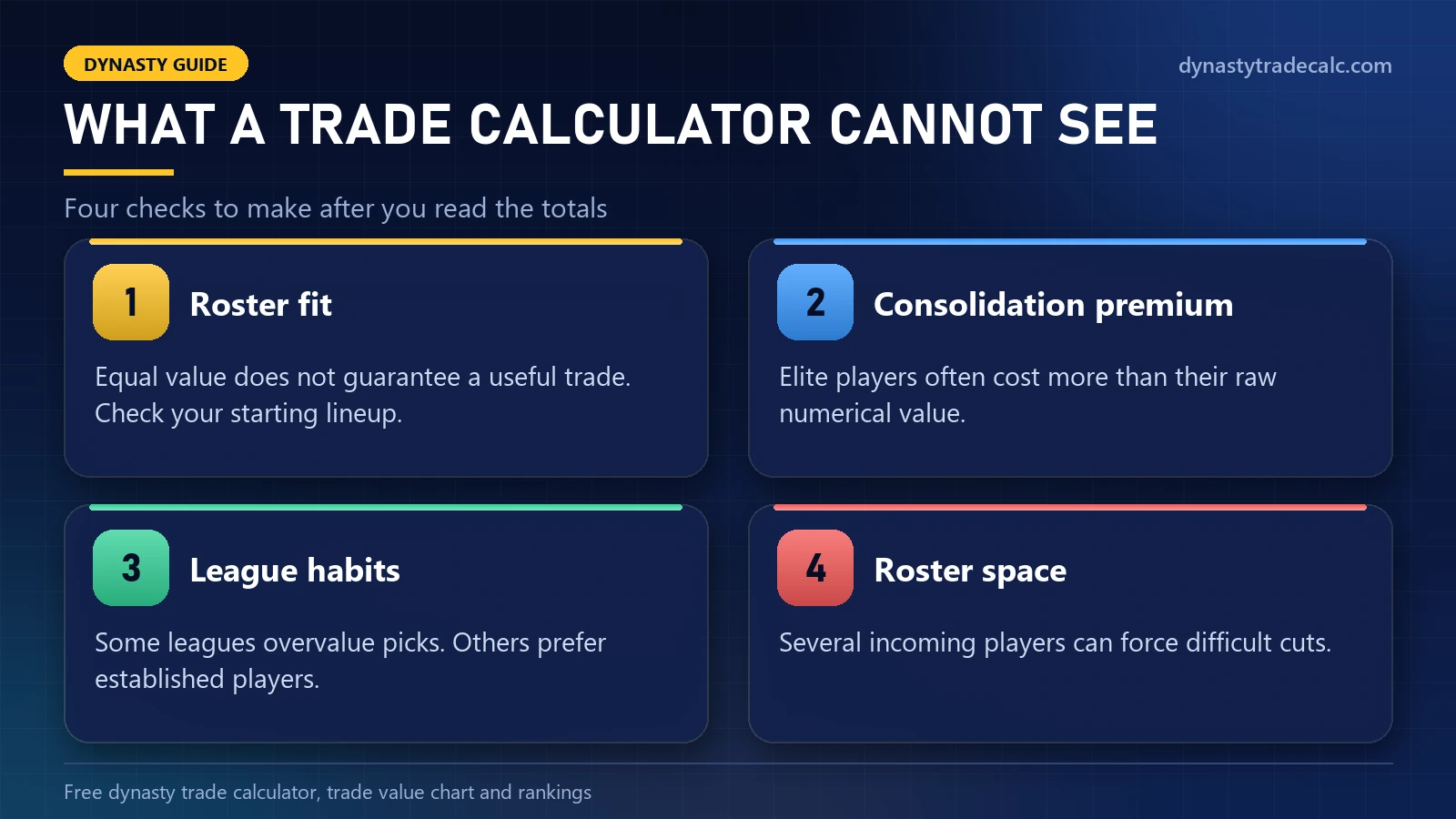
4 | Check your roster needs | Equal value does not guarantee a useful trade

5 | Test a counteroffer | Small changes may improve the deal

6 | Review current NFL news | Injuries and role changes affect market value

7 | Send a clear proposal | Simple offers often receive better responses

For example, imagine that you need a starting wide receiver. The calculator shows equal total value on both sides. However, you would give away your only healthy running back. Although the numbers call the deal fair, your roster construction says otherwise. That second judgment protects your team.

Key Features of Our Free Dynasty Trade Calculator

Our Free Dynasty Trade Calculator gives managers fast trade comparisons without a complicated setup. You can switch between dynasty and redraft values. In addition, you can choose 10-team, 12-team, or 14-team formats. You can also select standard, half-PPR, or full-PPR scoring.

The tool supports Superflex analysis and position filtering. For instance, you can browse quarterbacks, running backs, wide receivers, and tight ends. It allows several players on each side. Moreover, values update immediately after you change the settings or adjust either package.

These features make the tool useful for both new and experienced managers. A beginner can understand a confusing offer. At the same time, an advanced manager can test several counteroffers quickly. The clear display also helps league mates discuss value without turning every disagreement into a courtroom drama.

The trade calculator fantasy football experience should remain simple. A manager should not need a spreadsheet degree. Instead, you should enter the assets, match your format, and review the result. Then, you can spend more time studying your roster and less time wrestling with numbers.

Feature | Practical benefit

Instant calculations | You can review offers quickly

Multiple league sizes | Values better reflect player scarcity

Three PPR options | Pass-catching roles receive proper context

Superflex control | Quarterback values match the lineup format

Multi-player support | Larger trade packages become easier to compare

Position filters | You can locate players more quickly

No account requirement | You can begin without registration

Calculate Player, Rookie Pick, and Multi-Team Trade Values

Player trades look simple until several assets enter the conversation. Three average players may equal one star on paper. Yet, they may not offer equal roster value. The manager receiving the star gains production in one lineup spot. Meanwhile, the other manager must use three roster spaces.

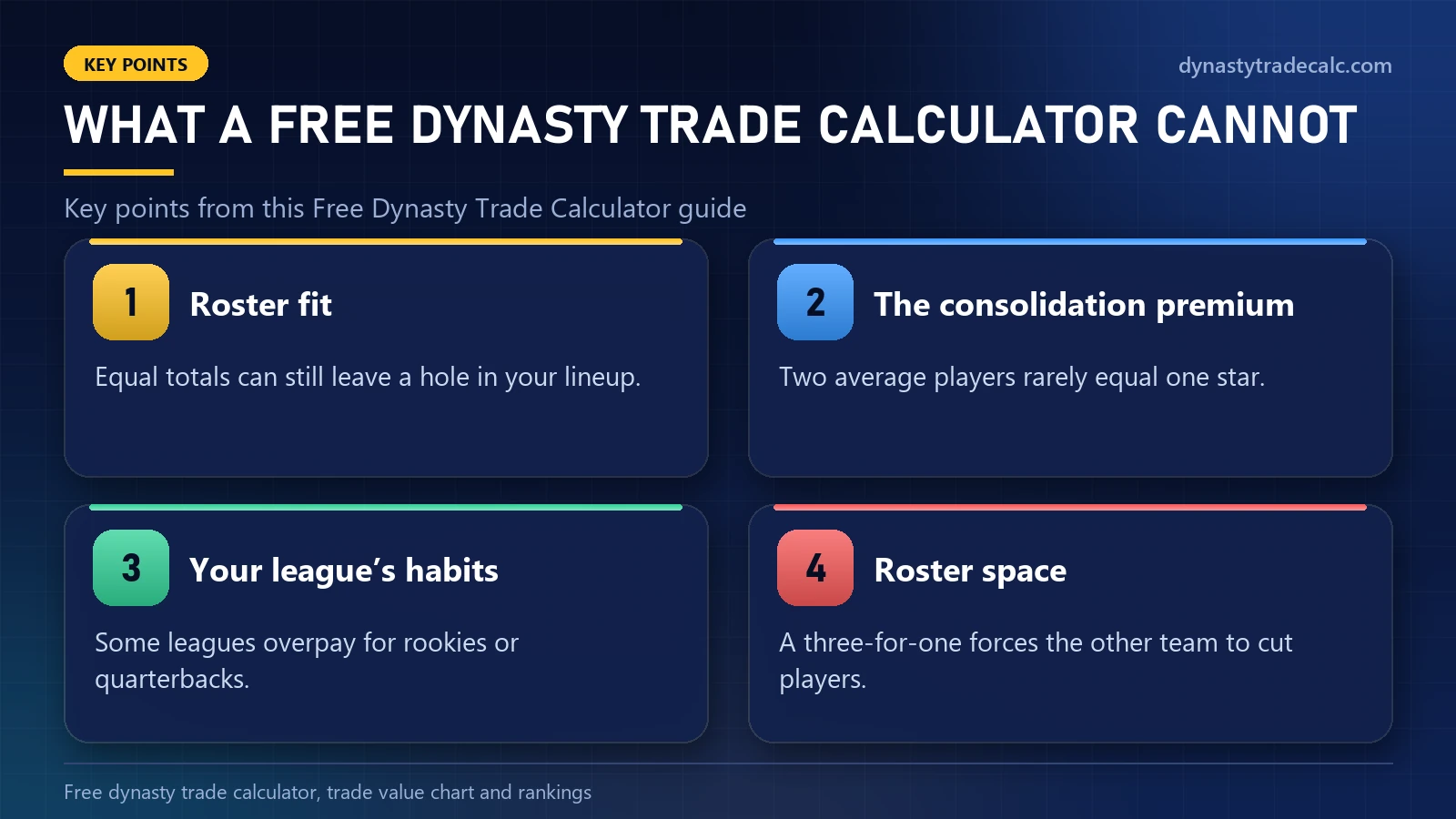
This difference creates a consolidation premium. Elite players often cost more than their raw numerical value. In addition, they provide stronger weekly scoring and simplify lineup choices. Therefore, a two-for-one or three-for-one deal may need an extra asset before the star’s manager accepts.

Rookie picks require a different approach. Their value depends on the projected draft position and class quality. For example, an early first-round pick offers access to stronger prospects. A late first, by comparison, offers fewer choices. However, the exact draft order may remain unknown for months.

You should also consider timing. Future picks often become easier to trade near the rookie draft. At that point, managers can see specific prospects. Naturally, excitement grows fast. A vague future first suddenly becomes a possible quarterback, receiver, or running back with a real name.

The following table shows how managers commonly view different asset types.

Asset type | Main value driver | Major risk

Young established player | Production and long career window | Market price may become expensive

Older veteran | Immediate points | Value may fall quickly

Early rookie pick | Access to premium prospects | The selected prospect can fail

Late rookie pick | Affordable upside | Lower historical success rate

Backup quarterback | Superflex scarcity | Role can disappear

Injured player | Discounted future production | Recovery may take longer than expected

Multiple depth players | Roster flexibility | They may never enter your lineup

Multi-team trades need extra care. First, analyze every side separately. Otherwise, one manager may give fair value while another receives little help. You should also confirm that every participant has enough roster space. After all, a fair package can still create problems when four incoming players force difficult cuts.

Many platforms allow future pick trading in dynasty leagues. For example, Sleeper lets managers trade current and future selections when league settings allow it. Nevertheless, always review ownership carefully. A traded pick follows its original team’s final position.

Why Use a Free Dynasty Trade Calculator Before Making a Trade?

A Free Dynasty Trade Calculator gives you an impartial starting point. Emotions often distort fantasy decisions. You may overvalue a player because you drafted him. Alternatively, you may panic after one poor game. A numerical comparison slows that reaction and adds useful market context.

The tool also improves negotiations. Instead of rejecting an offer without explanation, you can identify the value gap. Then, you can suggest a smaller player or future pick. This approach feels reasonable. More importantly, it keeps trade talks friendly and productive.

Consider a simple case study. Sarah manages a rebuilding roster. She receives an offer containing an older running back for a young receiver. The running back projects for more immediate points. However, the receiver holds stronger long-term value. The calculator reveals that difference.

Sarah rejects the first offer. Afterward, she asks for an additional future pick. The other manager accepts because he wants current production. As a result, both teams improve their chosen timelines. The calculator did not choose the trade. Instead, it simply helped both managers see the cost clearly.

Manager type | Main target | Assets often preferred

Contender | Current weekly points | Productive veterans and reliable starters

Rebuilder | Future value | Young players and draft picks

Balanced roster | Flexibility | Stable players with lasting market demand

Injury-hit roster | Short-term survival | Affordable starters and useful depth

Quarterback-needy Superflex team | Positional security | Starting quarterbacks and strong backups

Good dynasty rankings fantasy football data can support the same decision. Still, rankings show order rather than exact trade balance. A calculator adds numerical distance. Consequently, that distance helps you understand whether two closely ranked players carry similar value.

How Dynasty Player and Draft Pick Values Are Calculated

Dynasty player values begin with projected production. Models estimate future points from usage, efficiency, role, and team context. However, production tells only part of the story. Age and position also affect how long a player may remain useful.

Quarterbacks often hold value longer than running backs. Likewise, wide receivers can maintain strong careers across many seasons. Running backs usually face greater injury risk and shorter peaks. Tight end value, meanwhile, changes with scoring rules and lineup requirements.

Market demand matters too. A player can gain value after a breakout performance. Conversely, his value can fall after an injury or role change. Coaching moves, free agency, and the NFL Draft can shift expectations quickly. Therefore, strong tools update values regularly.

Different websites use different methods. Some depend on expert rankings. Meanwhile, others use community votes. Real-trade models study completed deals. No method captures every league perfectly. However, each method offers another view of the market.

A model may consider this simplified value structure:

Factor | Typical effect on value

Projected points | Raises value when future output looks strong

Age | Rewards longer expected career windows

Position | Reflects scarcity and career length

Opportunity | Measures likely snaps, touches, or targets

Injury history | Adds uncertainty to future projections

Contract and team role | Shows how secure the opportunity may be

League format | Changes positional and scoring demand

Market activity | Reveals what managers currently pay

Draft pick values require probabilities. An early selection has a better chance of producing a high-level player. Yet, no pick guarantees success. Therefore, managers should compare the pick against a range of possible outcomes rather than one favorite prospect.

Strong fantasy football dynasty rankings separate current production from future market value. Meanwhile, fantasy football rankings dynasty data can reveal player tiers. Tiers matter because players inside one tier may offer similar value. Crossing into a higher tier, however, usually costs more.

Free Dynasty Trade Calculator for Superflex and 1QB Leagues

A Free Dynasty Trade Calculator must separate Superflex and 1QB values. The formats create different quarterback markets. In a 1QB league, every team usually starts one passer. Therefore, several playable quarterbacks may remain available through trades or waivers.

Superflex leagues allow a quarterback in an additional flex spot. Most managers start two whenever possible. As a result, demand rises because quarterbacks usually score more than other eligible players. A starting quarterback can therefore become one of the league’s most valuable assets.

This difference affects more than elite quarterbacks. Mid-level starters gain trade value. In addition, young backups become useful speculative assets. Even uncertain quarterbacks may attract interest when several managers lack depth.

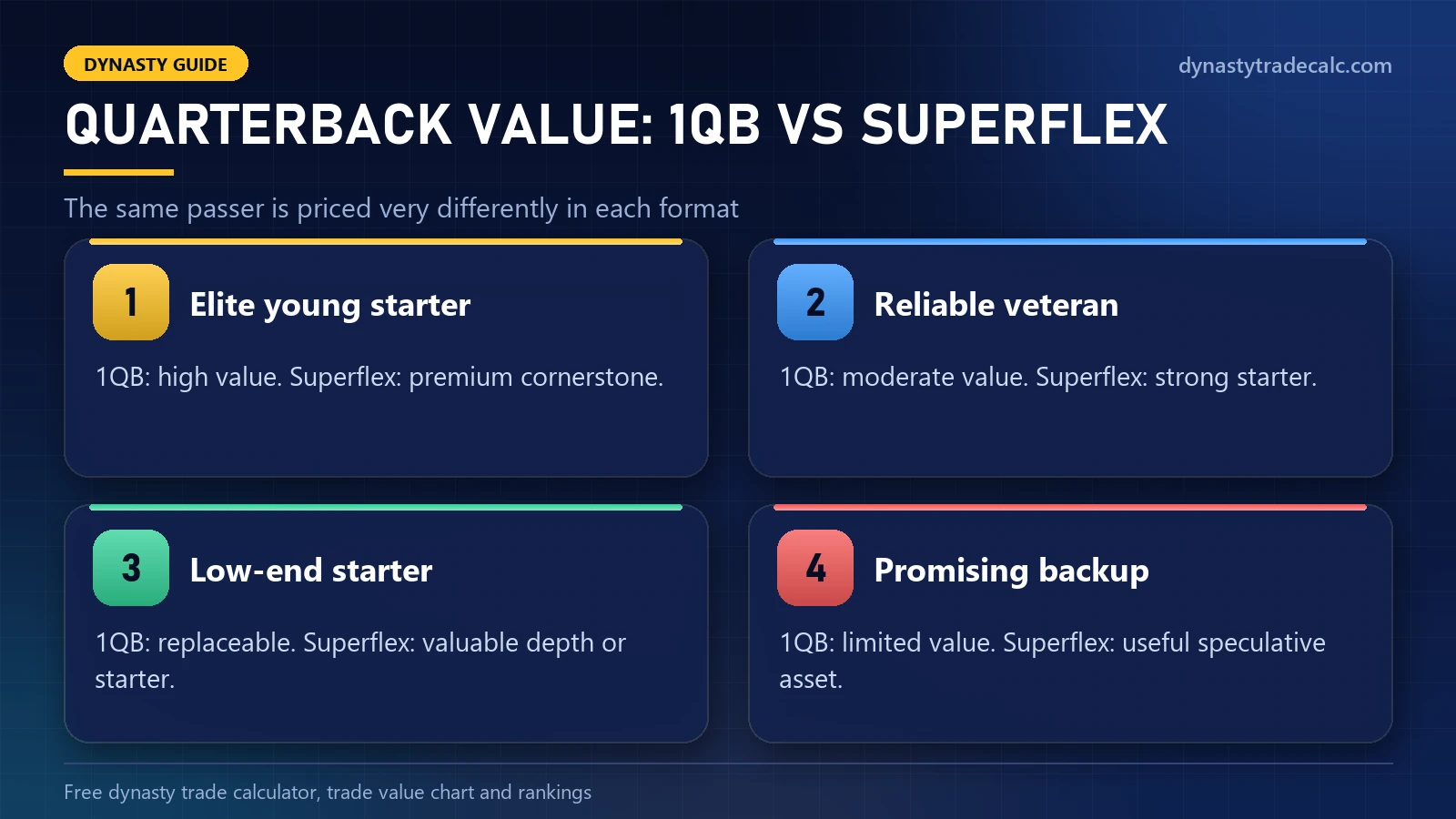
Quarterback type | Typical 1QB value | Typical Superflex value

Elite young starter | High | Premium cornerstone

Reliable veteran | Moderate | Strong starter

Low-end starter | Replaceable | Valuable depth or starter

Promising backup | Limited | Useful speculative asset

Temporary starter | Short-term streamer | Tradable emergency option

In 1QB leagues, wide receivers and running backs often control more trade leverage. Managers can replace average quarterbacks more easily. An elite passer still helps. However, the gap between quarterback tiers may not justify a massive trade price.

Always confirm the setting before using a fantasy football trade calculator. A Superflex value in a 1QB deal can badly mislead you. In other words, it is like using highway speed to judge a parking space. The number may look impressive while missing the real problem.

Common Dynasty Trading Mistakes to Avoid

The first major mistake involves chasing last week’s points. One strong performance can create excitement. Yet, it may not reflect a lasting role. Therefore, check snaps, touches, targets, injuries, and team competition before paying a breakout price.

The second mistake involves ignoring your roster timeline. A rebuilding team should rarely overpay for an aging player. By contrast, a contender should not refuse every veteran because youth looks more exciting. Value matters. Still, usable value matters more.

Managers also make mistakes when they add every asset together equally. Two bench players rarely replace one weekly starter. The calculator may show close totals. However, lineup strength and roster spots can create a hidden difference.

Another mistake involves relying on only one source. Instead, compare the result with recent trades and reliable rankings. Review league behavior too. Some leagues overvalue picks. Other leagues, however, prefer established players. Ultimately, your local market determines what you can actually buy.

Common mistake | Better approach

Reacting to one game | Study role and usage trends

Ignoring league settings | Match every calculator option

Treating all roster spots equally | Pay more for true difference-makers

Forgetting team direction | Trade according to your competitive window

Overvaluing your own players | Compare several neutral sources

Trusting the calculator blindly | Add roster needs and market context

Sending huge opening offers | Start with clear and focused packages

A manager using fantasy football rankings dynasty data should also examine tiers. A small rank difference may mean very little. On the other hand, a large tier break may justify an extra pick. Exact rank numbers can create false precision when the players carry similar expected outcomes.

Frequently Asked Questions About the Free Dynasty Trade Calculator

A Free Dynasty Trade Calculator answers the value question quickly. Still, smart managers usually have follow-up questions. They want to know whether the numbers stay accurate. In addition, they want to understand when they should trust their own judgment.

The answers below cover the most common concerns. They explain accuracy, updates, scoring formats, and rookie picks. Moreover, each answer gives you a practical rule that you can apply during real negotiations.

Is a Fantasy Football Trade Calculator Always Accurate?

No calculator stays perfectly accurate for every league. Values reflect general markets and selected settings. However, your league may value certain positions differently. Therefore, use the result as a baseline. Then, check injuries, roster needs, recent news, and accepted trades before making your final decision.

Can I Use a Trade Calculator for Redraft Leagues?

Yes, but you must choose redraft mode. Redraft values focus on the current season. Dynasty values, however, include future production and long-term market demand. Mixing both formats creates poor comparisons. Therefore, always confirm the selected mode before adding players.

How Often Should I Check Dynasty Trade Values?

Check values after important changes. Injuries, depth-chart moves, free agency, trades, and the NFL Draft can move the market. Generally, weekly checks work during the season. You should also review values before sending or accepting any serious offer.

Are Rookie Picks More Valuable Before the Draft?

Rookie picks often gain demand near the draft. At that point, managers begin studying real prospects. The draft order also becomes clearer. However, value can fall after you use the pick. A flexible selection becomes one specific player with one specific risk profile.

Should I Accept Every Trade the Calculator Calls Fair?

No. A fair total does not guarantee a good roster move. Consider your starting lineup, bench space, team timeline, and positional depth. A calculator measures general value. However, it cannot fully understand your championship chances or your league’s trading habits.

Does PPR Scoring Change Player Trade Values?

Yes. PPR scoring rewards receptions. Therefore, running backs with receiving roles gain value. High-volume wide receivers also benefit. Standard scoring, however, places more weight on yards and touchdowns. Always match your scoring system before using a trade calculator fantasy football tool.

What Is the Best Way to Analyze a Large Trade?

Break the deal into smaller comparisons. First, identify the best asset. Then, evaluate the secondary players and picks. Next, consider roster spaces and lineup impact. Finally, test several versions. This method stops a crowded package from hiding one major value imbalance.

Can a Calculator Help Me Create a Counteroffer?

Yes. First, remove the least useful incoming player. Then, check the value gap again. Afterward, add a smaller asset that fits both teams. A thoughtful counteroffer works better than simply saying no. It keeps the discussion moving and shows that you understand the market.

Final Thoughts on Smarter Dynasty Trading

A dynasty calculator gives you clarity when trade talks become confusing. It translates players into comparable market values. In addition, it helps you test counteroffers. However, the final decision still belongs to you.

Use current values alongside roster context and league behavior. Study your competitive window. Also, check position scarcity and review real trades when possible. Then, choose the package that improves your team rather than the one that merely wins the calculator.

The best managers combine data with judgment. They know when to rebuild and when to push for a title. Furthermore, they understand that every fantasy nfl league develops its own market. Therefore, use the numbers as guidance. Then, make the move that fits your plan.

Similar Posts

Leave a Reply

Your email address will not be published. Required fields are marked *