


Table of Contents
- What Makes the Best Dynasty Trade Calculator?
- How to Use the Best Dynasty Trade Calculator Step by Step
- Set a Buy and Sell Range Before You Trade
- Multi-Player Trades
- Why the Best Dynasty Trade Calculators Disagree
- Free or Paid?
- Common Mistakes With a Trade Calculator
- Two Quick Examples
- Frequently Asked Questions
- Conclusion
- Related Guides
The best dynasty trade calculator is the one that matches your league, includes rookie picks and shows clearly which side of a trade is ahead. This guide explains what to look for, how to use one step by step, how to set a buy and sell range before you negotiate, and why different tools disagree.
What Makes the Best Dynasty Trade Calculator?
A dynasty trade calculator gives every player and pick a long-term value and adds up both sides of a deal. The best dynasty trade calculator for you does that with your own league’s rules, because the same trade can be fair in one format and lopsided in another.
- Your lineup format: 1QB, Superflex or 2QB. Quarterback prices change more than any other position.
- Your scoring: standard, half-PPR or full PPR.
- Rookie picks on both sides, since picks are the easiest way to balance a deal.
- Multi-player trades, because real offers are rarely one-for-one.
- Current values with a visible update date.
Our free dynasty trade calculator covers all five and needs no account. How its values are built is explained on the methodology page.
How to Use the Best Dynasty Trade Calculator Step by Step
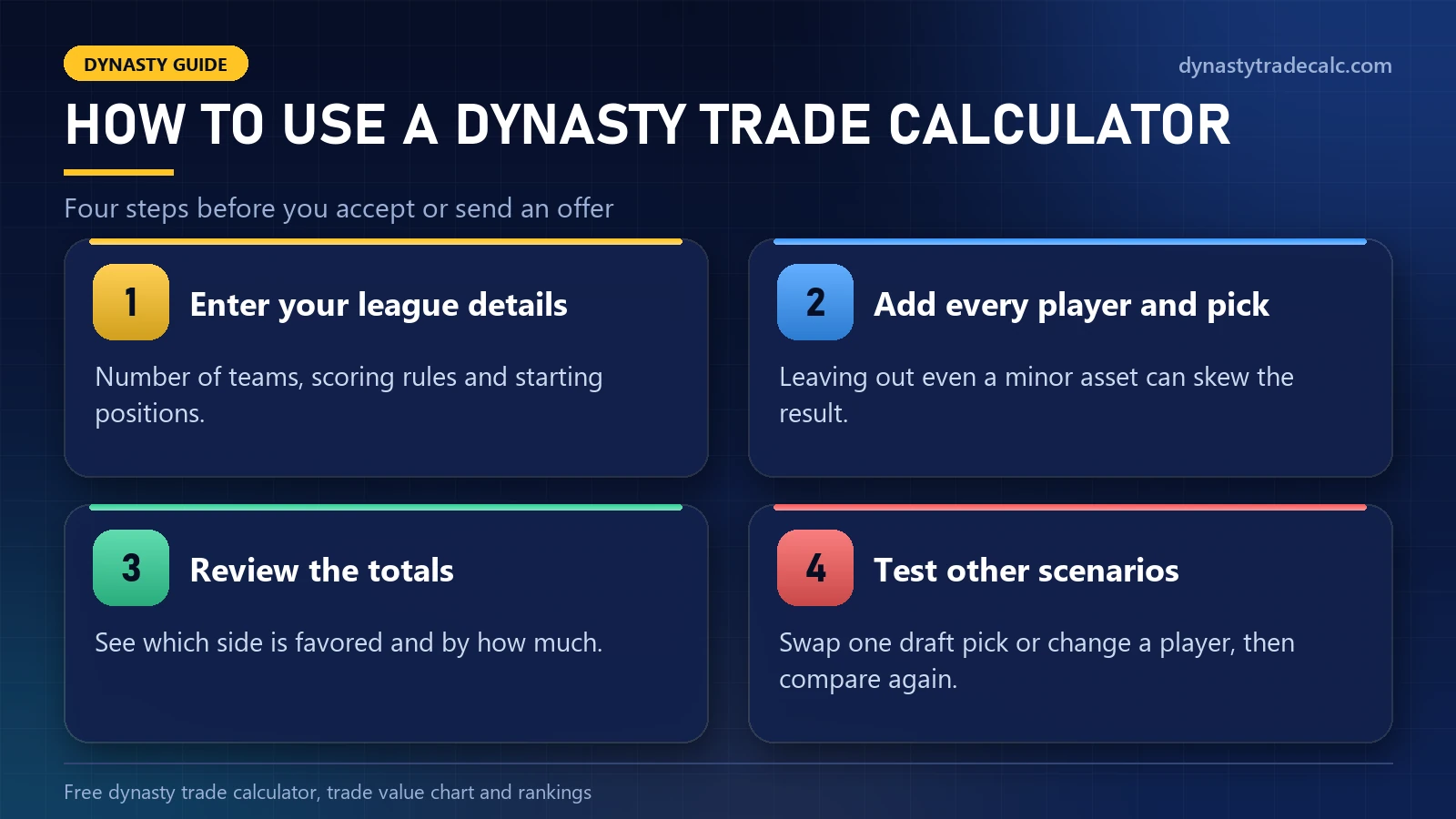
- Enter your league details. Lineup format and scoring come first.
- Add every player and pick. Leaving out one small piece skews the result.
- Read both totals and the gap. A small gap is normal; a large one needs a reason.
- Check your starting lineup. Count how many incoming players would actually start.
- Test a counter. Swap one piece and run the trade again.
Even the best dynasty trade calculator only answers the value question. The full walkthrough is in how to use a dynasty trade calculator.
Set a Buy and Sell Range Before You Trade
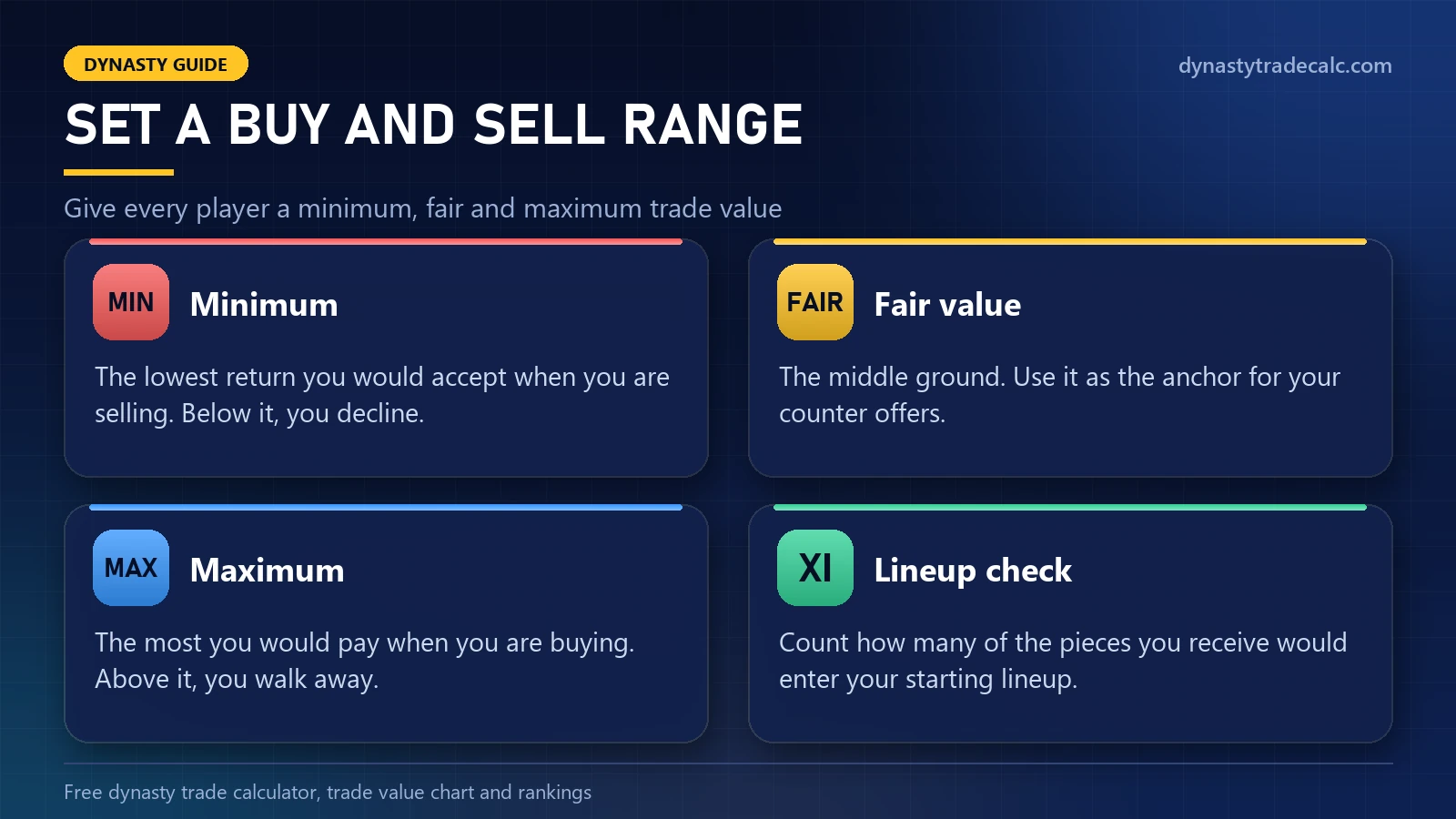
A calculator gives you one number. A range turns that number into a plan you can negotiate with. Before you send or answer an offer, give the main player three values:
| Range | What it means | How to use it |
|---|---|---|
| Minimum | The lowest return you would accept as a seller | Decline offers below it without a long debate |
| Fair | The value you would accept on either side | Use it as the anchor for counter offers |
| Maximum | The most you would pay as a buyer | Walk away when the asking price goes above it |
Run the deal through your main calculator and a second source, note the lower and higher result, and set your range between them. Then you know in advance when to accept, when to counter and when to walk away.
Multi-Player Trades
One-for-one trades are easy to judge. Packages are not. A three-for-two deal might bring two starters and a bench player, while you give up one star and a depth piece. On paper the totals can be close, yet only starters score each week.
A good calculator shows both totals, but you still have to count the lineup. If the side with more players gets no extra starters, the side with the best player usually wins. Two average players rarely equal one star.
Why the Best Dynasty Trade Calculators Disagree
Run one trade through three tools and you will often get three answers. Each site builds its values a different way:
| Value source | How it works | What to watch |
|---|---|---|
| Crowd votes | Many managers rank players against each other | Hype can move values fast |
| Completed trades | Values follow what managers actually paid | Thin data for rarely traded players |
| Expert rankings | Values follow analysts’ long-term projections | Can lag behind sudden news |
When two sources agree, trust the number more. When they disagree by a lot, the player is a buy-low or sell-high candidate worth a closer look. Good second sources are KeepTradeCut crowd-sourced dynasty values and FantasyCalc.
Free or Paid?
For most leagues a free tool is enough to check whether a deal is balanced. Paid tools usually add league syncing, startup simulators or extra scoring options. Those are useful if your league has unusual rules, but they do not make the values more correct. Before you pay, check that the tool supports your lineup format, your scoring and rookie picks, and that it shows when its values were last updated. If a free tool already does that, spend the time checking a second source instead.
Common Mistakes With a Trade Calculator
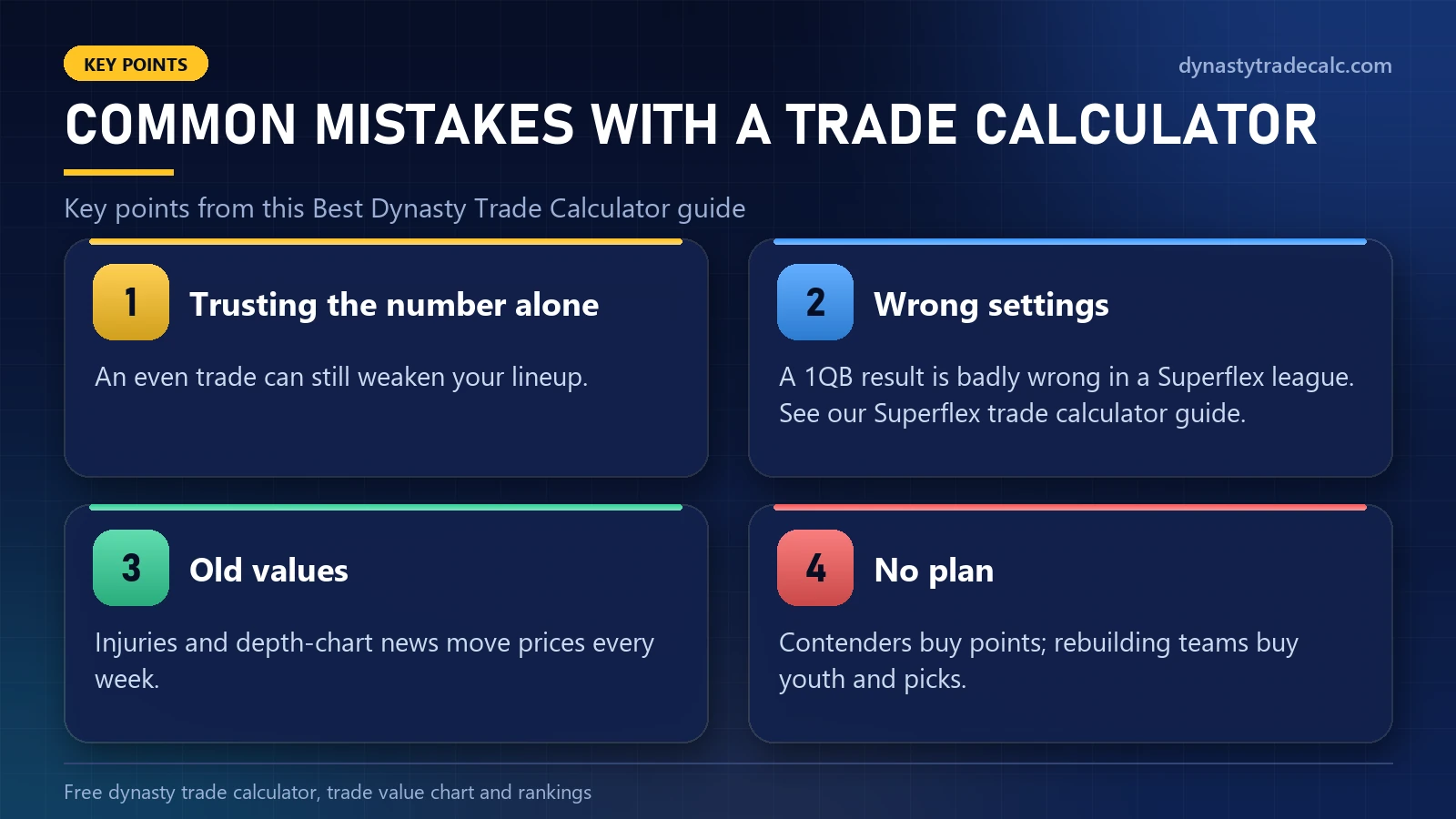
- Trusting the number alone. An even trade can still weaken your lineup.
- Wrong settings. A 1QB result is badly wrong in a Superflex league. See our Superflex trade calculator guide.
- Old values. Injuries and depth-chart news move prices every week.
- No plan. Contenders buy points; rebuilding teams buy youth and picks.
More examples are in the biggest dynasty trade mistakes.
Two Quick Examples
A rebuilding team trades a veteran running back for two young receivers and a future first. The best dynasty trade calculator shows the deal as balanced, and the rebuilder gets younger assets that can grow, so it fits their plan.
A contender trades one elite receiver for three bench players. The totals look even, but only one of the three would start. The hidden cost is a weaker lineup, which is why the count of starters matters as much as the totals.
Frequently Asked Questions
What is the best dynasty trade calculator?
The best dynasty trade calculator is the one that matches your league. It should handle your lineup format and scoring, include rookie picks, keep values current and show both totals clearly.
Is the best dynasty trade calculator free to use?
It can be. The calculator on DynastyTradeCalc is free and needs no account. KeepTradeCut, FantasyCalc and DynastyProcess also have free calculators, each built on a different source of values.
Can I trust a dynasty trade calculator completely?
No. Use the score as a guide, not a final answer. Check injuries, your roster needs, your timeline and how your own league trades before you accept or reject an offer.
How do I set a buy and sell range for a dynasty trade?
Give the main player a minimum, fair and maximum value before you talk. Sell only above your minimum, buy only below your maximum, and use the fair value as the anchor for counter offers.
Which dynasty trade calculator is best for multi-player trades?
Pick one that lets you add several players and picks to each side and shows both totals. Then count how many of the pieces you receive would actually start for you.
Why do dynasty trade calculators give different values?
Each one builds its values differently: some from crowd votes, some from completed trades and some from expert rankings. That is why the same trade can look fair on one site and uneven on another.
Conclusion
The best dynasty trade calculator is the one set up for your league. Enter every player and pick, read the gap, set a buy and sell range, count your starters and check a second source. Do that for every offer and the numbers will work for you instead of against you.
Related Guides
Compare With Other Sources
Our values are estimates, not quotes. It is good practice to compare a trade against KeepTradeCut crowd-sourced dynasty values and FantasyCalc as well. For this season’s values, see our dynasty trade calculator 2026 guide.
