2026 Dynasty Rookie Mock Draft: 1QB & Superflex

Rookie drafts rarely reward the manager holding the longest spreadsheet. Instead, they reward managers who understand player tiers, positional scarcity, and market timing. This guide combines official NFL draft capital with current dynasty rankings to build practical first-round boards for both popular formats.

The landscape starts with Jeremiyah Love, yet it becomes foggy soon afterward. Several wide receivers offer long-term appeal. However, quarterback depth remains shallow. Therefore, you should approach this class like a careful shopper rather than someone grabbing every shiny prospect near the register.

1. 2026 Dynasty Rookie Mock Draft: Class Overview and Early Expectations

Here is the defining feature of this class: elite talent sits near the top. Love headlines the group, followed by Carnell Tate, Jordyn Tyson, and Makai Lemon. Current consensus rankings place those four skill players inside the opening five selections across standard formats.

However, the talent shelf drops sharply during the middle round. That creates a meaningful divide between premium picks and ordinary selections. Draft Sharks also describes the class as top-heavy, particularly after its leading running back and three premier receivers leave the board.

Overall Strength of the 2026 Rookie Class

Think of this group as an excellent appetizer with a thinner main course. The opening tier offers cornerstone potential, first-round NFL capital, and strong market insulation. Nevertheless, managers drafting after 1.08 must accept greater uncertainty regarding opportunity, developmental timelines, or long-term starting ability.

Top Offensive Positions in the 2026 Class

Wide receiver supplies the deepest premium group through Tate, Tyson, Lemon, and KC Concepcion. Meanwhile, running back begins with Love before losing considerable sparkle. Tight end offers intriguing athletes, although Kenyon Sadiq and Eli Stowers may need patience before delivering dependable weekly production.

Class Strengths and Weaknesses

The class brings polished receivers, two athletic tight ends, and one exceptional three-down running back. Conversely, it lacks numerous high-end quarterbacks or deep running-back options. Consequently, late first-round managers should value NFL draft capital more heavily than hopeful depth-chart speculation.

Comparison With the 2025 Rookie Class

The 2025 group provided much greater running-back depth, including numerous middle-round prospects with viable roles. The 2026 class counters with stronger early receiver variety. Still, managers should avoid assuming every draft class offers equal second-round value because this group becomes speculative rather quickly.

2. 2026 Dynasty Rookie Mock Draft Format: 1QB vs Superflex Explained

Format changes everything, especially quarterback value. A 1QB league starts only one passer per roster, which reduces scarcity. Superflex leagues usually allow another quarterback in the flex position. Therefore, reliable starters become precious assets rather than easily replaceable lineup pieces.

This class exaggerates that contrast because Fernando Mendoza owns first-overall NFL capital. Ty Simpson also received a first-round investment from Los Angeles. However, the gap between those quarterbacks remains substantial, which makes disciplined tier-based drafting especially important.

How the 1QB Rookie Draft Format Works

In 1QB leagues, prioritize running backs and receivers during the early selections. Quarterbacks rarely provide enough positional advantage to justify aggressive reaches. For example, Mendoza may last until the closing first-round picks even though Las Vegas selected him first overall.

Why Quarterbacks Matter More in Superflex

A starting quarterback usually offers more predictable weekly volume than an ordinary flex player. Therefore, Superflex managers pay a scarcity tax. Mendoza climbs into the opening tier, while Simpson becomes a late first-round option despite his uncertain timeline behind established veterans.

Player Value Differences Between Both Formats

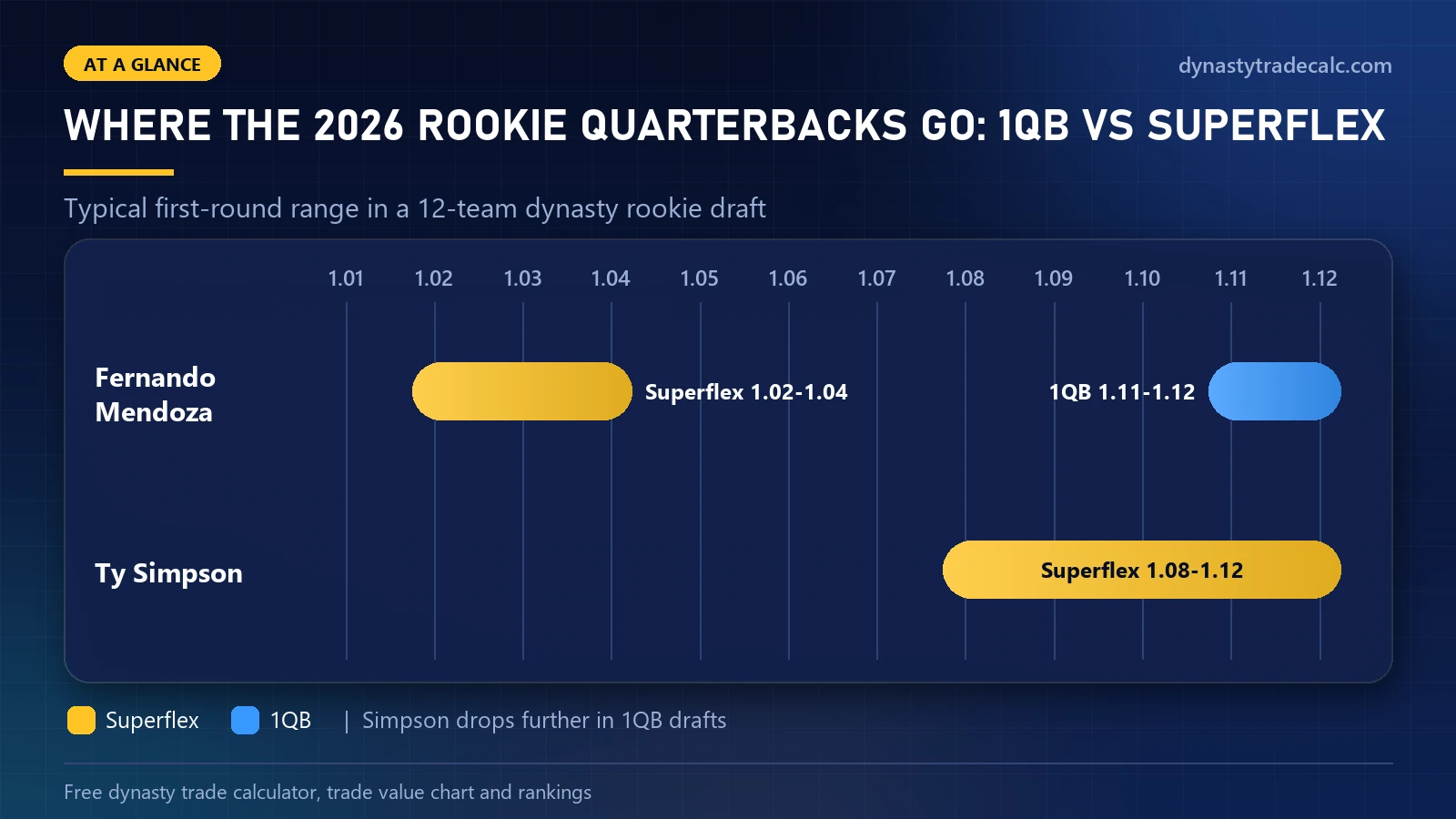
Mendoza represents the clearest value swing. He ranks near 1.02–1.04 in Superflex formats but often falls near 1.11–1.12 in 1QB drafts. Simpson experiences an even greater drop because his developmental profile carries limited appeal when quarterbacks remain available on waivers.

League Size and Scoring Settings

Fourteen-team leagues increase positional scarcity, while six-point passing touchdowns can strengthen quarterback floors. Meanwhile, tight-end premium scoring raises Sadiq and Stowers. Always adjust your board before drafting because a generic ranking cannot measure your exact scoring environment or lineup requirements.

3. 2026 Dynasty Rookie Mock Draft: 1QB First-Round Picks

This board assumes 12 teams, full PPR scoring, and no tight-end premium. Love remains the obvious opening selection. Tate, Tyson, and Lemon follow inside a compact receiver tier, while Concepcion and Jadarian Price begin the second wave.

The later picks require stronger judgment. Sadiq and Stowers offer positional upside, while Omar Cooper Jr. and Denzel Boston carry meaningful NFL investment. Mendoza closes the round because first-overall draft capital still creates valuable job security, even within a shallow quarterback format.

PickPlayerPositionNFL TeamNFL Draft Capital
1.01Jeremiyah LoveRBArizona Cardinals1.03
1.02Carnell TateWRTennessee Titans1.04
1.03Jordyn TysonWRNew Orleans Saints1.08
1.04Makai LemonWRPhiladelphia Eagles1.20
1.05KC ConcepcionWRCleveland Browns1.24
1.06Jadarian PriceRBSeattle Seahawks1.32
1.07Kenyon SadiqTENew York Jets1.16
1.08Eli StowersTEPhiladelphia Eagles2.54
1.09Omar Cooper Jr.WRNew York Jets1.30
1.10Denzel BostonWRCleveland Browns2.39
1.11Germie BernardWRPittsburgh Steelers2.47
1.12Fernando MendozaQBLas Vegas Raiders1.01

2026 1QB Rookie Mock Picks 1.01 to 1.04

Love offers explosive rushing, advanced receiving ability, and top-three NFL capital. Tate brings polish and effortless ball skills. Tyson presents a WR1 ceiling, although injuries add risk. Lemon finishes this tier because his route craft and versatile alignment create a sturdy PPR foundation.

2026 1QB Rookie Mock Picks 1.05 to 1.08

Concepcion wins through sudden separation and creative after-catch ability. Price brings first-round capital, elite vision, and valuable positional scarcity. Sadiq owns the highest tight-end ceiling. Meanwhile, Stowers resembles a large receiver who could eventually become a dangerous seam-running mismatch.

2026 1QB Rookie Mock Picks 1.09 to 1.12

Cooper and Boston offer contrasting profiles. Cooper creates after the catch, while Boston supplies size and boundary potential. Bernard brings versatile route skills. Finally, Mendoza provides uncommon job insulation, although his modest rushing ceiling prevents him from challenging the leading skill players.

Positional Value and Roster Construction

Rebuilding teams should favor receivers because their value windows usually remain open longer. Contenders may prefer Price because productive running backs can immediately alter weekly lineups. However, you should never sacrifice multiple talent tiers merely to fill one temporary roster need.

Dynasty Upside and Possible Risks

Love carries the best ceiling, yet even premium running backs face injury and workload volatility. Tyson’s history adds durability concerns. Sadiq may develop slowly, while Mendoza could become a better NFL quarterback than fantasy difference-maker. Every prospect carries cracks beneath the fresh paint.

4. 2026 Dynasty Rookie Mock Draft: Superflex First-Round Picks

Quarterback scarcity pushes Mendoza into the opening three selections. Nevertheless, Love remains my 1.01 because his profile combines exceptional talent, receiving upside, and rare running-back capital. Current Superflex consensus also ranks Love first, followed by Tate, Mendoza, and Tyson.

Simpson joins the board at 1.09 after Los Angeles selected him 13th overall. That first-round commitment provides meaningful patience. Still, his developmental timeline prevents an aggressive reach above proven skill-position prospects with clearer routes toward fantasy relevance.

PickPlayerPositionNFL TeamNFL Draft Capital
1.01Jeremiyah LoveRBArizona Cardinals1.03
1.02Fernando MendozaQBLas Vegas Raiders1.01
1.03Carnell TateWRTennessee Titans1.04
1.04Jordyn TysonWRNew Orleans Saints1.08
1.05Makai LemonWRPhiladelphia Eagles1.20
1.06KC ConcepcionWRCleveland Browns1.24
1.07Jadarian PriceRBSeattle Seahawks1.32
1.08Kenyon SadiqTENew York Jets1.16
1.09Ty SimpsonQBLos Angeles Rams1.13
1.10Omar Cooper Jr.WRNew York Jets1.30
1.11Denzel BostonWRCleveland Browns2.39
1.12Eli StowersTEPhiladelphia Eagles2.54

2026 Superflex Rookie Mock Picks 1.01 to 1.04

Love wins the 1.01 through elite positional upside. Mendoza follows because first-overall quarterbacks rarely become affordable later. Tate provides a polished receiving profile, while Tyson combines separation skills with boundary toughness. Managers needing quarterbacks may reverse the first two picks without making a mistake.

2026 Superflex Rookie Mock Picks 1.05 to 1.08

Lemon supplies the safest receiving floor within this range. Concepcion offers a more explosive short-area game. Price brings valuable running-back scarcity, while Sadiq can become a weekly lineup advantage. This tier rewards managers who prioritize talent rather than blindly chasing quarterbacks.

2026 Superflex Rookie Mock Picks 1.09 to 1.12

Simpson becomes attractive once the premium skill players disappear. Cooper and Boston then provide first-round or early second-round NFL investment. Stowers closes the board because athletic pass-catching tight ends often require patience, yet successful development could create substantial trade value.

Quarterback-Heavy Draft Strategy

Drafting quarterbacks early makes sense when their talent supports the price. However, positional scarcity cannot transform an ordinary prospect into an elite one. Select Mendoza confidently. Consider Simpson near the late first. Avoid pushing weaker quarterbacks several tiers upward because desperation often writes expensive checks.

Best Player Available Approach

The best-player-available method protects dynasty value over several seasons. For example, drafting Lemon above a developmental passer gives you a stronger asset. You can later trade that receiver for quarterback help, especially after injuries or poor veteran performances reshape your league’s market.

Team Need Versus Long-Term Value

Need should break ties inside one tier. It should never erase major talent gaps. A quarterback-needy manager can reasonably prefer Mendoza over Love. However, selecting a third-round passer above Tate simply creates another roster problem wearing a different jersey.

5. 2026 Dynasty Rookie Mock Draft: Second-Round Values and Sleepers

Round 2 contains fewer safe options, yet useful profiles remain available. Germie Bernard and De’Zhaun Stribling received second-round NFL investment. Antonio Williams, Chris Bell, and Chris Brazzell II offer developmental appeal, while several running backs provide contingent upside.

This area rewards patience and portfolio thinking. Select receivers with plausible starting paths, running backs who could inherit touches, or tight ends with uncommon receiving traits. Avoid drafting low-upside players merely because preseason depth charts currently show an open backup position.

Rookie PickRecommended TargetPositionNFL Team
2.01De’Zhaun StriblingWRSan Francisco 49ers
2.02Antonio WilliamsWRWashington Commanders
2.03Jonah ColemanRBDenver Broncos
2.04Chris BellWRMiami Dolphins
2.05Chris Brazzell IIWRCarolina Panthers
2.06Nicholas SingletonRBTennessee Titans
2.07Zachariah BranchWRAtlanta Falcons
2.08Kaytron AllenRBWashington Commanders
2.09Oscar DelpTENew Orleans Saints
2.10Max KlareTELos Angeles Rams
2.11Emmett JohnsonRBKansas City Chiefs
2.12Drew AllarQBPittsburgh Steelers

Early Second-Round Targets

Stribling received the opening second-round NFL selection and offers vertical ability. Williams brings after-catch creativity. Coleman lacks premium speed, although his vision and three-down experience create sleeper appeal. These prospects combine reasonable capital with realistic routes toward eventual offensive involvement.

High-Upside Running Backs

Singleton remains an athletic lottery ticket despite falling to pick 165. Coleman offers a steadier backup profile, while Emmett Johnson brings decisive running to Kansas City. Their values could rise quickly because running-back injuries often turn anonymous bench players into expensive waiver targets.

Undervalued Wide Receivers

Brazzell combines 6-foot-4 size with genuine vertical juice. Bell offers physicality and straight-line speed. Meanwhile, Branch can create touches through motion, screens, and manufactured space. Each player owns a specialized skill that could earn early snaps before a complete route tree develops.

Developmental Quarterbacks

Drew Allar deserves consideration in deeper Superflex leagues after Pittsburgh selected him during Round 3. However, his accuracy remains inconsistent. Treat him as a bench investment rather than immediate lineup rescue. In standard 1QB leagues, comparable skill-position upside usually provides better value.

Tight-End Sleepers

Delp landed in New Orleans after the Saints used pick 73. Klare joined the Rams at pick 61 and offers receiving athleticism. Neither rookie guarantees immediate volume. Still, both provide worthwhile upside when your league offers deep benches or tight-end premium scoring.

6. 2026 Dynasty Rookie Mock Draft Risers, Fallers, and Late-Round Targets

NFL draft weekend reshaped several player values. Price climbed after receiving first-round capital. Sadiq joined him as an unexpected top-16 selection. Stribling also gained momentum when San Francisco selected him 33rd overall, creating stronger insulation than most dynasty managers expected.

Meanwhile, Singleton became a clear faller after lasting until pick 165. Late draft capital reduces patience and opportunity. However, talented Day 3 running backs can still produce when injuries strike. Therefore, lower his price without completely removing him from your board.

Biggest Rookie Draft Risers

Price, Sadiq, and Stribling gained the most practical value. Price now owns first-round running-back investment. Sadiq offers premium athleticism with five-year contract control. Stribling carries early second-round capital, which should guarantee a genuine opportunity to earn meaningful offensive snaps.

Players Whose Dynasty Value Declined

Singleton’s fifth-round fall created the loudest warning. Chris Brazzell also slipped into Round 3 despite impressive physical traits. Meanwhile, lower-capital running backs face fragile roster security. One missed protection assignment can send them from promising sleeper to Sunday spectator rather quickly.

Combine and Pro-Day Impact

Athletic testing helps confirm movement skills, yet it should never erase production or film concerns. A fast receiver still needs to separate during actual routes. Likewise, an explosive running back must process blocking lanes. Treat combine numbers as seasoning rather than the entire meal.

Third-Round Rookie Draft Sleepers

Johnson, Delp, Branch, Klare, and Kaytron Allen fit this range. Their paths differ, yet every player offers one identifiable fantasy trait. Focus on receiving ability, athletic upside, or injury-contingent roles. Ordinary prospects with ordinary skills rarely become valuable simply through patience.

Late-Round Lottery-Ticket Players

Target players who can earn specialized roles early. Cyrus Allen, Justin Joly, Demond Claiborne, and Adam Randall offer useful final-round profiles. At this stage, chase ceiling instead of safety. A safe fourth-round rookie usually becomes the safest player on your waiver wire.

7. Top Quarterbacks to Target in 1QB and Superflex Leagues

Mendoza stands alone atop this quarterback class. Las Vegas selected him first overall after NFL evaluators praised his accuracy, toughness, processing, and command. However, average velocity and limited escapability may restrain his fantasy ceiling compared with more dynamic dual-threat passers.

Simpson ranks second because Los Angeles invested pick 13. His long-term environment looks attractive, yet patience remains essential. After those two, Allar and other developmental passers carry significantly weaker insulation. Therefore, Superflex managers should avoid treating the position as deeper than reality.

Best Quarterback Prospect

Mendoza wins with timing and precision rather than backyard improvisation. He consistently delivers catchable throws while operating within structure. That profile can support a long NFL career. Still, managers should expect a stable fantasy starter rather than automatically projecting an elite rushing-fueled superstar.

Dual-Threat Quarterbacks

This class lacks a genuine rushing wrecking ball. Simpson offers some functional mobility, while Mendoza can navigate pressure modestly. Neither prospect projects like a weekly 60-yard runner. Consequently, their fantasy value will depend heavily on passing volume, touchdown efficiency, and offensive quality.

Passing Ability and Rushing Upside

Mendoza provides the strongest passing floor through accuracy and rapid decisions. Simpson offers sufficient arm talent, although his limited starting experience widens the outcome range. In fantasy terms, Mendoza resembles the safer investment. Simpson functions more like an unopened mystery box with an expensive label.

Importance of NFL Draft Capital

First-round quarterbacks receive longer evaluation windows and fifth-year contract options. Teams usually give them repeated opportunities after early mistakes. That insulation matters enormously in dynasty leagues because market value can survive an uneven rookie season when the organization remains publicly committed.

Superflex Quarterback Tiers

Tier 1 contains Mendoza alone. Tier 2 features Simpson as a patient developmental asset. Tier 3 includes Allar and other speculative starters. The distance between these tiers matters more than one ranking spot, so avoid trading backward without understanding which quarterback shelf remains available.

8. Best Running Backs, Wide Receivers, and Tight Ends in the 2026 Class

Love owns the strongest overall profile. He combines speed, route-running talent, and three-down potential. Tate leads the receiver group through polish and ball skills, while Sadiq tops tight end because his athletic traits can create an eventual weekly advantage.

Still, positional rankings should reflect format and roster timing. Running backs can produce quickly but lose value suddenly. Receivers often mature more gradually, while tight ends require longer development. Therefore, a rebuilding manager may rank the same players differently than a title contender.

Top Running Back Prospects

Love belongs in a tier by himself. Price follows because Seattle invested pick 32, although his receiving ceiling looks modest. Coleman, Singleton, Johnson, and Allen form a volatile group. Each could gain value through opportunity, yet none matches Love’s three-down versatility.

Top Wide Receiver Prospects

Tate narrowly leads Tyson and Lemon. Tate offers refined ball skills, Tyson carries a WR1 ceiling, and Lemon provides polished route running. Concepcion follows through separation ability. Cooper, Boston, Bernard, and Stribling create a diverse secondary tier with varying strengths.

Top Tight-End Prospects

Sadiq offers the highest ceiling through athleticism and first-round capital. Stowers brings impressive run-after-catch talent, while Klare can threaten deeper areas. Delp rounds out the leading group. However, rookie tight ends frequently require patience before their route participation becomes fantasy-friendly.

Production Profile

College production shows whether a prospect consistently commanded opportunities. Nevertheless, context matters. Shared backfields, quarterback quality, injuries, and offensive design can distort raw totals. Look for target earning, efficiency, role expansion, and performance against strong opponents rather than worshipping one box-score column.

Athletic Traits

Useful athleticism appears during football actions, not only testing drills. Love converts speed into explosive runs. Concepcion turns quickness into separation. Sadiq creates mismatches against linebackers. These traits matter because they directly support touches, targets, and yards rather than merely creating impressive workout clips.

Breakout Age

An early breakout often signals advanced development against older competition. However, transfers and changing schemes complicate the calculation. Use breakout age as supporting evidence. Never let one metric outweigh draft capital, film quality, injury history, and a player’s realistic professional role.

Receiving Ability

Receiving work protects fantasy production during negative game scripts. Love’s route ability strengthens his floor, while Price may rely more heavily on rushing volume. At tight end, Sadiq and Stowers can align away from traditional formations, which increases their potential route participation.

Dynasty Ceiling and Floor

Love offers both the highest ceiling and safest floor. Tate provides the steadiest receiver profile, while Tyson supplies greater volatility. Sadiq could become an elite positional weapon, yet his developmental risk remains significant. Simpson owns perhaps the widest quarterback outcome range.

Rankings create order, yet tiers create strategy. The gap between Love and the next running back matters more than the gap between Tate and Tyson. Likewise, Mendoza sits far above the remaining quarterbacks. Recognizing these cliffs helps you trade intelligently during the draft.

Current consensus places Love first in both standard and Superflex rankings. Tate, Tyson, Lemon, and Mendoza complete the leading group, although format changes their order. Concepcion, Price, and Sadiq occupy the next major value pocket.

Overall Rookie Rankings

My opening tier contains Love, Tate, Tyson, Lemon, and Mendoza in Superflex. The second tier includes Concepcion, Price, Sadiq, and Simpson. Cooper, Boston, Stowers, and Bernard follow. League format should alter ordering without completely dismantling the underlying talent structure.

1QB Rookie Tiers

Tier 1 contains Love. Tier 2 features Tate, Tyson, and Lemon. Tier 3 includes Concepcion, Price, Sadiq, and Stowers. Tier 4 holds Cooper, Boston, Bernard, and Mendoza. That structure encourages trades whenever another manager crosses a tier boundary.

Superflex Rookie Tiers

Tier 1 includes Love, Mendoza, Tate, and Tyson. Lemon begins Tier 2 alongside Concepcion, Price, Sadiq, and Simpson. Cooper, Boston, and Stowers complete Tier 3. Managers should price quarterbacks aggressively without pretending the entire class deserves first-round treatment.

Positional Rankings

Quarterback starts Mendoza, Simpson, then Allar. Running back begins Love, Price, Coleman, Singleton, and Johnson. Receiver opens Tate, Tyson, Lemon, Concepcion, and Cooper. Tight end begins Sadiq, Stowers, Klare, and Delp. These lists favor long-term dynasty value.

Tier Breaks and Value Gaps

The steepest breaks appear after Love, after the top three receivers, and after Mendoza. Therefore, trading down works best when several acceptable players remain inside your current tier. Once only one remains, moving backward becomes far more dangerous.

Factors That Will Update the Rankings

Training-camp roles, injuries, pass protection, route participation, and preseason usage will move prices. Still, avoid overreacting to one practice report. Beat-writer observations provide clues, not commandments. Anchor your decisions to talent and investment before chasing every August drumbeat.

Simple value ladder

Franchise cornerstone: Love
Premium assets: Tate, Tyson, Mendoza, Lemon
Strong first-round targets: Concepcion, Price, Sadiq, Simpson
Volatile upside plays: Cooper, Boston, Stowers, Bernard
Second-round bets: Stribling, Williams, Coleman, Bell, Brazzell

10. Dynasty Rookie Draft Strategy, Pick Trades, and Common Mistakes

Rookie drafts create emotional bidding because every player arrives without NFL failure on his résumé. Smart managers exploit that optimism. They trade within tiers, sell inflated picks, and avoid selecting temporary depth-chart winners above prospects with superior talent and investment.

Your roster window also matters. Contenders need usable production, while rebuilders can absorb developmental seasons. However, every manager should protect long-term value. A rookie pick remains flexible currency until you spend it, so never make that decision casually.

When to Trade Rookie Picks

Sell when another manager prices your selection near its best possible outcome. Buy when several desirable prospects remain available. Rookie picks become most valuable near draft day because managers stop imagining abstract selections and start picturing specific players in their lineups.

Trading Up Versus Trading Down

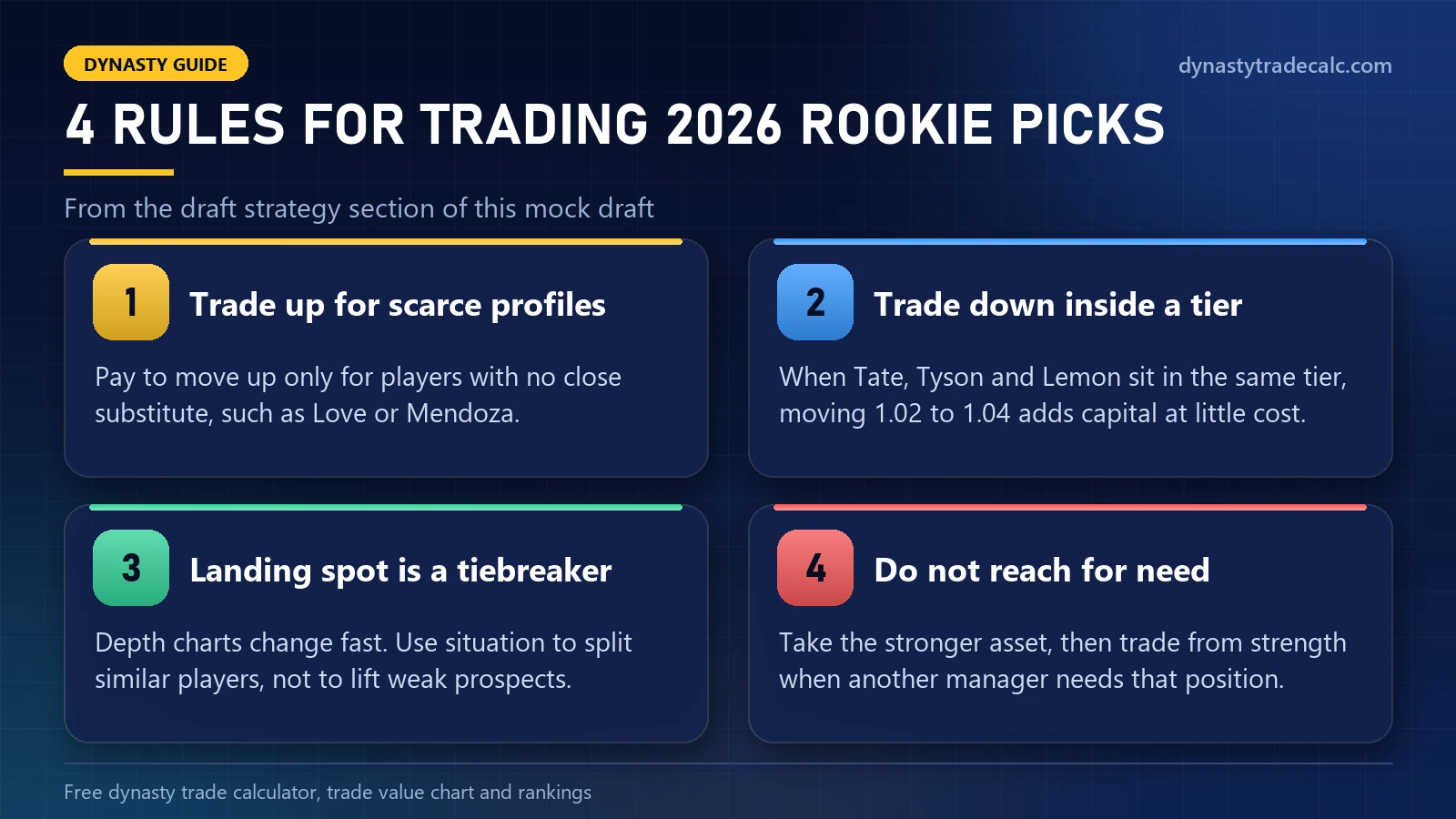
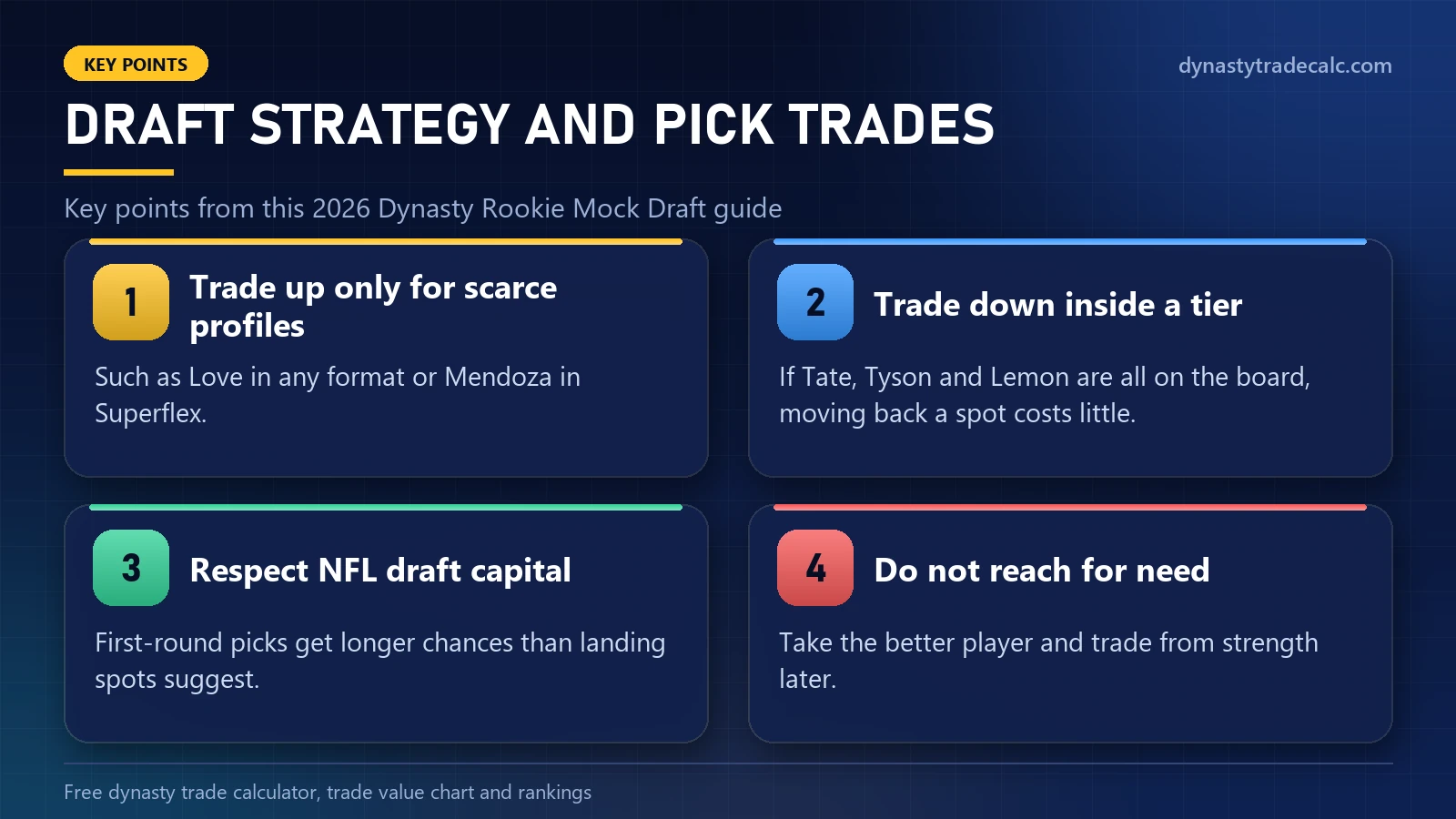
Trade up for scarce profiles such as Love or Mendoza. Trade down when Tate, Tyson, and Lemon remain inside the same receiver tier. For example, moving from 1.02 to 1.04 can produce extra capital without meaningfully weakening your final selection.

Strategy for Contending and Rebuilding Teams

Contenders can prioritize Love, Price, or polished receivers who may contribute quickly. Rebuilders should favor durable value through receivers and quarterbacks. Still, avoid rigid rules. A rebuilding manager can draft Love and later trade him once immediate production increases his market price.

Overvaluing Landing Spots

Landing spots change faster than prospect quality. Coaches leave, veterans get traded, and depth charts collapse through injuries. Therefore, use situation as a tiebreaker between similar players. Never elevate a weak prospect several rounds merely because his current competition appears unimpressive.

Ignoring NFL Draft Capital

Draft capital reveals organizational commitment. First-round selections usually receive longer contracts, greater patience, and more chances to recover from mistakes. Ignoring that information means betting against the team that spent considerable resources evaluating and acquiring the player.

Reaching for Positional Need

A reach can solve today’s lineup concern while damaging tomorrow’s trade market. For example, selecting Allar above Lemon because you need a quarterback sacrifices too much value. Draft the stronger asset, then negotiate from strength when another manager needs your receiver.

Long-Term Upside Versus Immediate Production

Build a balanced rookie portfolio. Combine early contributors with patient developmental bets. Price may help sooner than Simpson, while Simpson could eventually hold greater Superflex value. Too many immediate options cap your ceiling. Too many projects leave your weekly lineup gathering dust.

11. Frequently Asked Questions About the 2026 Dynasty Rookie Mock Draft

The most important questions involve format, pick value, and positional scarcity. Your answers should change slightly across leagues because scoring systems and roster depth influence every decision. Still, strong talent evaluation and disciplined tier management remain useful everywhere.

Remember that rookie rankings represent informed probabilities rather than promises. Even first-round selections can fail. Therefore, diversify your picks, protect trade flexibility, and avoid treating one prospect as the magical cure for every weakness across your dynasty roster.

Who should be the 1.01 pick in a 2026 dynasty rookie draft?

Jeremiyah Love should be the 1.01 in most formats. Arizona selected him third overall, while NFL evaluators highlighted his speed, receiving ability, and three-down profile. Mendoza deserves consideration in quarterback-starved Superflex leagues, yet Love offers the class’s strongest fantasy ceiling.

How different are 1QB and Superflex rookie drafts?

The formats differ primarily through quarterback scarcity. Mendoza moves from the late first round in many 1QB drafts into the opening tier during Superflex drafts. Simpson also rises sharply. Meanwhile, receivers, running backs, and tight ends slide several selections when quarterbacks climb.

When should quarterbacks be selected in Superflex leagues?

Mendoza belongs within the first four selections and can reasonably go 1.01. Simpson fits between 1.08 and 1.12, depending on team needs. Afterward, avoid forcing quarterbacks above clearly superior skill players because scarcity should influence rankings without overruling talent entirely.

Is the 2026 dynasty rookie class considered strong?

The class looks strong near the top but noticeably weaker after the first several prospects. Love and the premier receivers offer cornerstone potential. However, limited quarterback depth and an uncertain secondary running-back group reduce the appeal of late first-round and second-round picks.

Should dynasty managers trade for 2026 rookie picks?

Early selections deserve serious interest, especially picks likely to become Love, Tate, Tyson, Lemon, or Mendoza. However, late picks should remain affordable because the talent pool thins quickly. Trade within tiers whenever possible, and avoid paying premium prices for uncertain second-round lottery tickets.

Similar Posts

Leave a Reply

Your email address will not be published. Required fields are marked *