


Table of Contents
- What Is a Free Dynasty Trade Calculator?
- What Our Free Calculator Includes
- How to Use It Step by Step
- Superflex, 1QB and PPR: Why Settings Change the Answer
- Players vs Rookie Picks
- A Simple Two-for-One Example
- Accept, Counter or Reject: Reading the Result
- Why Free Calculators Give Different Numbers
- What a Free Dynasty Trade Calculator Cannot Tell You
- Frequently Asked Questions
- Conclusion
- Compare With Other Sources
- Related Guides
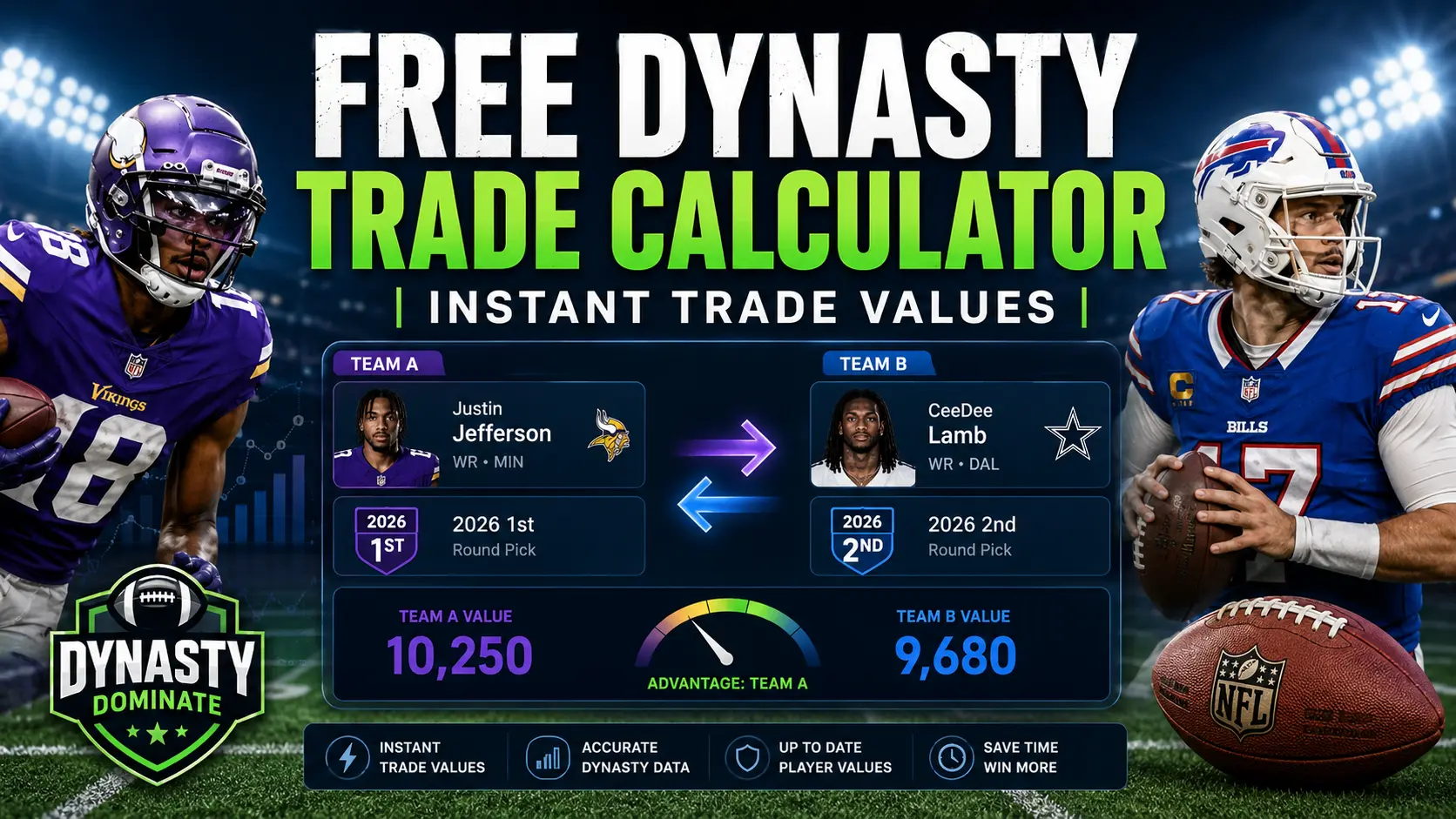
A free dynasty trade calculator puts every player and rookie pick on one value scale, adds up both sides of a trade and shows which side is ahead. It takes a minute, needs no account, and it stops you from judging a deal on names and gut feeling. This guide shows how the tool works, how to read the result and what it cannot see.
What Is a Free Dynasty Trade Calculator?
Think of it as a translator for uneven assets. A running back, a young receiver and a future first-round pick are hard to compare by eye. The calculator gives each one a number that reflects long-term value, so a three-for-one offer becomes simple addition.
Dynasty values differ from redraft values. A redraft tool looks at this season only. A dynasty tool also weighs age, role security and draft picks, because you keep your roster for years. A 29-year-old running back and a 22-year-old receiver with the same weekly points are not worth the same in dynasty.
What Our Free Calculator Includes
The dynasty trade calculator on this site is free to use and needs no sign-up. It covers the settings that move dynasty prices the most:
- Lineup format: 1QB, Superflex or 2QB.
- Scoring: standard, half-PPR or full PPR.
- Players and rookie picks on either side of the deal.
- Multi-asset trades, so you can test two-for-one and three-for-two offers.
- A clear result: the total on each side and the gap between them.
How the values in our free dynasty trade calculator are built is explained on our methodology page.
How to Use It Step by Step
- Match your league. Choose the lineup format and scoring before you add anyone. Wrong settings give the wrong answer.
- Enter both sides. Add every player and pick, including the small sweeteners.
- Read the gap. A small gap is normal. A large one means the offer needs work.
- Check your roster. Ask whether your starting lineup is better after the trade.
- Decide. Accept, counter with one small change, or decline politely.
The full walkthrough is in how to use a dynasty trade calculator.
Superflex, 1QB and PPR: Why Settings Change the Answer
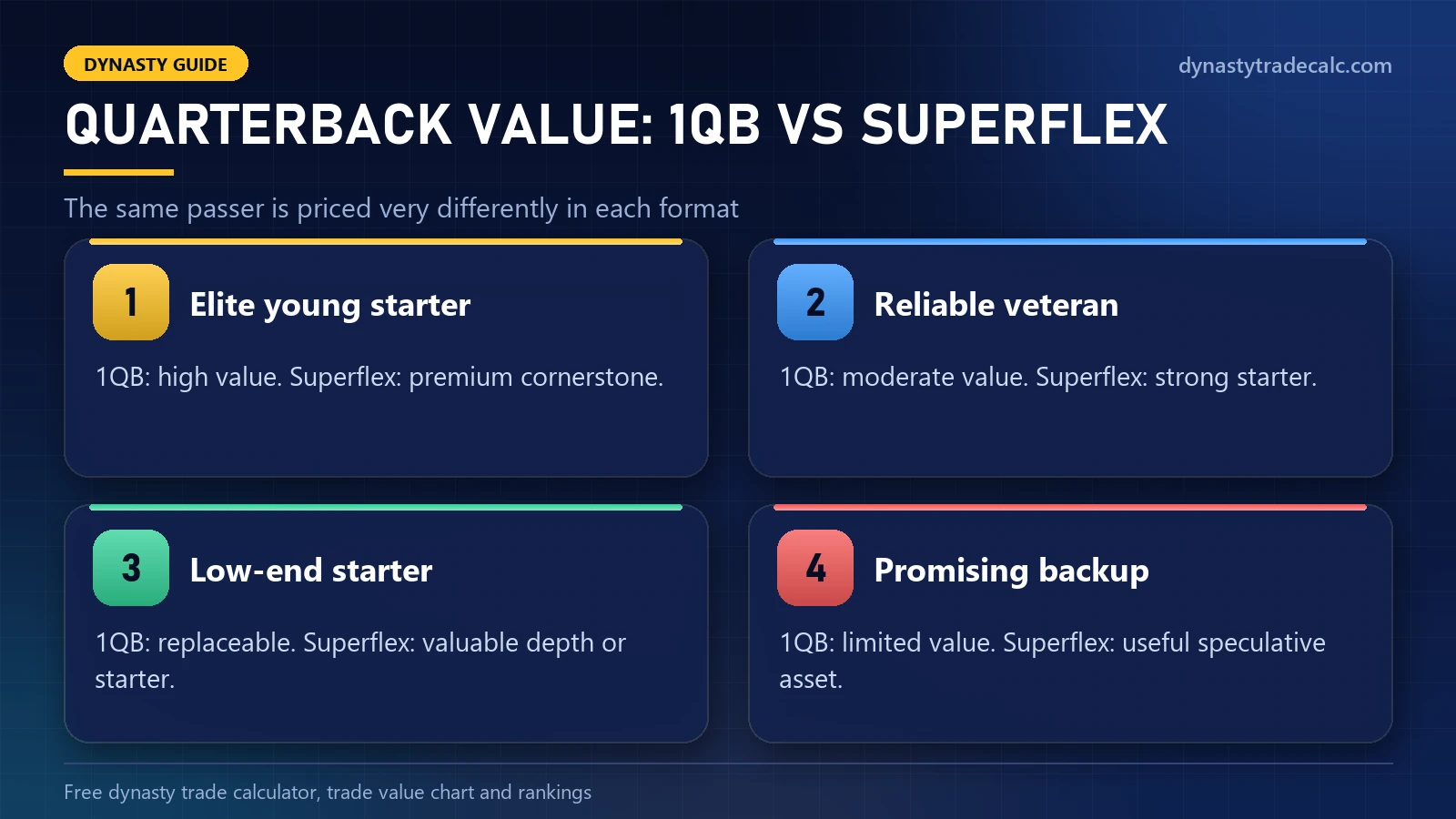
League rules change prices more than anything else. In a 1QB league, most teams start one passer, so playable quarterbacks are easy to find. In Superflex, teams can start two, and starting quarterbacks become the scarcest asset in the league.
| Format | Who gains value | What to watch |
|---|---|---|
| 1QB | Running backs and wide receivers | Quarterbacks are easier to replace |
| Superflex | Starting quarterbacks | Even a steady backup has real trade value |
| Full PPR | Slot receivers and pass-catching backs | Touchdown-only players lose value |
| Standard | Yardage and touchdown scorers | Reception volume matters less |
For more on quarterback prices, see our Superflex trade calculator guide. Reception scoring is covered in the dynasty trade calculator PPR guide.
Players vs Rookie Picks
A free dynasty trade calculator lets you put picks on either side of a deal. Picks do not score today, but they are flexible currency. An early first can become a cornerstone player or the centre of a big trade. A late first or a second-round pick works best as a sweetener that closes a small gap.
Label picks as early, middle or late whenever you can. A future first from a strong team is worth less than one from a weak team. Current prices are on our rookie pick values page.
A Simple Two-for-One Example
Say you are offered two useful starters for your best wide receiver. On paper the two players add up to slightly more than your receiver, so the totals look like a win for you.
Now look at the lineup. You fill one spot with a good player instead of a great one, and you need a roster spot for the second player. The other manager gets the best player in the deal and opens space on the bench. That is why a two-for-one that is close on paper often favours the side getting the star. Ask for a little more than an even total before you give up the best player.
The same logic runs the other way. If injuries have left two holes in your lineup, splitting one star into two starters can raise your weekly score even when the calculator shows a small loss.
Accept, Counter or Reject: Reading the Result
| What the calculator shows | What to do |
|---|---|
| Totals are close and the trade fits your plan | Accept |
| Totals are close but one piece is missing | Counter: ask for a later pick or a bench player |
| You get the best player but lose a little on value | Usually accept, because only starters score |
| You are far behind, or the deal works against your plan | Reject politely and keep talking |
Contenders should buy points now, and rebuilding teams should buy youth and picks. If a trade does neither for your team, a fair total is not enough reason to accept it.
Why Free Calculators Give Different Numbers
Run the same trade through three tools and you will often get three answers. That is not a bug. Each site builds its values a different way:
- Crowd votes: many managers rank players against each other, so values follow the market mood.
- Completed trades: values follow what managers actually paid in real leagues.
- Expert rankings: values follow analysts’ long-term projections.
No single method is right every time. When two sources agree, you can trust the number more. When they disagree by a lot, the player is a buy-low or sell-high candidate worth a closer look. Our own approach is described on the methodology page, and we suggest checking at least one other source before a big deal.
What a Free Dynasty Trade Calculator Cannot Tell You
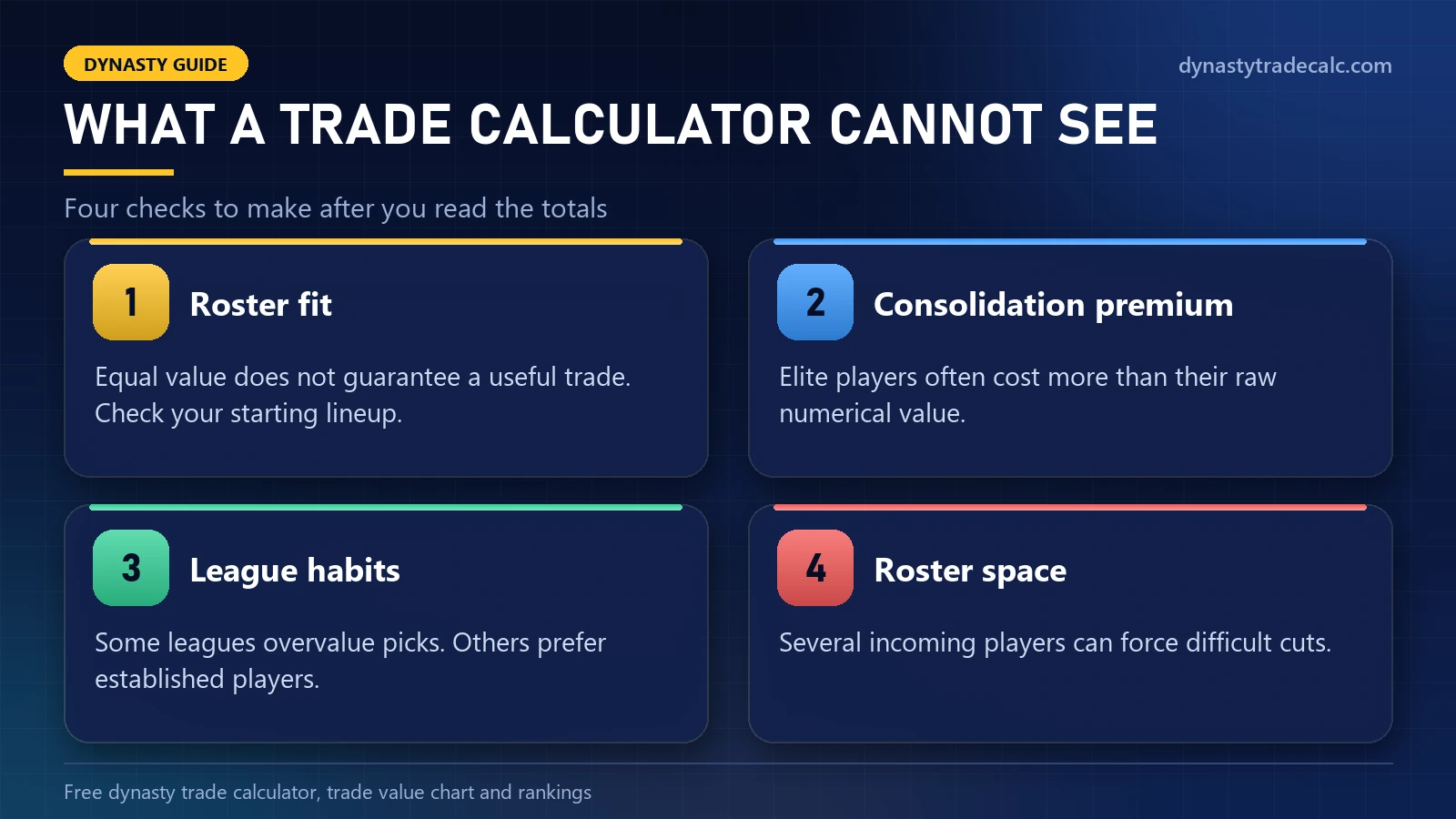
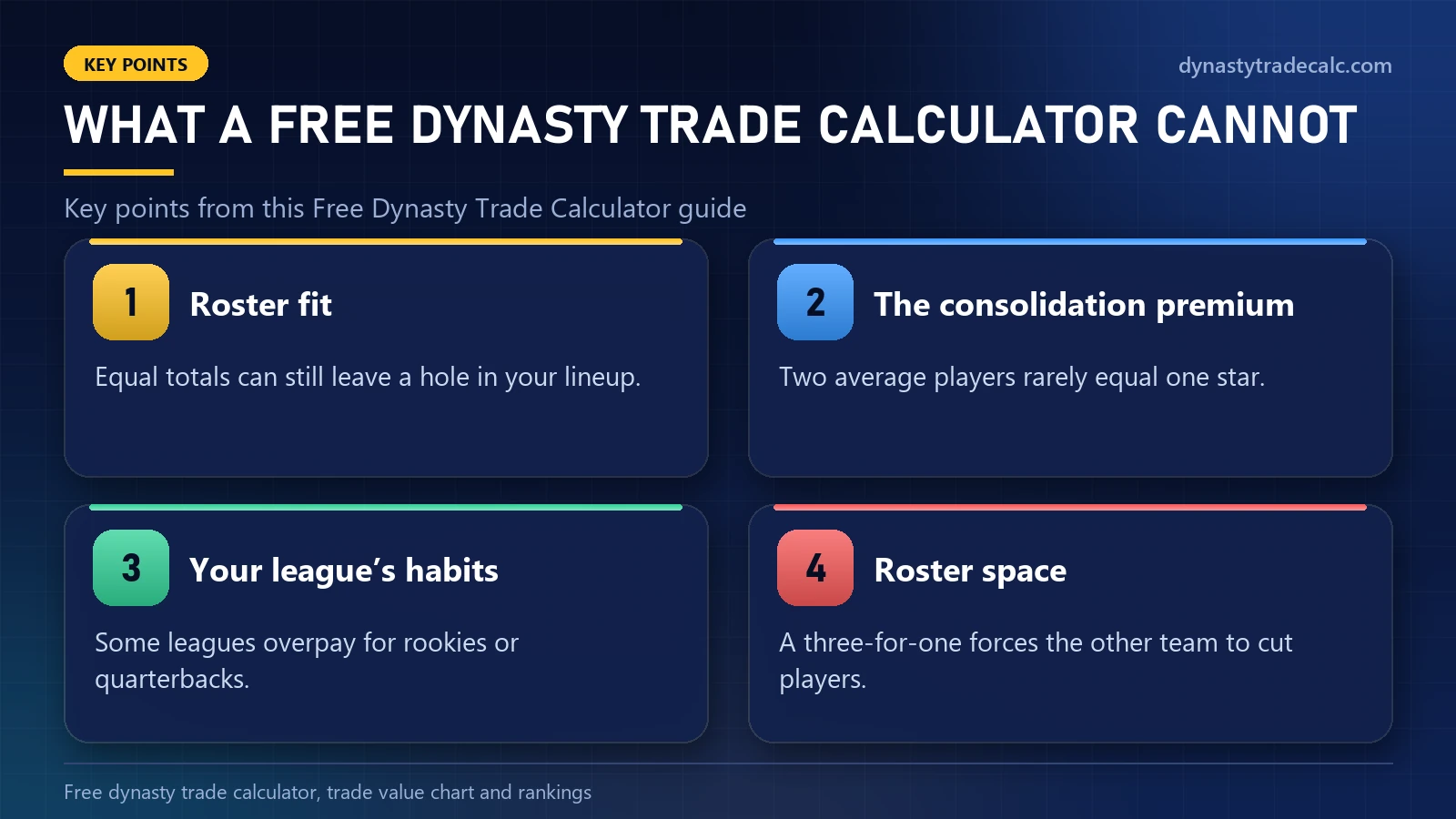
- Roster fit. Equal totals can still leave a hole in your lineup.
- The consolidation premium. Two average players rarely equal one star.
- Your league’s habits. Some leagues overpay for rookies or quarterbacks.
- Roster space. A three-for-one forces the other team to cut players.
Use the total from any free dynasty trade calculator as a baseline, then check these four things before you accept. More examples are in the biggest dynasty trade mistakes.
Frequently Asked Questions
Is there a free dynasty trade calculator?
Yes. The dynasty trade calculator on DynastyTradeCalc is free and needs no account. KeepTradeCut, FantasyCalc and DynastyProcess also offer free calculators, each built on a different source of values.
Do I need to sign up to use a free dynasty trade calculator?
No. The calculator on DynastyTradeCalc works without an account. Add players or rookie picks to each side and the comparison appears right away.
Is a free dynasty trade calculator accurate?
It gives a good estimate when the values are current and the settings match your league. Treat the number as a starting point, then check injuries, roster needs and recent trades in your league.
Does a dynasty trade calculator work for Superflex leagues?
Yes, if you choose the Superflex setting. Quarterbacks are worth far more when a team can start two, so a 1QB result can be badly wrong in a Superflex league.
Should both sides of a dynasty trade have equal values?
Not always. The manager who gets the best player in the deal can fairly pay a little extra, because only starters score. Aim for a deal that helps both rosters, not identical totals.
When should I counter a dynasty trade instead of rejecting it?
Counter when the totals are close but one piece is missing. Ask for a later pick or a younger bench player. Reject only when the offer works against your team plan.
Conclusion
A free dynasty trade calculator turns a messy offer into two numbers you can compare. Match your league settings, enter both sides, read the gap and check your roster. The tool tells you whether a deal is fair. You decide whether it is right for your team.
Related Guides
Compare With Other Sources
Our values are estimates, not quotes. Before a big trade, compare the same players against KeepTradeCut crowd-sourced dynasty values, FantasyCalc and FantasyPros dynasty rankings.
