

Table of Contents
- What Is a Dynasty Trade Database?
- How to Search a Trade Database
- Trade Database vs Value Chart
- Reading Trades the Right Way
- Using Trades to Price Rookie Picks
- Using Trade Data in a Negotiation
- Limits of Trade Data
- Building Your Own League Trade Log
- What to Look for in a Dynasty Trade Database
- Example: Pricing a Player With Trade Data
- Frequently Asked Questions
- Conclusion
- Related Guides
- Compare With Other Sources
A dynasty trade database is a searchable record of real trades made in dynasty leagues. Instead of guessing what a player is worth, you can see what other managers actually paid for him. This guide explains how a dynasty trade database works, how to search it and how to use it next to a value chart.
What Is a Dynasty Trade Database?
It is a list of completed trades, usually collected from connected leagues or reported by users, that you can search by player or pick. Each entry shows both sides of the deal, the date and often the league format. Some managers call it a trade database for fantasy football or simply trade history.
The value is simple: a dynasty trade database shows the real market. A value chart tells you what a player should be worth; trades show what managers will pay.
How to Search a Trade Database
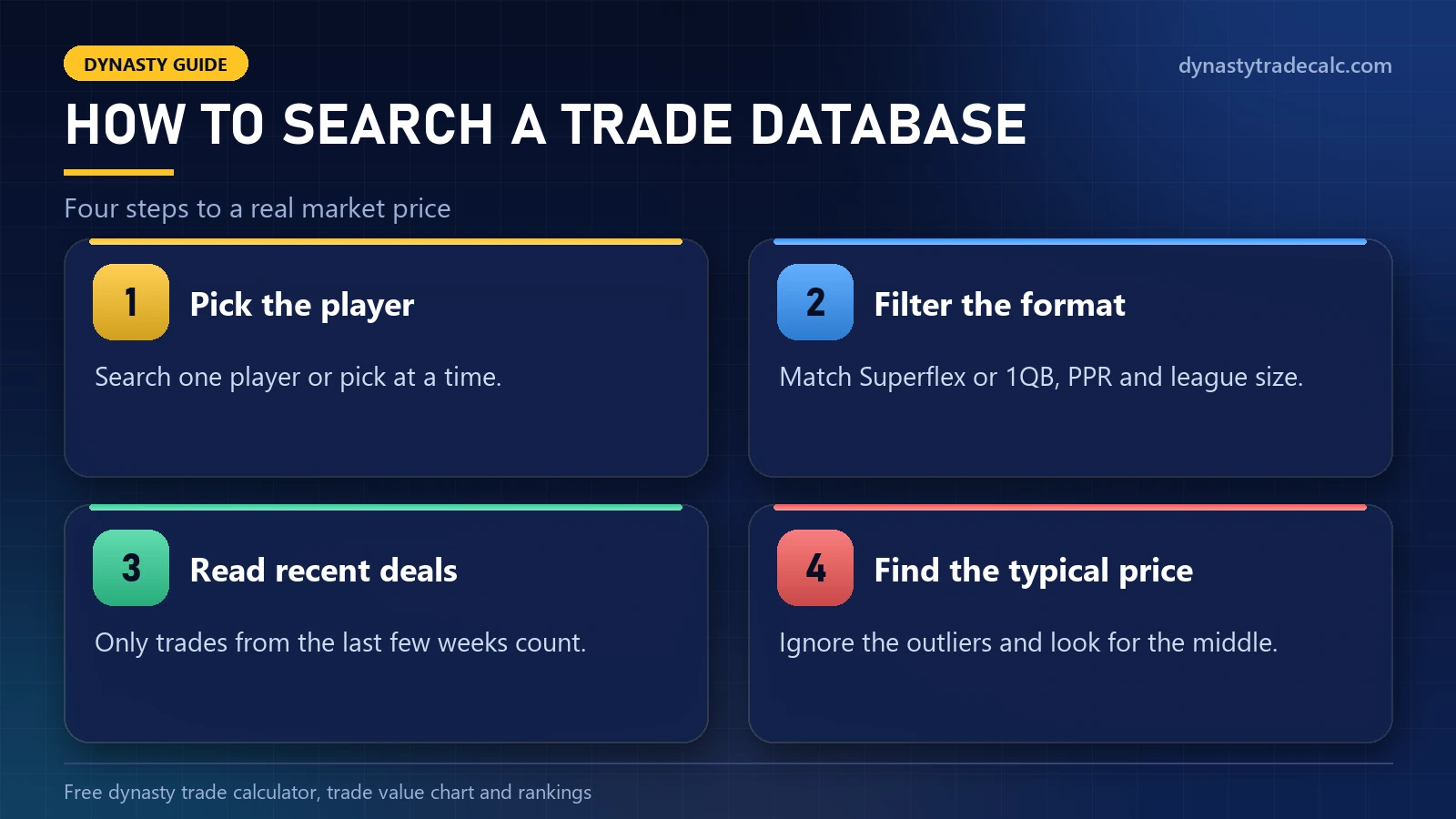
- Pick the player or pick you want to price.
- Filter by format: Superflex or 1QB, PPR or standard, and league size.
- Read only recent trades, ideally from the last few weeks.
- Ignore outliers and look for the price that appears most often.
- Compare that price with a value chart and our free dynasty trade calculator.
Trade Database vs Value Chart
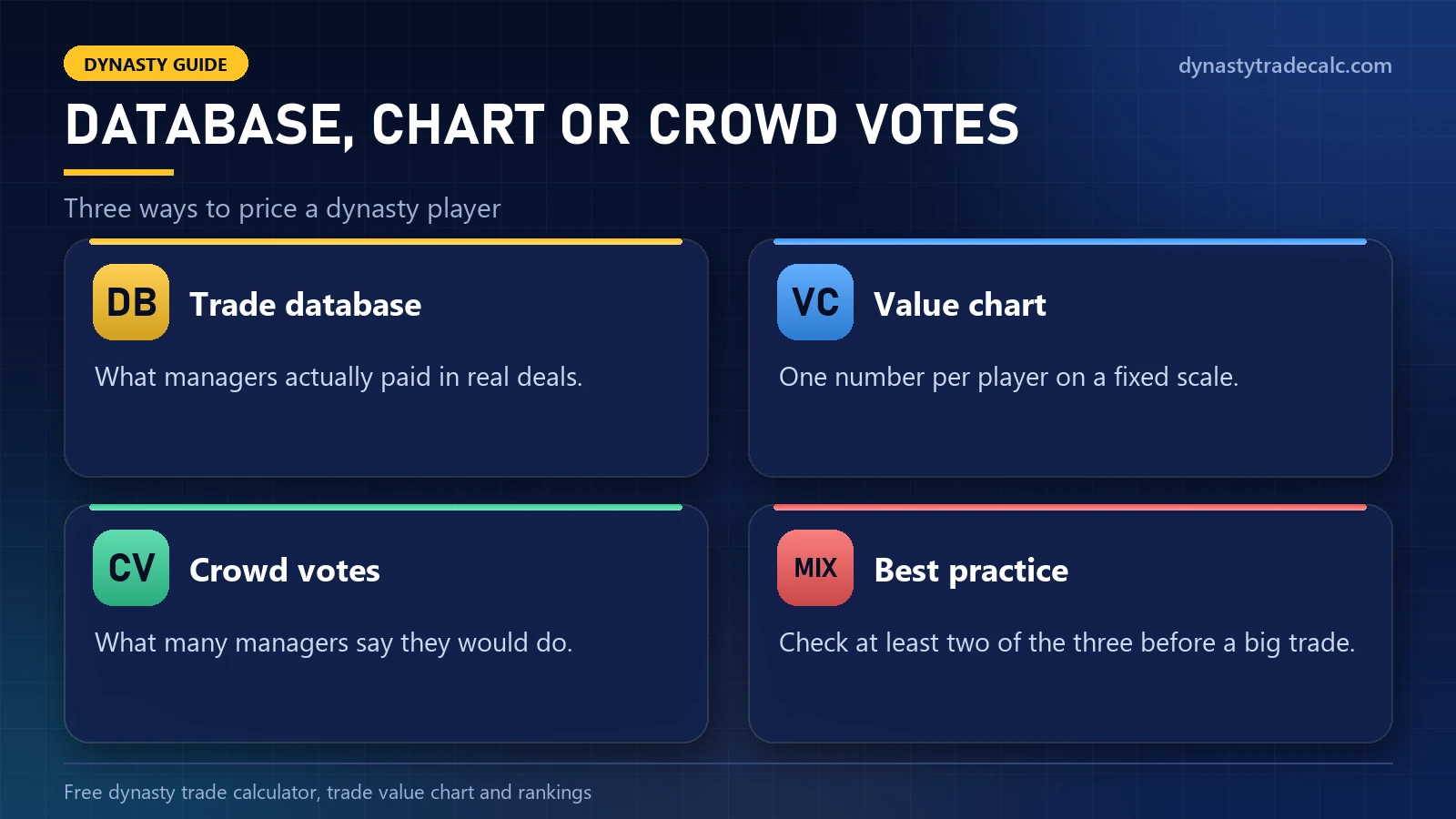
| Source | What it shows | Strength | Weakness |
|---|---|---|---|
| Trade database | Real completed trades | Shows the actual market | Few trades for some players |
| Value chart | One value per player | Quick and easy to compare | A model, not a market |
| Crowd votes | What managers say they would do | Large samples | Votes are not real trades |
Our dynasty trade value chart gives one value per player. Using a fantasy trade database next to it shows whether the market agrees.
Reading Trades the Right Way
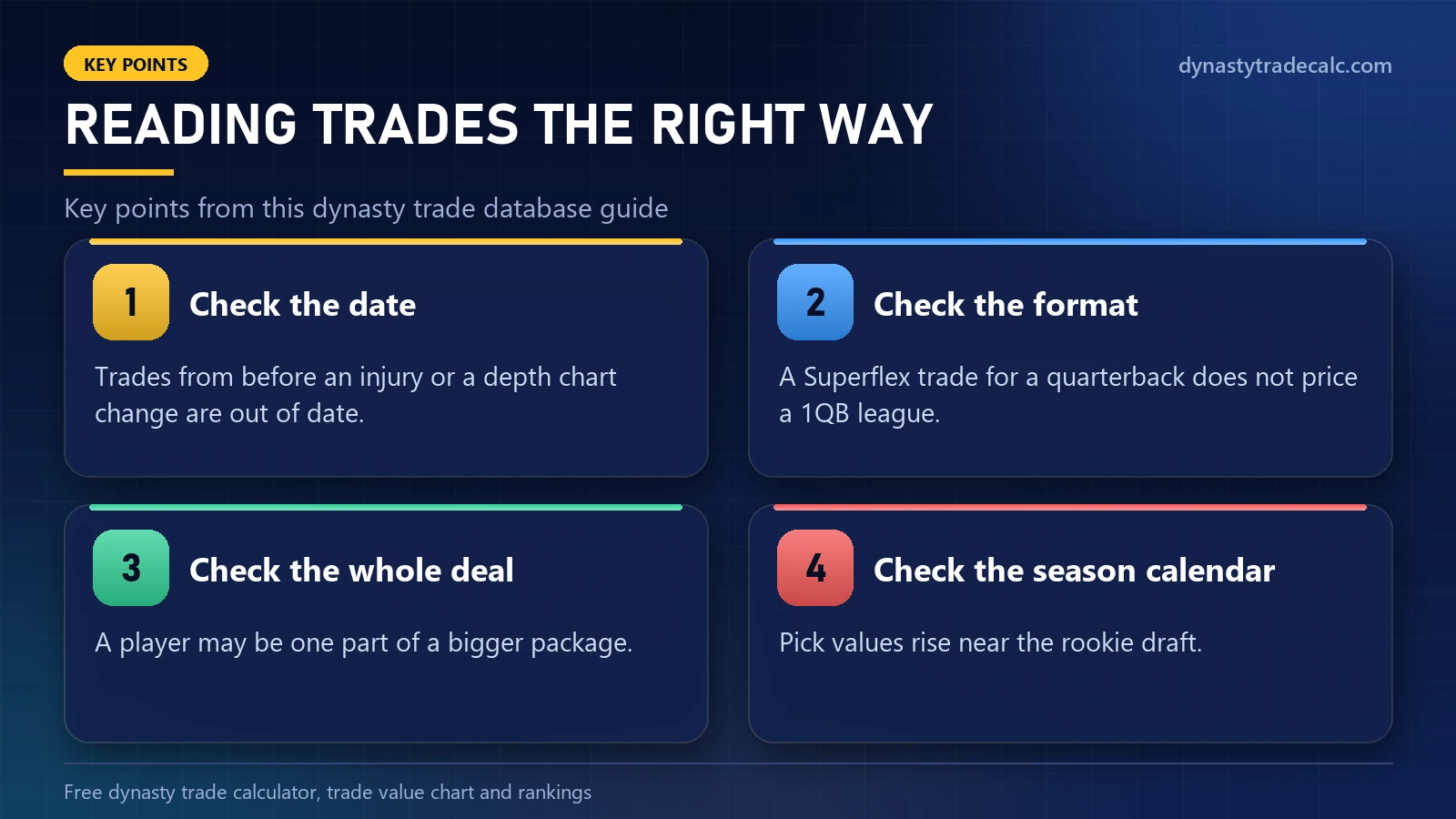
A single trade tells you little. One manager may have overpaid because of an injury on his team or a favorite player. Look for patterns across several trades: if a receiver keeps going for a late first plus a little extra, that is his price.
- Check the date. Trades from before an injury or a depth chart change are out of date.
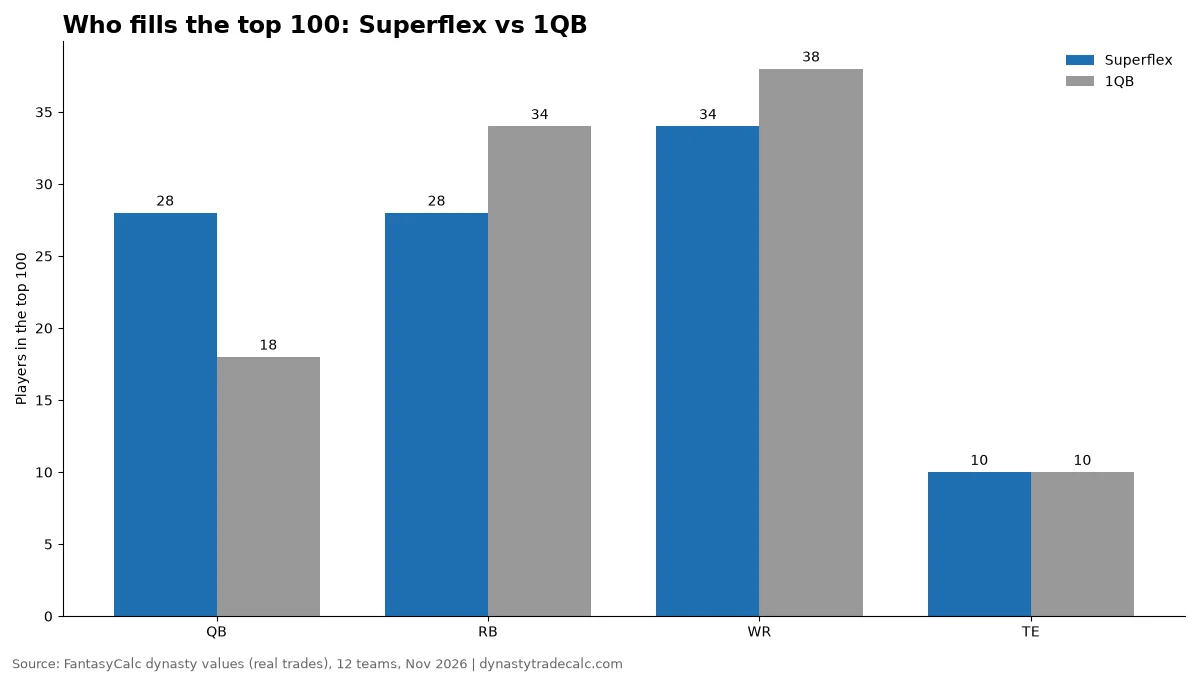
- Check the format. A Superflex trade for a quarterback does not price a 1QB league.
- Check the whole deal. A player may be one part of a bigger package.
- Check the season calendar. Pick values rise near the rookie draft.
Using Trades to Price Rookie Picks
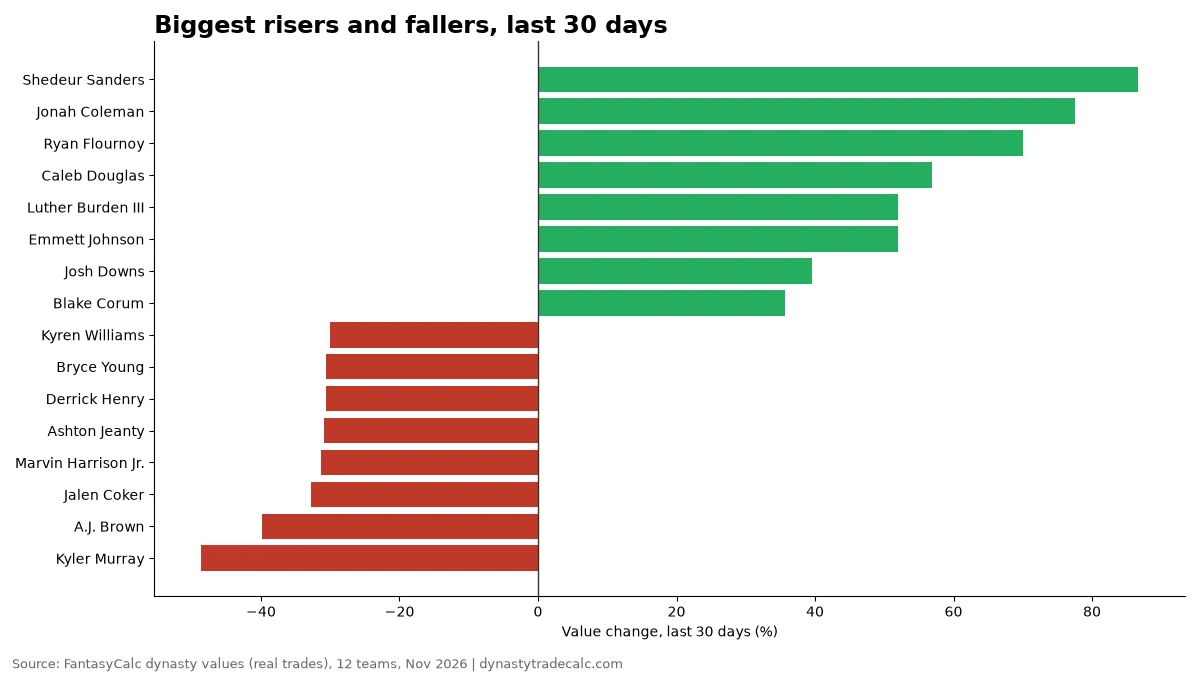
Rookie picks are where a dynasty trade database helps most, because managers trade picks often. Searching recent trades for a mid first shows how managers price it right now, which may differ from a chart. Prices also change through the year: picks are usually cheapest during the season and most expensive near the rookie draft. Compare with our rookie pick values and the dynasty rookie pick value chart.
Using Trade Data in a Negotiation
Real trades are strong evidence. If a manager says your offer is too low, two or three recent trades for the same player show the market price in a fair way. This keeps the talk about facts, not opinions, and it often moves a stuck negotiation forward. Our KeepTradeCut (KTC) guide explains how crowd values compare with ours. Grade your whole roster first with our dynasty team analyzer guide.
Use data honestly: pick trades in the same format and from the same time period. Choosing only the trades that suit you will hurt trust in your league.
Limits of Trade Data
Trade data has gaps. Popular players have many trades, while deep bench players and older veterans may have only a few. League types differ too: trades from casual leagues and expert leagues can show different prices. When the data is thin, lean more on value charts and rankings such as FantasyPros dynasty rankings.
- Few trades: use a chart and treat the database as a rough guide.
- Mixed formats: filter strictly or skip the data.
- Sudden news: trades before the news no longer apply.
Building Your Own League Trade Log
You can also keep a simple trade log for your own league. Write down every trade with the date and both sides. Over a season, you will see how your league prices players, which managers pay most for youth and who sells veterans early. Your own dynasty trade database is often more useful than a general one, because it reflects the managers you actually trade with.
Our guide to fantasy trade value charts explains how to compare that log with chart values.
What to Look for in a Dynasty Trade Database
Competing guides often list tools without saying what makes one useful. These are the features that matter when you choose a dynasty trade database:
| Feature | Why it matters |
|---|---|
| Format filters | Superflex, 1QB, PPR and tight end premium trades price players differently |
| League size filter | A 14-team trade is not the same as a 10-team trade |
| Trade date | Only recent trades reflect current value |
| Full trade details | You need both sides, including picks and their year |
| Sample size | More trades per player means a more reliable price |
A dynasty trade database without format filters mixes very different leagues, so its prices can mislead you. Value sites such as KeepTradeCut crowd-sourced dynasty values and FantasyCalc build their numbers in different ways, which is why comparing them with real trades is useful.
Example: Pricing a Player With Trade Data
- Search the player and filter to your format.
- Write down the last eight to ten trades.
- Remove the one or two trades that look far off.
- Find the price most of the rest share, such as a late first plus a bench player.
- Compare that price with a chart; if both agree, you have a reliable number.
This takes five minutes and gives you a price you can defend in any negotiation. Repeat it for the player you would receive, and you have both sides of the trade checked against the real market.
Frequently Asked Questions
What is a dynasty trade database?
It is a searchable list of real trades made in dynasty leagues. You can look up a player and see what other managers actually gave or received for him.
Where can I find a trade database for fantasy football?
Some value sites collect trades from connected leagues or user reports and let you search them. Look for one that shows the date and format of every trade.
Is a fantasy trade database better than a value chart?
Neither is better on its own. A fantasy trade database shows real prices, while a chart gives one clean number. Use both and look for agreement.
How many trades do I need to trust a price?
More is better. Five or more recent trades in your format usually show a clear middle price. One or two trades can be outliers.
Do old trades still matter?
Not much. Values change with injuries, depth charts and the season calendar, so focus on trades from the last few weeks.
Can I use a trade database to win a negotiation?
Yes. Showing a few recent trades for the same player is a fair way to support your price, and it keeps the talk about facts rather than opinions.
Conclusion
A dynasty trade database shows what managers really pay. Search by player, filter by format, read only recent deals and look for the typical price. Then compare it with a value chart before you make or accept an offer.
Related Guides
- Dynasty trade value chart: values by position.
- Fantasy trade value chart: how to read any chart.
- TradeCutKeep: how crowd-sourced values work.
- Fantasy calc: values built from real trades.
- Fantasy trade grader: turn prices into a grade.
- PPR trade value chart: values in reception leagues.
- Dynasty Fantasy Football Trade Targets: a related guide.
- Fantasy Trade Sheets: a related guide.
- Fantasy Buy Sell Guide: a related guide.
- AJ Brown Dynasty Trade Value: a related guide.
Compare With Other Sources
Our values are estimates, not quotes. Before a big trade, compare the same players against KeepTradeCut crowd-sourced dynasty values, FantasyCalc and FantasyPros dynasty rankings.
