Dynasty Trade Calculator Startup Draft Guide for Smarter Picks
A dynasty trade calculator startup draft can turn a confusing draft room into a smarter decision table. You still need instinct, courage, and football sense. However, a good calculator helps you compare players, picks, and league settings before you make a trade you regret.
Think of your dynasty startup draft like buying land in a fast-growing city. Every pick has present value and future value. Some picks become skyscrapers. Others become empty lots. This guide will help you use a calculator wisely, build value, and make cleaner trades in USA dynasty fantasy football leagues.
1. What Is a Dynasty Trade Calculator Startup Draft?
A dynasty trade calculator startup draft is a tool-based way to compare player value and draft pick value during the first draft of a dynasty fantasy football league. It helps you judge whether trading up, trading down, or staying put gives your roster a stronger long-term path.
The key idea is simple. You enter players or picks, check the estimated value, and compare both sides of the deal. However, the tool does not know your full plan. You must still consider age, scoring format, roster depth, and league behavior.
Explain the basic meaning
A startup draft builds your dynasty team from zero. A trade calculator helps you compare the value of players and picks before you accept a deal. In easy words, it gives you a second opinion when the clock is ticking and your league chat is getting noisy.
Why startup drafts are different from redraft leagues
Redraft leagues reset after one season. Dynasty leagues continue for years. That means you do not only draft points for this year. You also draft age, upside, trade value, and future flexibility. A veteran can help now, while a younger player may grow into a long-term hammer.
How calculators help compare players and draft picks
Calculators help because startup trades rarely look equal at first glance. One side may offer one early pick. The other side may offer two later picks. A calculator can show whether the extra depth really covers the lost player tier. That saves you from guesswork.
2. Why a Dynasty Trade Calculator Startup Draft Matters for Smarter Picks
A dynasty trade calculator startup draft matters because emotions can trick you. You may love a player from last season. You may panic when quarterbacks start flying off the board. You may also accept a trade because it looks busy, not because it helps.
A calculator gives you a calmer view. It shows whether the trade has fair market shape. Still, you should not treat it like gospel. The smartest managers use calculator value, player tiers, and roster direction together. That mix creates better decisions.
Helps avoid emotional draft decisions
Fantasy managers often chase familiar names. That is human. However, a startup draft rewards cold thinking. If you overpay for a favorite player, you may lose depth later. A calculator slows you down and asks, “Is this love, or is this value?”
Shows real player and pick value
A strong calculator can show how the market views a player or pick. That helps you avoid paying steakhouse prices for fast-food production. For example, a mid-round startup pick may look small, yet it can carry real value if the player tier remains deep.
Makes trade offers easier to judge
Trade offers can feel messy during a live startup. One owner may offer pick swaps. Another may add a future rookie pick. A calculator lets you compare the deal in seconds. Then you can decide whether the offer supports your build or only looks shiny.
3. How to Use a Dynasty Trade Calculator Startup Draft Before Round 1
Before Round 1, set your league format with care. A dynasty trade calculator startup draft only helps when the settings match your league. Superflex, PPR scoring, tight end premium, league size, and starting lineup rules can all change player values quickly.
You should also mark your player tiers before the draft starts. Tiers protect you from blind panic. If six similar wide receivers remain, trading down can work. If one elite quarterback stands alone, moving down may hurt more than the calculator first suggests.
Enter league format correctly
Always enter the correct league size, scoring, and quarterback format. A 12-team Superflex league values quarterbacks very differently from a 10-team 1QB league. If your settings are wrong, the trade result can look clean while the real football value stays crooked.
Compare early-round pick values
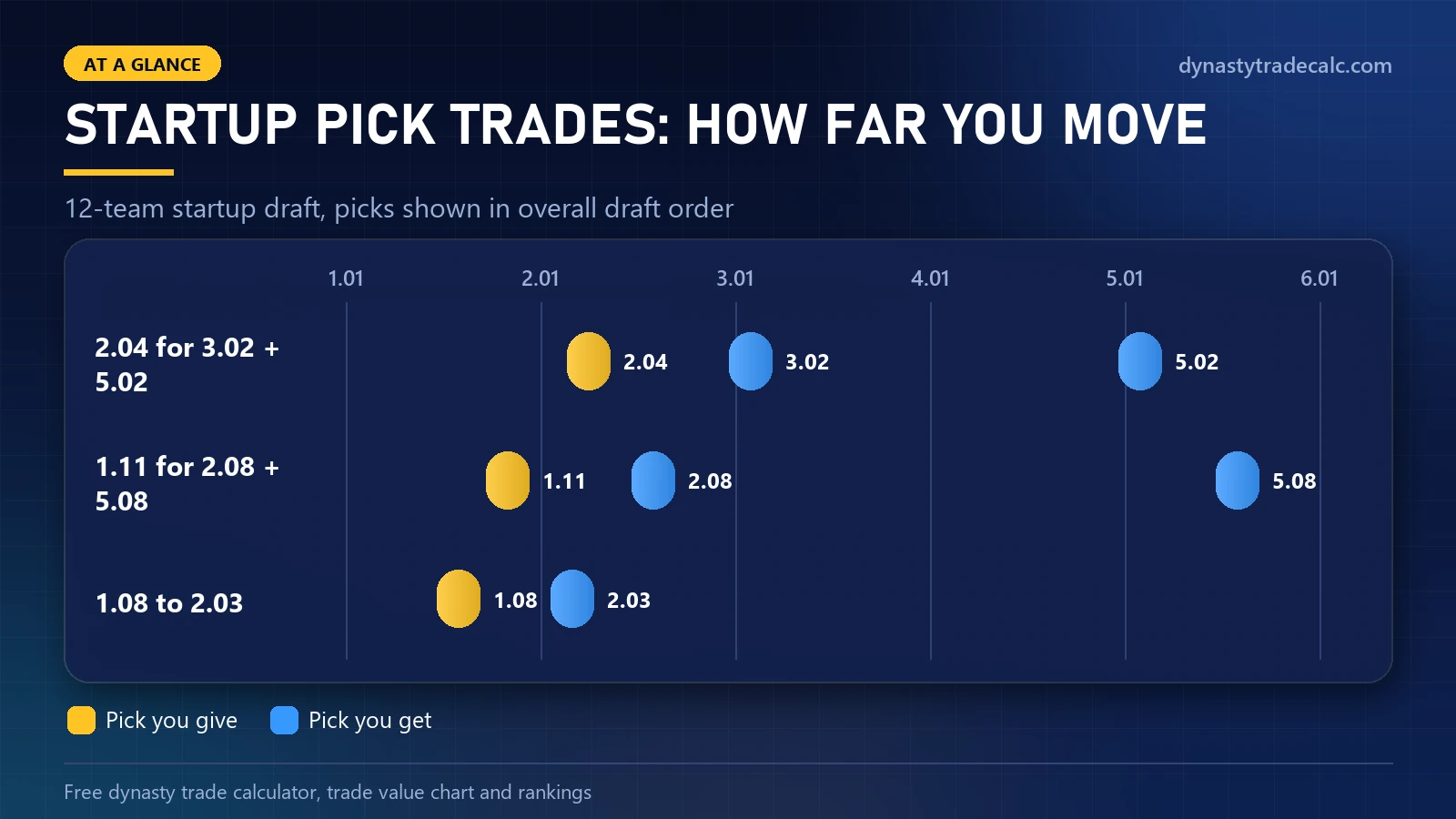
Early picks carry heavy value because they often land cornerstone players. Moving from 1.08 to 2.03 may look small on paper. However, the talent tier can change fast. Compare the pick gap before accepting, especially in Superflex formats where quarterbacks disappear early.
Check player tiers before accepting trades
Player tiers matter more than tiny ranking gaps. If several players offer similar value, trading down can give you extra picks without losing much quality. However, if only one player remains in a premium tier, you should demand stronger compensation before you move.
4. Startup Draft Strategy: Player Value, Pick Value, and League Format
Smart startup strategy starts with format, not player names. League rules create value. In Superflex leagues, quarterbacks can become gold bars. In tight end premium leagues, elite tight ends gain extra shine. In full PPR, target-heavy receivers become safer roster bricks.
You should also know how different tools think. A dynasty football trade value calculator may use expert rankings, market data, or live user votes. A dynasty deluxe trade calculator may offer extra settings. The best approach is to compare tools, then apply your own football logic.
Superflex vs 1QB value differences
Superflex leagues increase quarterback value because you can start a second QB. That changes the draft board. In 1QB, you can wait longer. In Superflex, waiting too long may leave you with weak weekly stability. That can damage your team before the season begins.
PPR, half-PPR, and standard scoring impact
PPR scoring rewards receptions. That helps wide receivers, pass-catching running backs, and volume tight ends. Half-PPR creates more balance. Standard scoring makes touchdowns more important. So, before using any dynasty superflex ppr trade calculator, make sure the scoring matches your league.
Why age, position, and upside matter
Age matters because dynasty value lives across several seasons. Young wide receivers often hold value longer. Running backs can win weeks, but their market can fall fast. Quarterbacks usually last longer, especially in Superflex. Upside matters too, because safe players can become roster glue without ceiling.
5. Dynasty Trade Calculator Startup Draft Tips for Superflex and 1QB Leagues
A dynasty trade calculator startup draft works differently in Superflex and 1QB leagues. In Superflex, quarterbacks often drive the first round. In 1QB, elite wide receivers and young skill players may become better anchors. That is why settings matter so much.
Do not copy one league’s draft board into another league. That is like wearing snow boots to a beach picnic. You may survive, but you will look silly. Read your room, study positional scarcity, and use the calculator as support.
Why quarterbacks rise in Superflex
Quarterbacks rise in Superflex because most teams want two reliable starters. That creates scarcity. When a stable quarterback is gone, replacing him gets expensive. This is why early QB access can carry massive value, even when a casual 1QB manager thinks the price looks wild.
When wide receivers become safer picks
Wide receivers often become safer dynasty picks because many hold value longer than running backs. A young receiver with strong target volume can help for several years. That steady value makes receivers strong building blocks, especially when your draft plan favors patience and flexibility.
How running back value changes in dynasty
Running backs can score fast and win matchups. However, their value often changes quickly because of injuries, committees, and contract shifts. Many sharp managers build around quarterbacks and receivers first, then buy running backs when the roster is ready to compete.
6. Common Mistakes When Using a Dynasty Trade Calculator Startup Draft
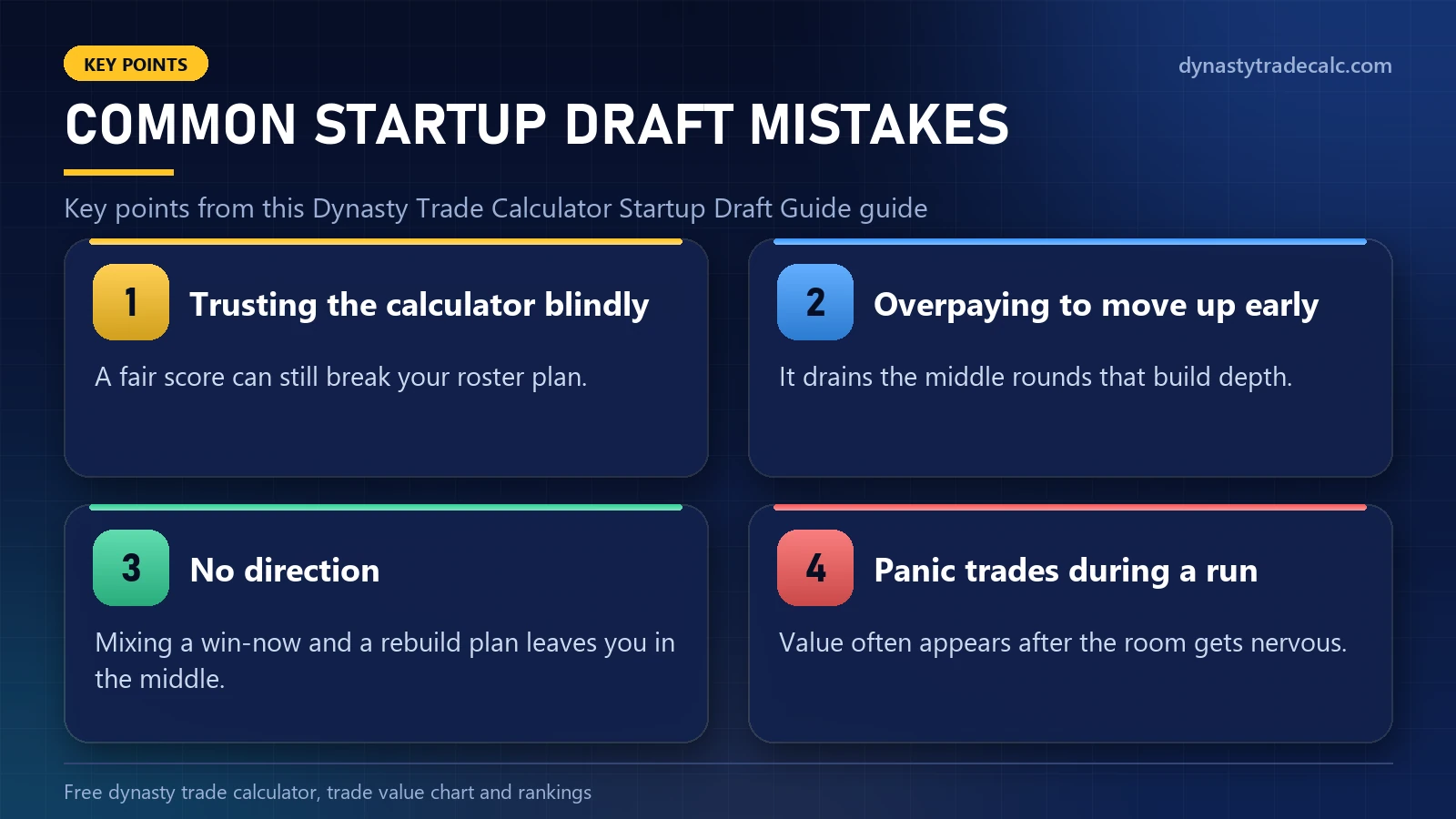
The biggest mistake with a dynasty trade calculator startup draft is blind trust. A calculator can show value, but it cannot read your league chat, your rivals, or your roster vision. It also cannot predict every coaching change, injury, or breakout.
Another common mistake is ignoring depth. Some managers trade up again and again until their roster has one superstar and too many holes. That looks exciting on draft day. Later, it feels like owning a sports car with no tires.
Trusting the calculator blindly
A calculator gives guidance, not permission. If it says a deal is fair, ask one more question. Does this trade help your team build? If the answer is no, walk away. Good dynasty managers respect numbers, but they do not worship them.
Ignoring roster build and team direction
Your roster needs a direction. A win-now team may value veterans. A patient team may value youth and picks. If you mix both plans badly, your team can land in the middle. That is fantasy purgatory, and nobody wants rent there.
Overpaying to move up too early
Moving up feels fun because you get “your guy.” However, early overpays can drain your middle rounds. Those rounds often build depth. Before you climb the board, ask whether the target player is truly special or just wearing a shiny name tag.
7. How to Trade Up, Trade Down, and Build Value During the Draft
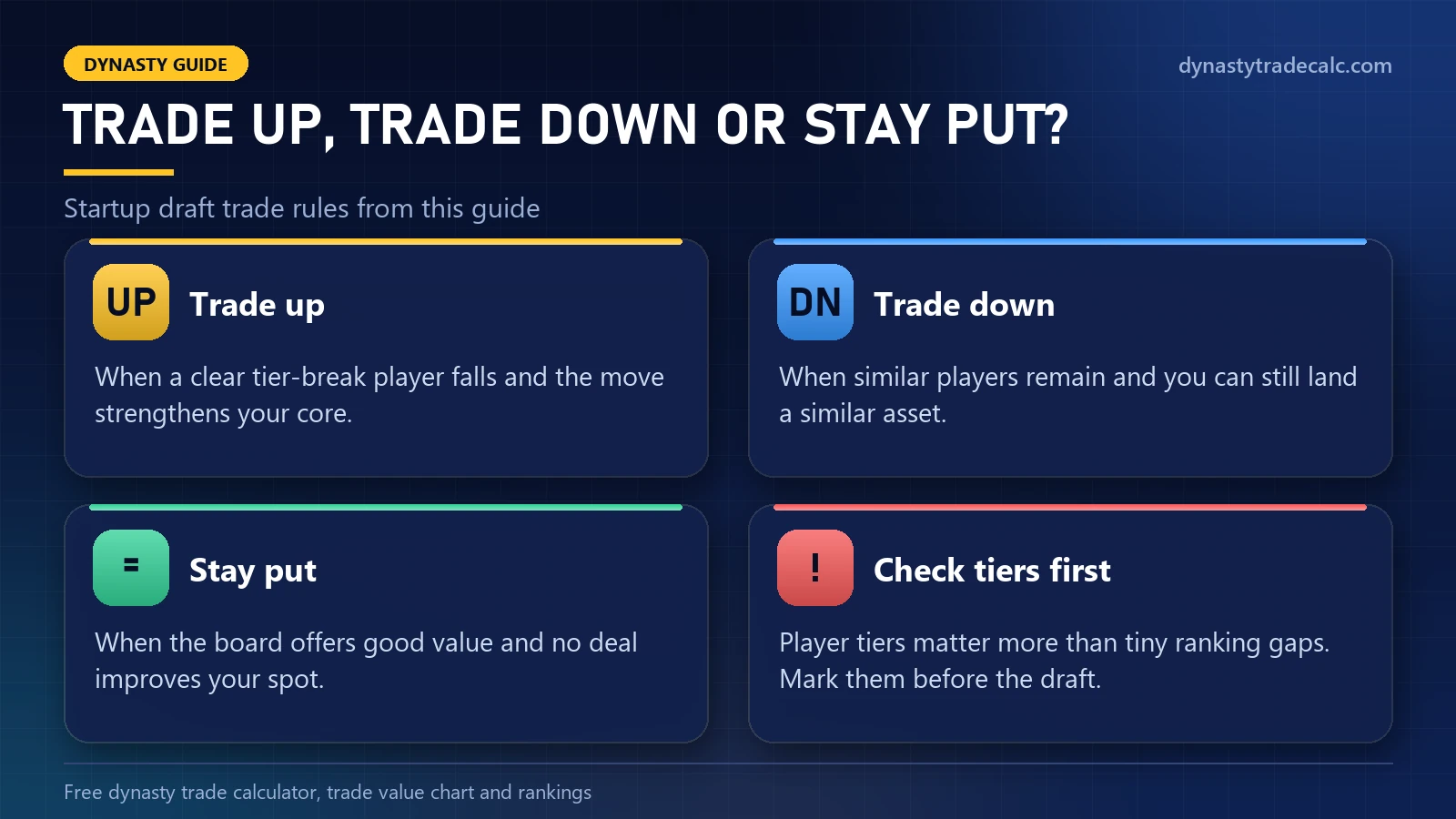
Trading during a startup draft should feel planned, not frantic. You trade up when a clear tier-break player falls. You trade down when similar players remain. You stay put when the board offers good value and no deal improves your spot.
This is where dynasty trade calculator draft picks become useful. Pick values help you see whether a trade-down offer gives enough back. They also help you avoid accepting three small pieces that look useful but do not replace the player you lost.
When trading up makes sense
Trading up makes sense when the player fills a premium need and sits above the remaining tier. In Superflex, that could be a top quarterback. In 1QB, it could be a young elite receiver. Do it when the move strengthens your core, not your ego.
When trading down gives better long-term value
Trading down works when the draft board still has many players you like. If you can move back and still land a similar asset, take the extra value. This is how strong dynasty teams quietly gain depth while other managers chase names.
How to collect extra mid-round picks
Mid-round picks create roster insulation. They help you add upside receivers, young tight ends, backup quarterbacks, and value running backs. You can collect them by moving down small distances. Small trade wins may look boring, but they stack like coins in a jar.
8. Dynasty Trade Calculator Startup Draft Examples for Real Draft Scenarios
A dynasty trade calculator startup draft becomes easier when you see real scenarios. Imagine you hold pick 2.04 in a 12-team Superflex league. Another manager offers 3.02 and 5.02. The deal may look tempting because you gain an extra useful pick.
However, context decides the answer. If a top quarterback remains at 2.04, moving down may cost you weekly stability. If the quarterback tier already ended, the move may help. This is why calculators, tiers, and league settings must work together.
Example 1: Trading an early pick for multiple picks
Suppose you trade pick 1.11 for picks 2.08 and 5.08. This can work if the elite tier has ended. Yet it can fail if one elite quarterback or wide receiver remains. The extra fifth-round pick must cover the value gap, not just decorate the offer.
Example 2: Moving down in Superflex
In Superflex, moving down can become risky during a quarterback run. If five managers need quarterbacks behind you, your pick gains leverage. A dynasty startup draft pick trade calculator can help you price that leverage before you accept a light offer.
Example 3: Comparing a veteran player with a rookie pick
A veteran gives clearer short-term points. A rookie pick gives flexibility and hope. If your team can win now, the veteran may fit. If your roster needs runway, the rookie pick may age better. Dynasty value always depends on timing.
Startup Trade Case Study Table
| Draft situation | Possible trade | Smart question to ask | Best decision angle |
|---|---|---|---|
| Early Superflex QB falls | Move up two spots | Does this QB change my weekly ceiling? | Trade up only if the price stays fair |
| Deep WR tier remains | Move down six spots | Can I still get a similar receiver? | Trade down and collect extra value |
| RB run starts | Chase a running back | Am I reacting or planning? | Stay calm unless the player fits |
| Future first is offered | Trade startup pick | Is this team likely weak later? | Consider it if your roster stays balanced |
| Veteran star is discounted | Draft older player | Can he help me win now? | Buy value if your build supports it |
9. Best Features to Look for in a Dynasty Trade Calculator
A strong calculator should do more than add names in two boxes. It should support league settings, startup picks, rookie picks, future picks, and Superflex values. It should also update often because dynasty markets move quickly after news, injuries, and depth-chart changes.
You may compare tools like dynasty trade calculator fantasypros, dynasty trade calculator rotoballer, and dynasty trade calculator nfl style resources when checking values. Some tools use expert rankings. Others use market data. The best answer often sits between both.
Startup pick support
Startup pick support matters because startup picks are unique assets. They can become any player in the draft pool. That makes them different from rookie picks. A calculator without startup pick support may miss the real value of moving up or down.
Superflex and 1QB settings
Superflex and 1QB settings must be separate. Quarterbacks do not carry the same value in both formats. If a tool treats them too closely, the output can mislead you. Always check the format before trusting the result.
Updated dynasty rankings
Updated rankings keep your trade decisions fresh. Player values change after the NFL Draft, free agency, injuries, training camp reports, and role changes. Stale rankings can turn a calculator into an old map. It may still show roads, but some bridges are gone.
Rookie pick and future pick values
Future rookie picks are trade currency. They gain value near rookie draft season because managers start dreaming again. A good calculator should price rookie picks and future picks with care. That helps you judge whether tomorrow’s hope is worth today’s player.
Dynasty Calculator Feature Comparison Table
| Calculator feature | Why it matters | Best use during startup drafts |
|---|---|---|
| Startup pick mode | Shows pick-for-pick value | Helps trade up or down |
| Superflex setting | Adjusts quarterback value | Protects you from QB mistakes |
| PPR setting | Changes WR and RB value | Matches your scoring format |
| Future pick values | Prices rookie assets | Helps long-term trades |
| Defense or IDP support | Adds defensive player context | Useful for leagues using dynasty trade calculator with defense |
| Multi-tool comparison | Reduces single-tool bias | Gives a cleaner value range |
10. Final Checklist Before Making Startup Draft Trades
Before accepting any startup trade, pause for a few seconds. Check the league settings, player tier, roster direction, and future flexibility. A good trade should help your team today without trapping you tomorrow. Dynasty success needs both patience and bite.
Also, compare values across more than one tool when possible. A dynasty hockey trade calculator may help fantasy hockey managers, but this article focuses on NFL dynasty football. For football, use a calculator built for dynasty football formats, picks, and scoring.
Check league settings
Your league settings control value. Superflex boosts quarterbacks. PPR boosts receptions. Tight end premium boosts elite tight ends. Deeper starting lineups boost depth. Before any trade, confirm the rules. Small settings can create big value changes.
Compare multiple calculators
One calculator gives one view. Two or three tools give a better range. If every tool dislikes a trade, be careful. If tools disagree, study the reason. Maybe one values youth more. Maybe another values real trades more than expert ranks.
Think about long-term roster balance
A good dynasty roster needs stars, depth, youth, and future trade chips. If you draft only young players, you may lack early points. If you draft only veterans, your value may fade fast. Balance gives your team more ways to win.
Avoid panic trades during the draft
Panic trades usually happen after a run. Quarterbacks fly. Running backs vanish. Tight ends dry up. Then someone overpays. Do not become that person. Slow down, check tiers, and remember that value often appears after the room gets nervous.
FAQ: Dynasty Trade Calculator Startup Draft
Startup drafts create big questions because every decision feels permanent. The good news is simple. You do not need perfect picks. You need smart value, flexible thinking, and fewer mistakes than your league mates. That is enough to build a dangerous dynasty roster.
Is a dynasty trade calculator useful during a startup draft?
Yes, it is useful because it gives quick value guidance during trade talks. It helps you compare players and picks before making a decision. However, you should still check your league format, team direction, and player tiers before accepting.
Should I always follow the calculator value?
No, you should not always follow it. A calculator shows estimated value. It does not know your exact roster plan. If a trade looks fair but hurts your build, reject it. Your team goal matters more than a pretty number.
What is the best time to trade during a startup draft?
The best time to trade often comes near tier breaks. Trade down when several similar players remain. Trade up when one special player falls. The key is timing. Good managers do not chase every deal. They wait for leverage.
Are startup picks more valuable than rookie picks?
Startup picks are usually more flexible because they can become proven players, young stars, or rookies. Rookie picks only apply to incoming rookies. However, rookie picks can gain value before rookie drafts, especially when hype starts cooking.
How do Superflex leagues change startup draft trade values?
Superflex leagues raise quarterback value because managers can start a second quarterback. That makes stable passers harder to replace. As a result, early startup picks become more valuable when top quarterbacks remain. Always adjust your calculator settings before judging those deals.
“A calculator can show the market, but your roster plan decides the move.”
Final Thoughts
A dynasty startup draft rewards managers who think ahead. You need more than rankings. You need value awareness, format knowledge, and a calm hand during trade pressure. The best managers do not guess every move. They measure, compare, and then act.
Use calculators to protect yourself from bad offers. Use tiers to understand the draft board. Use your own plan to build a roster you can manage with confidence. That is how you turn startup chaos into long-term dynasty power.