


Table of Contents
- What Is a Dynasty Trade Calculator?
- How Dynasty Trade Calculators Work
- Key Features to Look For
- Step-by-Step Guide
- Common Mistakes to Avoid
- Five Ways to Maximize League Value
- Using Fantasy Trade Calculators and Trade Analyzers Together
- Trade Scenarios and Examples
- FAQs About Dynasty Trade Calculators
- Conclusion and Next Steps
- Related Guides
A trade calculator dynasty managers can rely on does one job: it puts a value on every player and pick so you can compare both sides of a deal. This guide goes one step further and shows how to use those values to grow your roster’s worth over many trades, not only to judge a single offer.
What Is a Dynasty Trade Calculator?
A dynasty trade calculator gives each player and draft pick a number, then adds up both sides of a trade. The side with the higher total is ahead on paper. Because dynasty rosters carry over from year to year, the numbers reflect age and future seasons as well as current production.
| Feature | Dynasty league | Redraft league |
|---|---|---|
| Player retention | You keep your players every year | Rosters reset each season |
| Draft pick value | High, and picks are traded like players | Low, picks only matter on draft day |
| Trade impact | Lasts for several seasons | Lasts for one season |
New to the idea of a trade calculator dynasty leagues use? Start with what a dynasty trade calculator is and how it works.
How Dynasty Trade Calculators Work
Every tool of this kind works the same way. Each value comes from a mix of age, position, production and market demand. League format then moves those values. Quarterbacks are worth far more in Superflex, and reception scoring lifts pass catchers. That is why the first step is always to choose the lineup and scoring that match your league.
Our own values are editorial estimates, and the methodology page explains how they are built. For format-specific detail, see the Superflex trade calculator guide and the PPR trade calculator guide.
Key Features to Look For
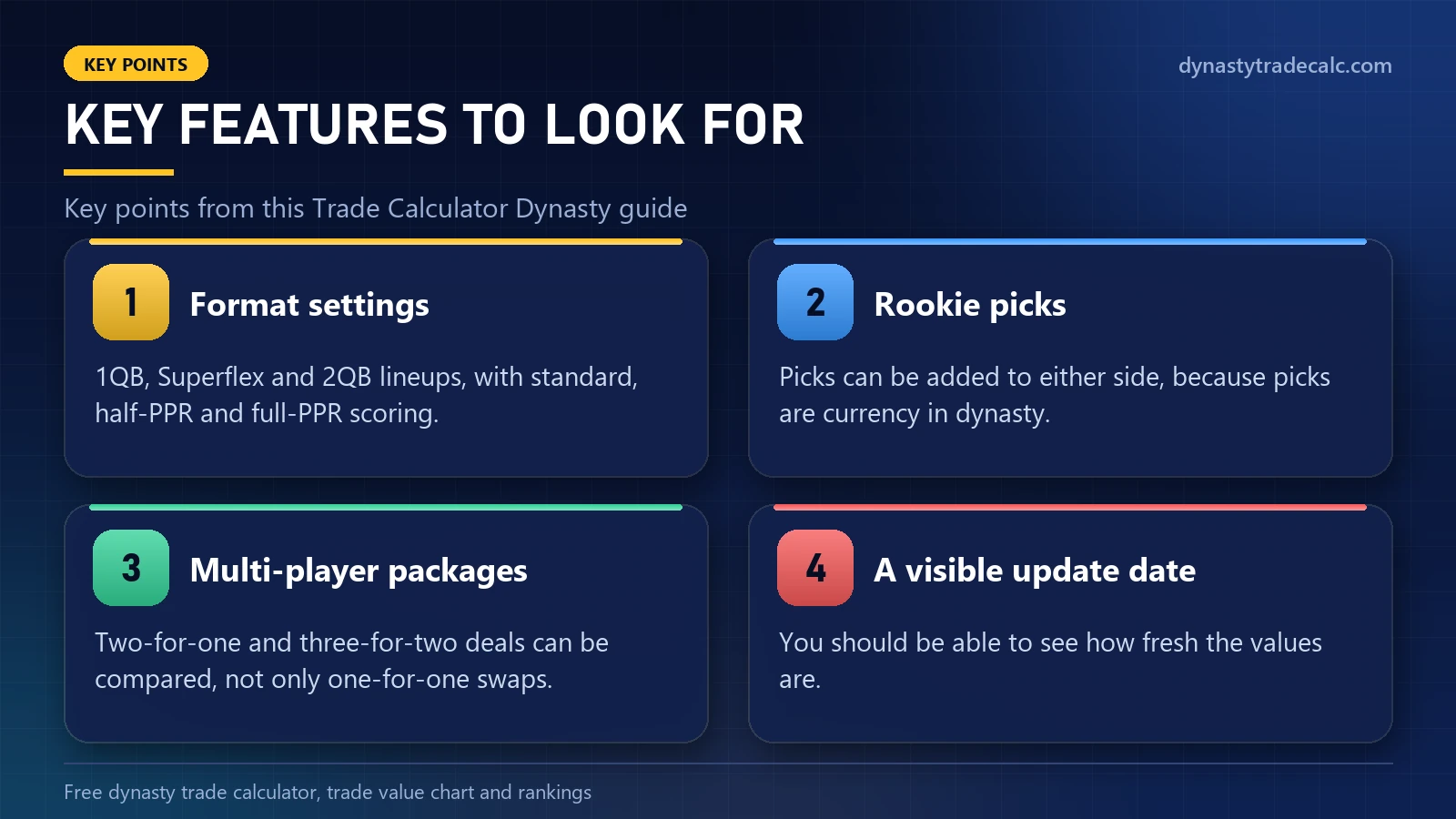
- Format settings: 1QB, Superflex and 2QB lineups, with standard, half-PPR and full-PPR scoring.
- Rookie picks: picks can be added to either side, because picks are currency in dynasty.
- Multi-player packages: two-for-one and three-for-two deals can be compared, not only one-for-one swaps.
- A visible update date: you should be able to see how fresh the values are.
- No sign-up: a quick check should not need an account.
| Feature | Benefit | Limit |
|---|---|---|
| Trade value totals | A fast read on who is ahead | Totals ignore your roster needs |
| Format settings | Values match your league | Unusual scoring still needs your own judgment |
| Rookie pick values | Picks and players on one scale | A pick’s final slot is unknown until the season ends |
Step-by-Step Guide
- Choose your lineup format and scoring.
- Add the players and picks you would give up to one side.
- Add the players and picks you would receive to the other side.
- Compare the two totals and note the size of the gap.
- Check the result against your roster: who starts, who sits, and whether the trade fits your timeline.
The full walkthrough, with common errors at each step, is in how to use a dynasty trade calculator.
Common Mistakes to Avoid
| Mistake | Why it costs you | Better move |
|---|---|---|
| Trusting the number blindly | A fair total can still weaken your lineup | Check who actually starts for you |
| Overvaluing veterans | Their value can fall quickly with age | Sell while the production is still there |
| Ignoring league format | A 1QB setting undervalues quarterbacks in Superflex | Match the settings to your league |
| Chasing one big game | Hype fades faster than role | Look at usage over several weeks |
More examples are in the biggest dynasty trade mistakes.
Five Ways to Maximize League Value
A trade calculator dynasty strategy is about more than winning one trade. The goal is a roster that is worth more every season. These five habits do most of the work.
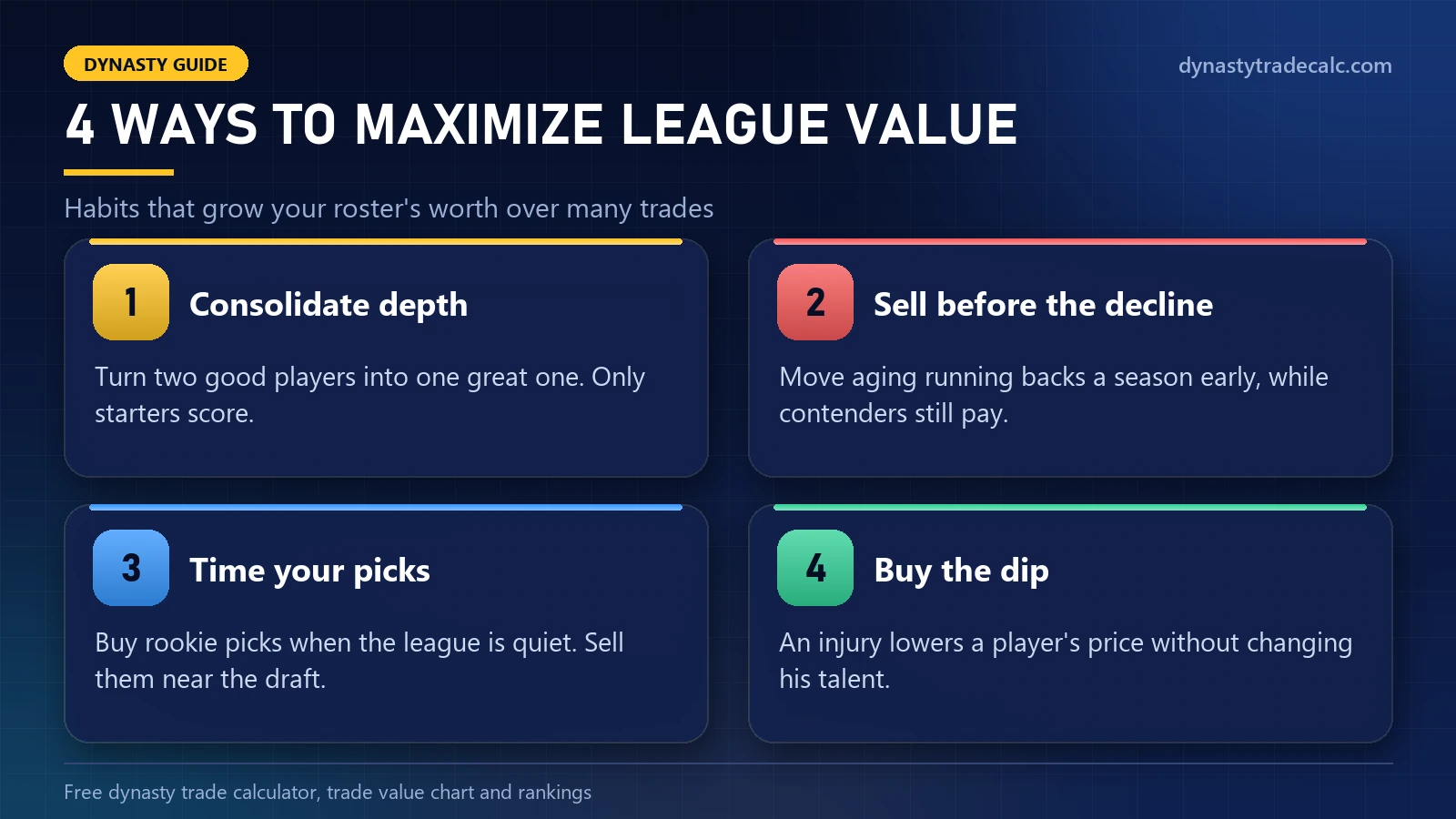
- Consolidate depth into starters. Two good players for one great player usually favors the side that gets the star, because only starters score. Use bench depth to move up a tier.
- Sell before the decline. Running backs lose value quickly as they age. Move them a season early while a contender still pays for the points.
- Time your picks. Rookie picks tend to cost less during the season and more near the draft. Buy them when the league is quiet and sell them when excitement peaks. Current estimates are on our rookie pick values page.
- Buy the dip. An injury or a quiet month lowers a player’s price without changing his talent. Managers who need points now will often sell.
- Match every trade to your window. Contenders should turn picks into points. Rebuilders should turn aging points into picks and young players.
Using Fantasy Trade Calculators and Trade Analyzers Together
A calculator tells you whether the values are close. A trade analyzer adds your roster and shows what the deal does to your starting lineup. Use the calculator first to find a fair range, then the analyzer to see whether the trade actually helps you. Our guides to the fantasy football trade analyzer and the free dynasty trade analyzer cover the second step.
It also helps to compare sources that build values in different ways. Some use crowd votes, some use real completed trades and some use expert rankings. When they disagree, the market for that player is unsettled.
Trade Scenarios and Examples
| Scenario | Who it suits | What to check |
|---|---|---|
| Rookie wide receiver for a veteran running back | The rebuilder takes the receiver, the contender takes the back | How many good seasons the veteran has left |
| Two solid starters for one elite player | The team with spare depth | Whether you still have enough starters after the deal |
| A future first-round pick for a proven starter | A contender near the trade deadline | Where your own pick is likely to land |
In each case the calculator gives the totals and your team direction decides the answer. The value behind each player is on our dynasty trade value chart.
FAQs About Dynasty Trade Calculators
How accurate are dynasty trade value charts?
They are estimates, not guarantees. A chart shows what the market thinks today, and it cannot see your roster or your league’s habits. Use it as a starting point and check a second source before a big trade.
Is a dynasty trade calculator good for beginners?
Yes. It shows how age, position and draft picks change a player’s value, which is the hardest part of dynasty to learn. Beginners should still read the news and check their team needs before accepting a deal.
Is a free trade calculator enough, or do I need a paid one?
A free calculator is enough for most trades. Paid tools add extras such as league sync and trade finders. Those save time for managers who trade often, but the basic comparison is the same.
How do I maximize value in a dynasty trade?
Trade for the best player in the deal, sell aging players before their value drops, and buy picks when your league is quiet. Small gains on each trade add up over several seasons.
When is the best time to trade rookie picks?
Picks are usually worth the most close to the rookie draft, when managers get excited about the class. Buy them during the season, when contenders want points now, and sell them near draft day.
What is the difference between a trade calculator and a trade analyzer?
A trade calculator compares the value on each side of a deal. A trade analyzer also looks at your roster and shows how the trade changes your starting lineup. Using both gives a fuller picture.
Conclusion and Next Steps
A trade calculator dynasty leagues can use well is a starting point, not a verdict. Set the format, compare the totals, then ask what the trade does to your lineup and your timeline. Repeat that process, keep selling a year early and buying when others panic, and your roster value will climb. For this season’s values, see the dynasty trade calculator 2026 guide.
Related Guides
Compare With Other Sources
Values on this page are editorial estimates. Compare them with KeepTradeCut crowd-sourced dynasty values, FantasyCalc and FantasyPros dynasty rankings before you commit to a trade. You can also run the same trade through our dynasty trade value chart. Playing redraft as well as dynasty? Our guide to the trade calculator shows how to read any trade result. To value players and picks across several seasons, see our dynasty calculator guide.
