

Table of Contents
- What Is a Trade Analyzer?
- Why It Matters in ESPN Leagues
- How to Use It Before You Trade
- Trading Terms Translated Into Fantasy Football
- Managing Risk
- Case Study: A Simple ESPN Trade
- Analyzer vs Manual Review
- Metrics Worth Knowing
- Common Mistakes
- Frequently Asked Questions
- Conclusion
- Related Guides
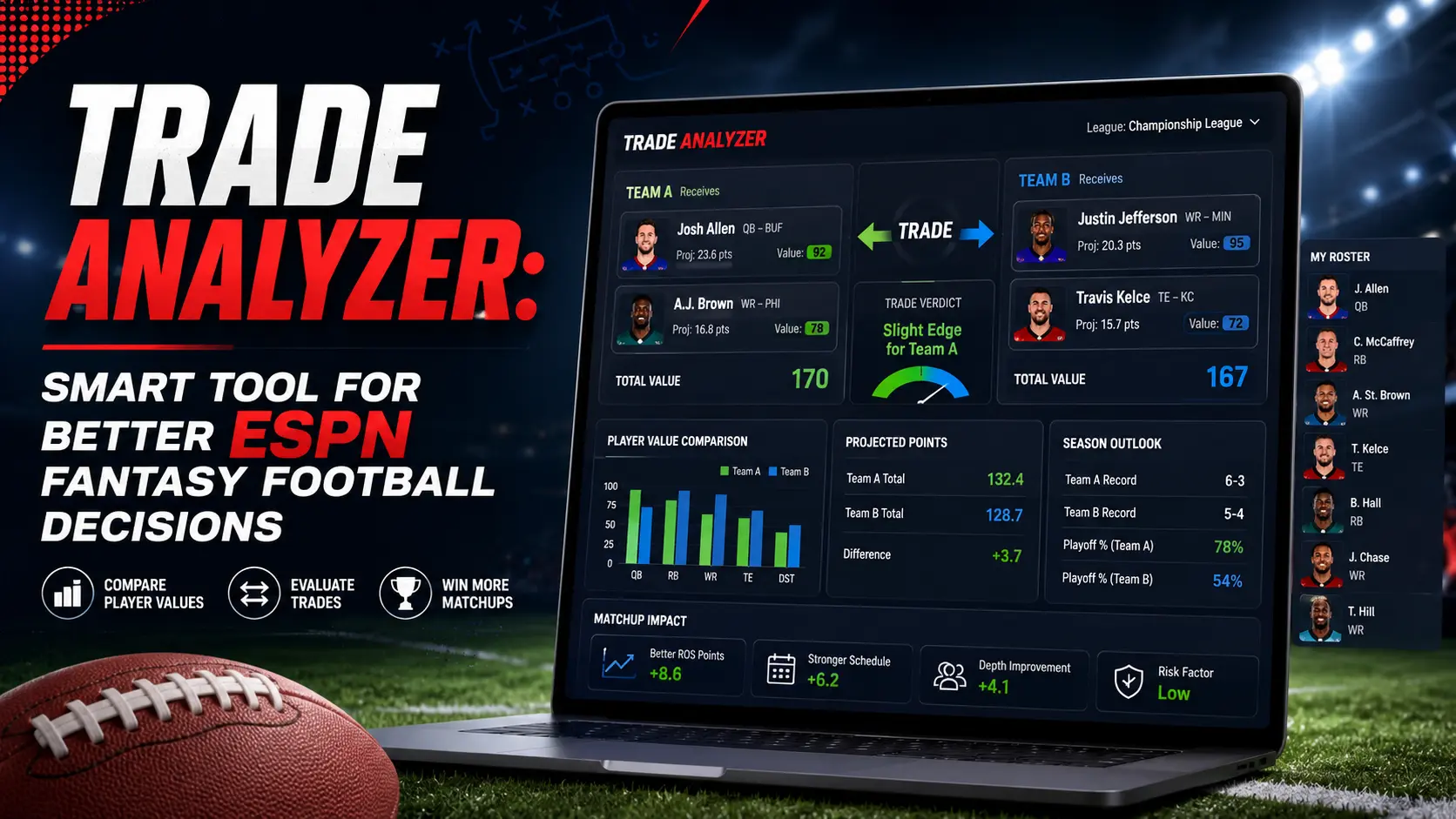
A trade analyzer checks a fantasy football trade before you make it. It compares player value, team needs, league scoring and future upside, so you decide with evidence instead of emotion. This guide focuses on ESPN leagues, where trades move fast, and shows how to use one step by step.
What Is a Trade Analyzer?
Think of a trade analyzer as a referee for both sides of a deal. If you trade a running back for a wide receiver, it shows which side gains more value and how your lineup changes. It looks at projections, usage, injury news and schedule, and it can compare expert rankings with your league settings.
The analyzer is a second opinion, not a boss. Wrong league settings make any answer look confident and still be wrong, so copy your ESPN scoring and lineup rules first.
Why It Matters in ESPN Leagues
ESPN leagues move quickly: injuries appear suddenly and bench players become starters overnight. An analyzer slows you down. It stops you selling a good player cheaply after one six-point week, and it shows whether moving depth for need actually raises your weekly total.
For ESPN’s own tools, see ESPN Fantasy Football. Our ESPN fantasy football trade tips cover the platform in more depth.
How to Use It Before You Trade
- Find your weakest starting spot. A good trade solves a real problem.
- Compare players by role, not just points: snaps, targets, carries and red-zone work.
- Check schedule and health, especially for the playoff weeks.
- Run the analyzer with your exact scoring.
- Confirm before you accept: injury status, role and roster space.
For dynasty leagues, use a tool that values age and picks, such as our free dynasty trade calculator.
Trading Terms Translated Into Fantasy Football
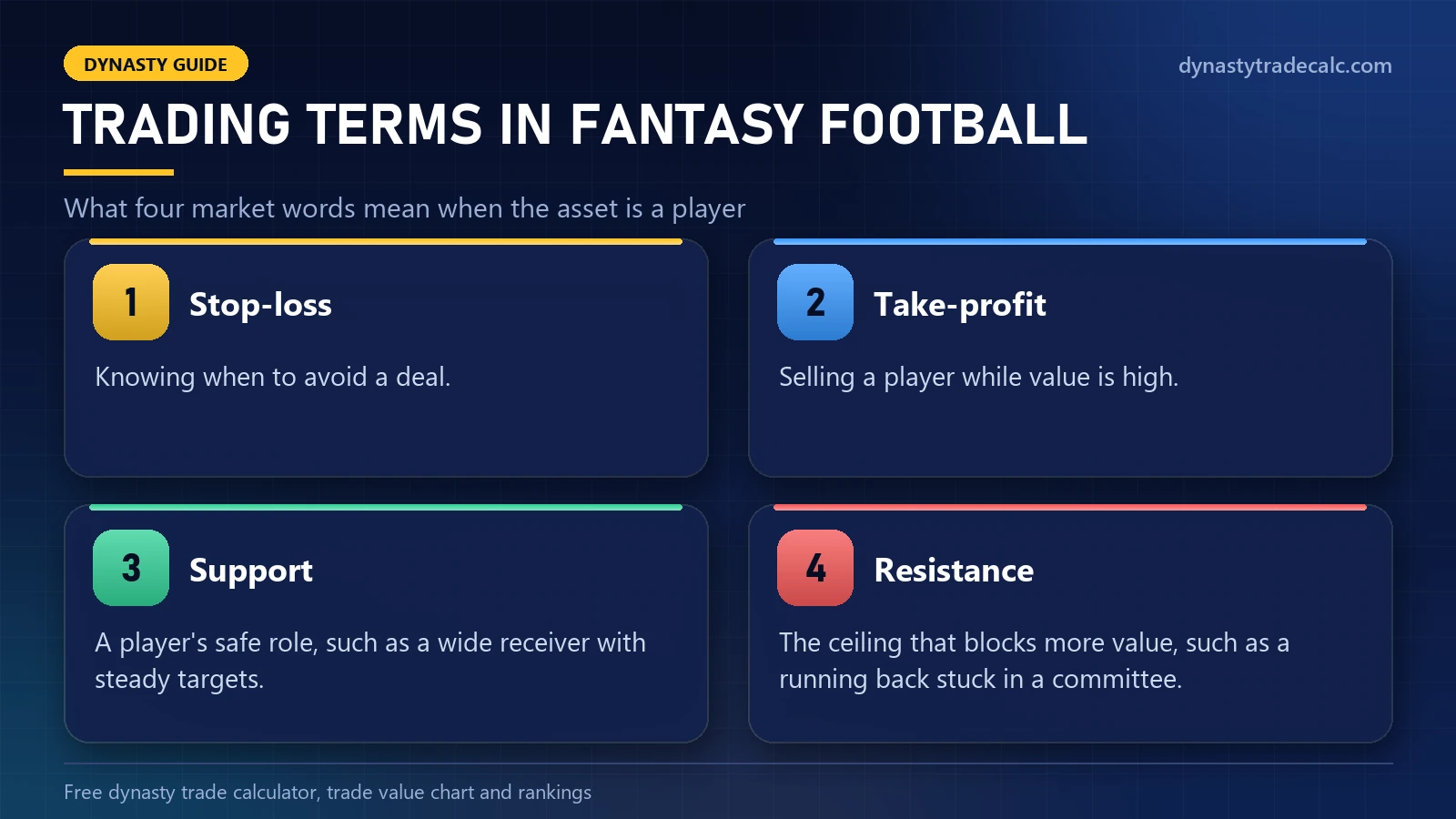
This guide borrows a few words from market trading, because the same discipline helps with a fantasy roster:
| Trading term | What it means in fantasy football |
|---|---|
| Entry | When you should offer a deal |
| Exit | When you should walk away |
| Stop-loss | Knowing when to avoid a deal |
| Take-profit | Selling a player while value is high |
| Support | A player’s safe role, such as steady targets |
| Resistance | The ceiling that blocks more value, such as a committee backfield |
| Drawdown | A drop in team value or scoring power |
| Backtesting | Reviewing past trades and asking what happened next |
| Trade expectancy | The likely long-term result of a trade |
Buy when a player’s role is growing but his points have not caught up. Sell after a lucky touchdown week if his volume looks weak. Walk away from any deal that weakens your starting lineup, however good the headline name looks.
Managing Risk
Many managers only look at the player they receive. The analyzer also shows what your lineup loses. Ask what happens if the new player gets hurt or loses volume, and who fills the old player’s spot. A fair deal can still hurt if it creates a hole you cannot fill on waivers.
- Do not overtrade. Trading to feel busy damages good rosters.
- Check bye weeks before you trade away depth.
- Do not chase losses. After a bad trade, slow down instead of making a revenge trade.
Case Study: A Simple ESPN Trade
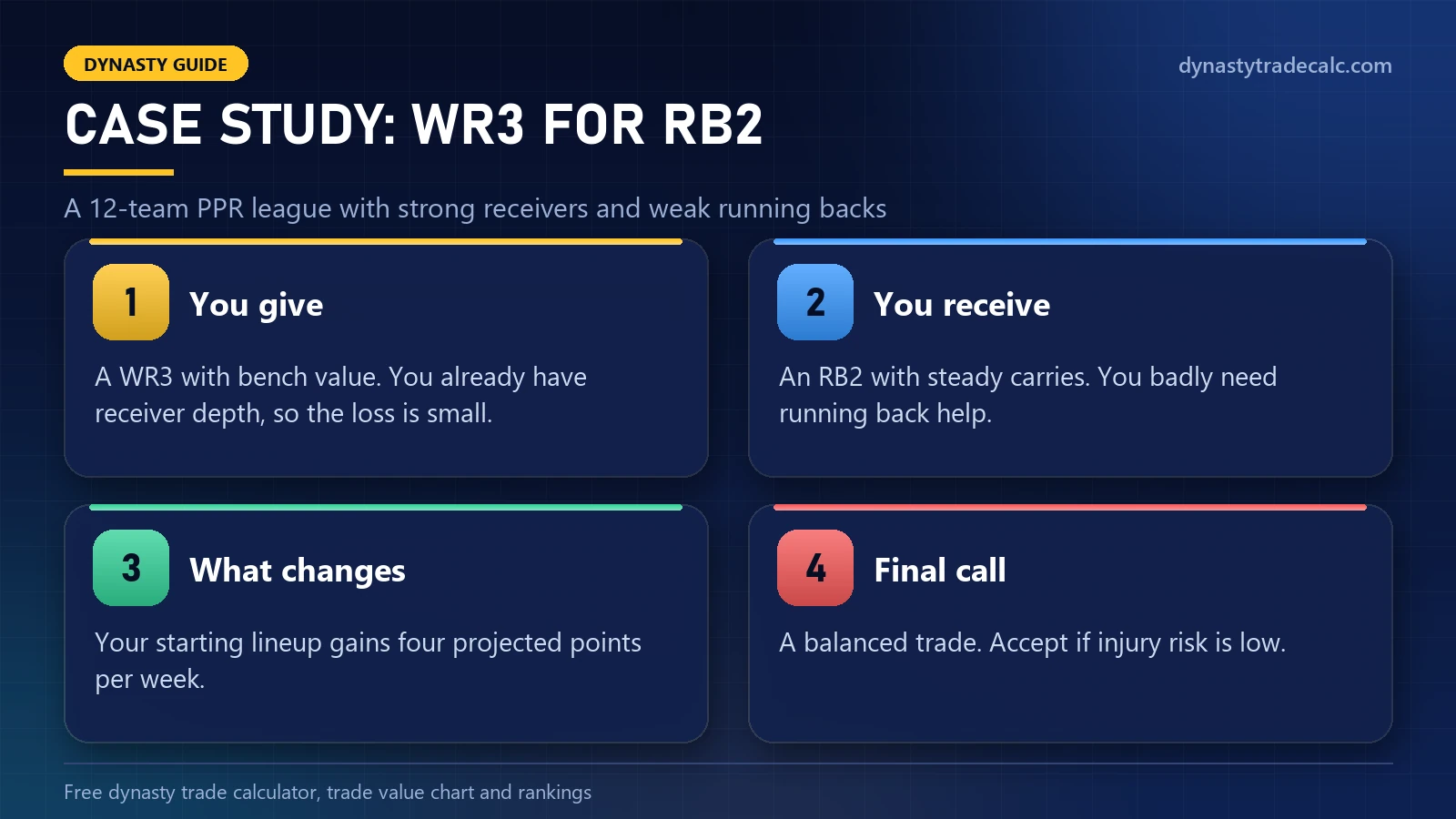
You play in a 12-team PPR league. Your receivers are strong but your running backs are weak. Another manager offers a solid RB2 for your WR3:
| Trade Side | Player Type | Team Need | Result |
|---|---|---|---|
| You give | WR3 with bench value | You already have receiver depth | Small depth loss |
| You receive | RB2 with steady carries | You badly need running back help | Strong lineup gain |
| Final call | Balanced trade | Better weekly scoring | Accept if injury risk is low |
On paper the trade looks small. In your lineup it adds about four projected points a week, because the running back starts and the receiver would have sat on your bench. That is the kind of gain an analyzer helps you see.
Analyzer vs Manual Review
An analyzer is fast; manual review is personal. The tool compares numbers in seconds, while you know your league’s habits and your rivals’ needs. Use the tool for the numbers and your own judgment for fit. Manual review matters most when news breaks faster than the tool updates.
Metrics Worth Knowing
- Snap share: how often a player is on the field. Rising snaps usually come before rising points.
- Target share: the part of the passing game that goes to a receiver or back.
- Red-zone work: touches near the goal line, where most touchdowns come from.
- Weekly floor: what a player scores in a quiet week. Contenders need a high floor.
Common Mistakes
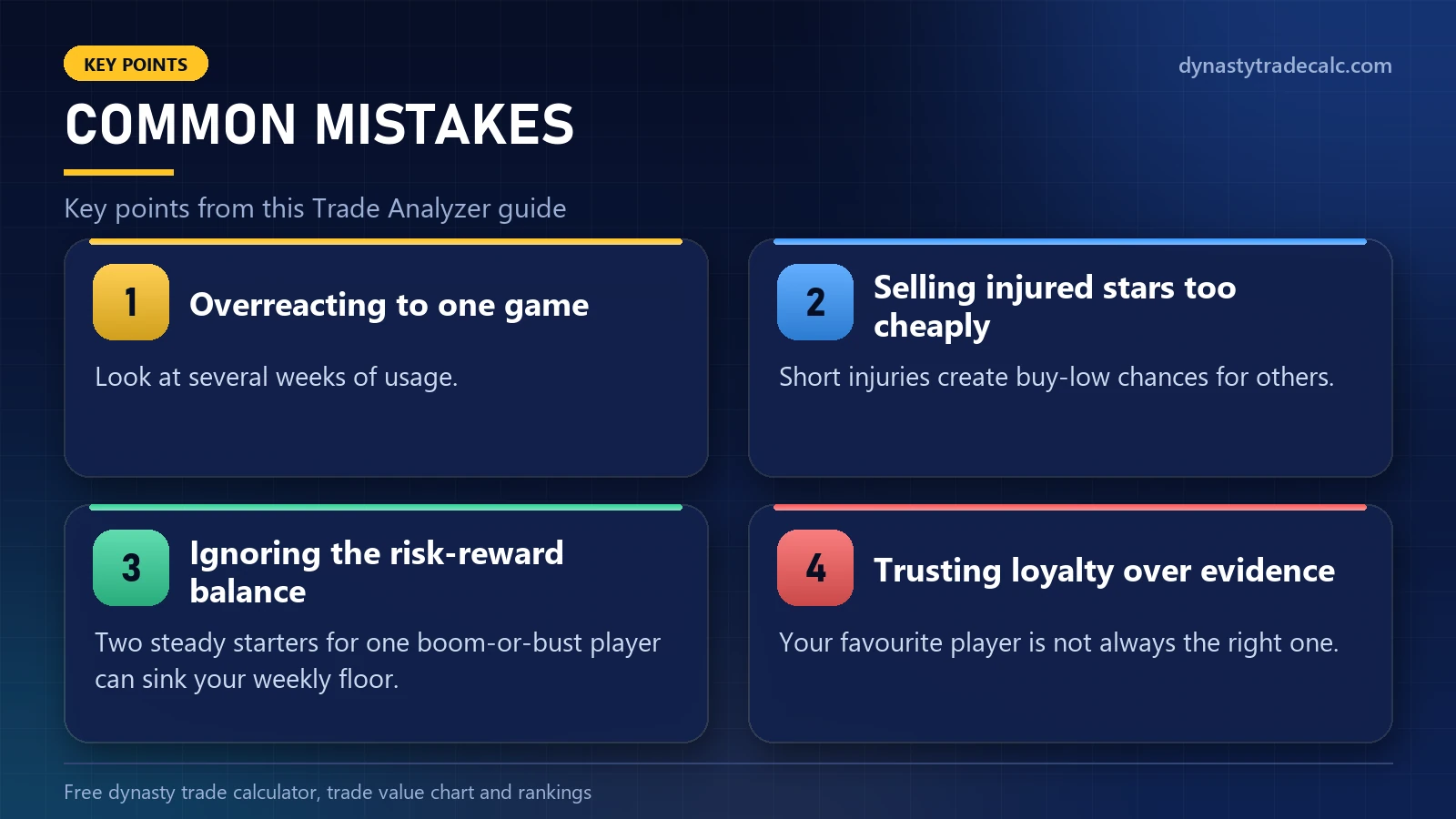
- Overreacting to one game. Look at several weeks of usage.
- Selling injured stars too cheaply. Short injuries create buy-low chances for others.
- Ignoring the risk-reward balance. Two steady starters for one boom-or-bust player can sink your weekly floor.
- Trusting loyalty over evidence. Your favourite player is not always the right one.
Frequently Asked Questions
What is a trade analyzer in fantasy football?
A trade analyzer checks a fantasy trade before you make it. It compares player value, team needs, scoring and upside on both sides, then shows which side is likely to gain more.
What is the best trade analyzer for ESPN fantasy football?
The best one matches your league type and scoring. For redraft, use one with weekly projections and injury news. For dynasty, use one that values age and draft picks, such as our free calculator.
Can I use a trade analyzer for dynasty leagues?
Yes, if it is built for dynasty. Dynasty leagues need age, draft picks and long-term role in the value. A redraft analyzer only looks at this season and misses those details.
Does a trade analyzer guarantee better trades?
No. Injuries, coaching changes and surprise breakouts can change everything. The tool reduces blind decisions, but you still have to check your roster and your league.
What does stop-loss mean in a fantasy football trade?
It means knowing when to walk away from a deal. Take-profit is the opposite: selling a player while his value is high, such as a backup running back after two big games.
When should I use a trade analyzer?
Before you send any offer and before you accept one. Check your weakest starting spot first, then compare players by role, schedule, health and weekly floor.
What is an NFL trade analyzer?
For fantasy managers, it compares the NFL players on each side of a fantasy trade and shows which side gains more value. It is a quick, neutral check before you accept or send an offer.
Is there a free NFL fantasy trade analyzer?
Yes. Our dynasty trade calculator works as a free NFL fantasy trade analyzer for long-term leagues and needs no account. For redraft leagues, use a tool with weekly projections as well.
Conclusion
A trade analyzer gives every offer the same check: value, need, risk and timing. Use it before you send or accept a trade, copy your ESPN settings exactly, and let your own judgment make the final call.
Related Guides
Compare With Other Sources
If your league is on ESPN, it is worth reading their own tools alongside ours — see ESPN Fantasy Football and FantasyPros dynasty rankings. You can also run the same trade through our fantasy football trade analyzer.
